

Last Updated 07/28/2026
Excerpt from Dallas County Stormwater Management Program
Section III.5 – Post-Construction Storm Water Management in New Development and Redevelopment (MCM #5)
The intent of this MCM is to lessen storm water quality impacts after construction has been completed on new and redeveloped sites of one (1) acre or greater of disturbed earth. Dallas County’s Systems-In-Place consisting of adopted Commissioners Court Orders, state regulations, County policy, and engineering / construction plan requirements presently provides Storm Water Phase 2 and MS4 compliance in the County Unincorporated Urbanized Areas (UUA’s).
“To the extent allowable under state and local law”, Dallas County will develop and implement a Post-Construction MCM for the County Unincorporated Urbanized Areas. Like most Texas Counties, under this MCM Dallas County presently allows the use of unlined or pervious drainage ditches in lieu of impervious concrete curb and gutter pavement sections in combination with underground storm sewer / drain pipe systems and / or concrete lined channels which Cities typically require and / or allow.
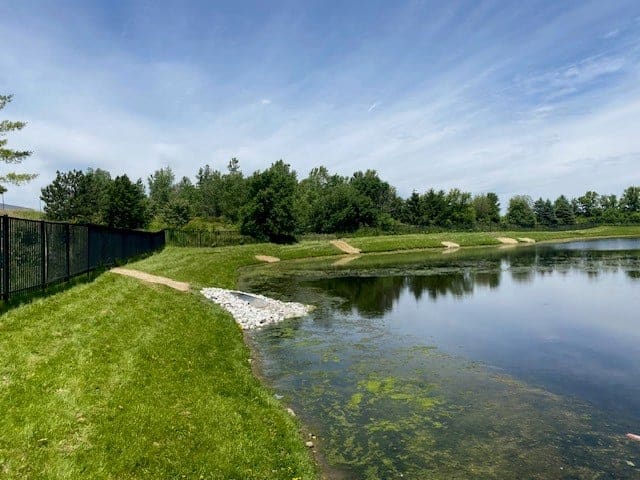
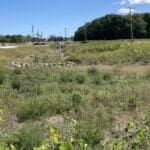
Compared to standard impervious underground storm sewer / drain pipe systems, at grade open / unlined grassy ditch systems allow more storm water runoff to soak or filtrate into the ground. This type of drainage system thereby reduces downstream runoff velocities and erosion, and provides a means of detaining and treating, to some degree, pollutants such as sediments, fertilizers, nutrients, detergents, etc.. It also allows illicit discharges to pond and collect making them easier to detect, locate, and consequently to investigate the probable source to expedite the IDDE’s elimination.
Such grassy drainage ditch systems are the least expensive to construct, are compatible with larger lots that are required for maintaining OSSF’s (greater that ½ acre in land area when supplied with an underground potable water supply, or greater that 1 acre land when supplied with a private potable water well). This type of rural land development is popular among residents of the County Unincorporated Areas providing an incentive for their continued installation beyond this permit period. Like most Texas Counties, Dallas County presently maintains these at grade open / unlined grassy drainage ditch systems located within the County Road Right-Of-Way (R.O.W.), easement, or prescriptive rights easement, and shall continue to do so throughout the permit period.
Dallas County regionally participates in and coordinates with the NCTCOG on municipal storm water issues through the Regional Storm Water Management Program. Program includes cooperative initiatives that are regional and development of the annual regional storm water work program. Construction Site Storm Water Runoff Control is achieved regionally by utilizing the NCTCOG website for informational support and access to Best Management Practices (BMP’s). Coordination meetings with Program updates including watershed roundtable discussions for the multiple municipalities, counties, and governmental agencies are facilitated by the NCTCOG quarterly. Dallas County’s annual participation costs are approximately $ 2,110. 21
a) BMP, Measurable Goal, and Date – Strategy: Allow Pervious Drainage Systems
In lieu of requiring impervious concrete curb and gutter pavement sections in combination with underground storm sewer / drain pipe systems and / or concrete lined channels, Dallas County will generally allow developers, home builders, and residents in the County Unincorporated Areas to use at grade open / unlined grassy drainage ditches adjacent to the privately or County owned and maintained roads. This is both cost effective to the construction community and environmentally based for the County’s compliance with the State storm water permit. Specific legal agreements with some adjacent municipalities may supersede this County policy, but overall this strategy and policy will continue for the duration of the permit period.
b) BMP, Measurable Goal, and Date – Tracking: Additional Pervious Drainage Systems
Dallas County Road and Bridge forces will maintain the open / unlined grassy drainage ditches located within the County Road Right-Of-Way (R.O.W.), easement, or prescriptive rights easement in the Unincorporated Areas. This will allow the drainage system to operate properly and produce storm water quality benefits as stated previously.
Excerpt from Dallas Municipal Code
Section 19-118.1- ENFORCEMENT
Section. 19-118.6- STORMWATER DISCHARGES FROM CONSTRUCTION ACTIVITIES.
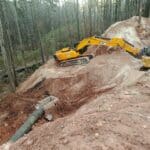
(a) An operator of a construction site shall comply with all terms and conditions of a construction general permit or an individual permit, whichever is obtained for or applicable to the construction site. An operator of a construction site shall provide the director with a copy of the stormwater pollution prevention plan required by the construction general permit or individual permit and shall implement best management practices to control and minimize the discharge into the stormwater drainage system, waters of the United States, and state water of any sediment, silt, earth, soil, or other material from the construction site. Erosion control elements meeting the criteria for best management practices must be installed before any construction site is established in accordance with an installation schedule as specified in a stormwater pollution prevention plan required by the construction general permit or individual permit.
Section 19-118.8. COMPLIANCE MONITORING.
View State Page
Frequently Asked Questions
Does stormwater compliance in the Dallas area differ between the City and the County?
Yes, and the difference is significant for property owners in unincorporated areas. The City of Dallas enforces its own stormwater ordinance under Chapter 19 of the Dallas Municipal Code, which applies within city limits. Dallas County operates under a separate Stormwater Management Program that governs unincorporated urbanized areas of the county under the Phase II MS4 permit.
One practical difference is drainage system design. Within the City, concrete curb and gutter sections with underground storm drain systems are typically required. In the county’s unincorporated areas, open grassy drainage ditches are generally allowed as a lower-cost alternative that also provides some natural filtration and pollutant detention. If you are not sure which jurisdiction applies to your property, that is worth confirming before any development or drainage work begins. AQUALIS can help you identify the applicable requirements for your specific location.
What are the penalties for stormwater violations in the City of Dallas?
Under Section 19-118.1 of the Dallas Municipal Code, each day or portion of a day that a stormwater violation continues is treated as a separate offense. Each offense carries a fine of not less than $250 and not more than $2,000. Enforcement authority rests with the director, the city environmental health officer, and code compliance officers, and the municipal court can issue administrative search warrants to aid in enforcement.
In addition to fines, the City can require any discharger contributing harmful pollutants to the stormwater system to conduct sampling, testing, and monitoring of its stormwater discharges at its own expense. The director sets the frequency and parameters of any required monitoring.
What does Dallas require for construction site stormwater management?
Operators of construction sites in Dallas must comply with all terms and conditions of whichever permit applies to their site, either a construction general permit or an individual permit. Before any construction begins, erosion control elements meeting best management practice criteria must be installed in accordance with the installation schedule in the stormwater pollution prevention plan required by the permit.
A copy of the SWPPP must be provided to the director. The operator must implement BMPs to control and minimize the discharge of sediment, silt, earth, soil, or other material from the site into the stormwater drainage system or state waters. Failing to have a SWPPP in place, failing to implement required BMPs, or failing to install erosion controls before construction begins are all violations subject to the daily fine structure. AQUALIS can help prepare and maintain your SWPPP and implement the required controls.
How do I know if my Dallas area stormwater system is at risk of failure or safety violation?
Watch for these warning signs.
Construction began without a SWPPP in place or without erosion controls installed. Dallas requires both before any construction site is established. Work that started without these in place is an active violation.
You are discharging pollutants to the stormwater drainage system. The City can enter your premises at any time to determine whether you are complying with permit requirements. If your operations, site conditions, or drainage patterns could be introducing sediment, chemicals, or other pollutants to the system, that is worth addressing before an inspection confirms it.
You have not confirmed which jurisdiction governs your property. Properties in unincorporated Dallas County are subject to county stormwater regulations, not city ordinances. If you are unsure which set of requirements applies to your site or development project, that needs to be confirmed before work begins.
Your grassy drainage ditch is blocked or not maintained. In unincorporated Dallas County, open grassy ditches are the primary post-construction drainage system. Dallas County Road and Bridge maintains ditches within the right of way, but ditches on private property or within easements serving private development remain the owner’s responsibility to keep clear and functional.
Recent property purchase. Stormwater compliance obligations stay with the property. If you recently acquired a developed site in the Dallas area, AQUALIS can confirm which jurisdiction applies and assess the condition of any stormwater controls on the property.
The information on this page is provided for general informational purposes only and is not legal advice. Regulations change frequently — AQUALIS makes no warranty as to the accuracy or completeness of this content, and any reliance on it is at your own risk. Consult a qualified professional or your local regulatory authority to confirm requirements applicable to your specific property.