

Last Updated 07/23/2026
Stormwater Code: Excerpts from Hampton Virginia, Code of Ordinance
ARTICLE II. - STORMWATER MANAGEMENT
Sec. 33.3-19. - Long-term maintenance of permanent stormwater management facilities.
(a) The administrator shall require the provision of long-term responsibility for and maintenance of stormwater management facilities and other techniques specified to manage the quality and quantity of runoff. Such requirements shall be set forth in an instrument recorded in the local land records prior to termination of the general permit or earlier as required by the administrator and at a minimum shall:
(1) Be submitted to the administrator for review and approval prior to the approval of the stormwater management plan;
(2) Be stated to run with the land;
(3) Provide for all necessary access to the property for purposes of maintenance and regulatory inspections;
(4) Provide for inspections and maintenance and the submission of inspection and annual maintenance reports to the administrator without demand; and
(5) Be enforceable by all appropriate governmental parties.
(b) At the discretion of the administrator, such recorded instruments need not be required for stormwater management facilities designed to treat stormwater runoff primarily from an individual residential lot on which it is located, provided it is demonstrated to the satisfaction of the administrator that future maintenance of such facilities will be addressed through an enforceable mechanism at the discretion of the administrator.
(c) If a recorded instrument is not required pursuant to subsection (b) herein, the administrator shall develop a strategy for addressing maintenance of stormwater management facilities designed to treat stormwater runoff primarily from an individual residential lot on which it is located. Such a strategy may include periodic inspections, homeowner outreach and education, or other methods targeted at promoting the long-term maintenance of such facilities. Such facilities shall not be subject to the requirement for an inspection to be conducted by the administrator.
Sec. 33.3-20. - Monitoring and inspections.
(a) The administrator shall inspect the land-disturbing activity during construction for:
(1) Compliance with the approved erosion and sediment control plan;
(2) Compliance with the approved stormwater management plan;
(3) Development, updating, and implementation of a pollution prevention plan; and/or
(4) Development and implementation of any additional control measures necessary to address a TMDL.
(b) The administrator, at reasonable times and under reasonable circumstances, may enter any establishment or upon any property, public or private, for the purpose of obtaining information or conducting surveys or investigations necessary in the enforcement of the provisions of this article.
(c) In accordance with a performance bond with surety, cash, cash escrow, or letter of credit, the administrator also may enter any establishment or upon any property, public or private, for the purpose of initiating or maintaining appropriate actions which are required by the permit conditions associated with a land-disturbing activity when a permittee, after proper notice, has failed to take acceptable action within the time specified.
(d) Pursuant to Code of Virginia, § 62.1-44.15:40, the administrator may require every land-disturbing permit applicant or permittee, or any such person subject to land-disturbing permit requirements under this chapter, to furnish when requested such application materials, plans, specifications, and other pertinent information as may be necessary to determine the effect of his discharge on the quality of state waters, or such other information as may be necessary to accomplish the purposes of this chapter.
(e) Post-construction inspections of stormwater management facilities required by the provisions of this article shall be conducted by the administrator pursuant to the city’s adopted and State Board approved inspection program, and shall occur at least once every five (5) years except as otherwise provided in section 33.3-19.
Sec. 33.3-33. - Service charge—Establishment; expenditures of revenue.
(a) There hereby is established a service charge pursuant to the statutory authority granted to localities in Code of Virginia, §§ 15.2-1102 and 15.2-2114 to provide for the general health, welfare, and safety of the city and its residents.
(b) Revenues collected pursuant to this article shall be deposited in a separate ledger account. The funds deposited shall be used exclusively to provide services and facilities related to the system. Services and facilities related to the system shall include but not be limited to:
(1) Acquisition, as permitted by Code of Virginia, § 15.2-1800, of real or personal property and interests therein necessary to construct, operate, and maintain the system;
(2) The cost of administering such programs, to include the establishment of reasonable operating and capital reserves to meet unanticipated or emergency requirements of the system and all associated legal and collection costs;
(3) Engineering and design, debt retirement, construction costs for new facilities, and enlargement or improvement of existing facilities;
(4) Facility maintenance;
(5) Monitoring of stormwater control devices;
(6) Pollution control and abatement, consistent with city, state, and federal regulations for water pollution control and abatement, including public education; and
(7) Planning, design, land acquisition, construction, operation, and maintenance activities.
Sec. 33.3-36. - Same—Waivers and adjustments.
(a) Waivers:
(1) Full waivers of the service charge shall be provided to properties owned by federal, state, and local government agencies when those agencies own and provide for maintenance of storm drainage and stormwater control facilities or are units of the city.
(2) Full waivers of the service charge shall be provided for roads and public street rights-of-way that are owned and maintained by state and local agencies.
(b) Adjustments:
(1) Any owner who has paid their service charge and who believes their service charge to be incorrect may submit an adjustment request to the director. All such requests must be submitted prior to the end of the fiscal year for which the request applies.
(2) Adjustment requests shall be made in writing, setting forth sufficient details to substantiate the claim to the satisfaction of the director, including plans, engineering calculations, and related documents prepared by a licensed professional engineer or land surveyor. The director may waive the licensed professional requirement if, in their opinion, the specific adjustment request does not warrant such a requirement.
(3) Response to the adjustment request, whether providing an adjustment or denying an adjustment, shall be made by the director in writing within sixty (60) days of receipt of the request.
(4) Any owner may appeal the director’s decision to the city manager, but must do so in writing within fifteen (15) calendar days of the date of the director’s response. The city manager shall respond to the appeal within fifteen (15) calendar days, and such response shall be final.
(5) The director may extend such city response times as appropriate to ensure full and complete evaluation of the application. In those cases, the director shall notify the applicant of the action by certified mail.
(c) Credit:
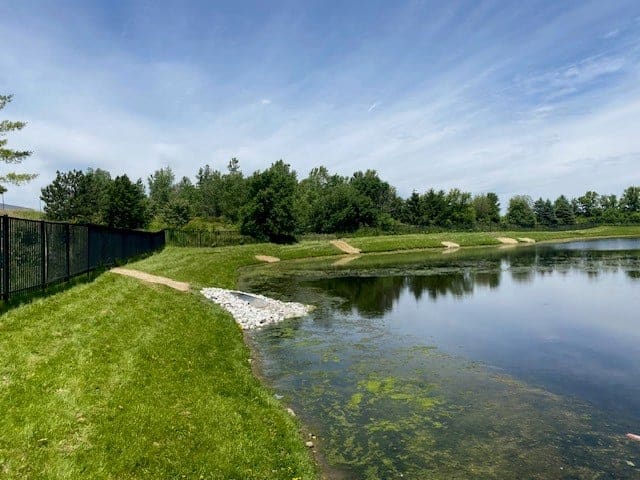
The city recognizes that on-site stormwater control facilities, increased green area, frequent sweeping of parking lots, and the like, reduce stormwater runoff rates and/or the transport of pollutants. Property owners who provide these private stormwater facilities incur expenses to operate and maintain these facilities in addition to their payment of stormwater fees. To encourage the proper maintenance of private stormwater facilities and other measures which would reduce the polluting effects of stormwater, the following stormwater utility fee credit system hereby is offered:
(1) The applicant is required to apply for and to demonstrate to the satisfaction of the director that a stormwater utility fee credit is warranted.
(2) The service charge after credits shall be greater than one (1) ERU.
(3) The water quality improvement must be privately constructed, owned, operated, and maintained.
(4) The stormwater facility shall be covered under an ongoing maintenance program approved by the director.
(5) The facility or stormwater quality improvement practice shall be designed to meet or exceed the minimum criteria established by the director.
(6) The following approved facilities and/or practices shall qualify for a specific percentage reduction in stormwater fee for a particular property:
| Facility or Practice Credit | Percentage | |
|---|---|---|
| 1(a) | Infiltration/bioretention | 30% |
| 1(b) | Dry swale | 20% |
| 1(c) | Wet retention pond | 25% |
| 1(d) | Dry retention pond | 15% |
| 2(a) | Green area in excess of 20% | 10% |
| 2(b) | Green area in excess of 50% | 25% |
| 3(a) | Parking lot sweeping at least once per week | 5% |
| 3(b) | Parking lot sweeping at least five (5) times per week | 10% |
| MAXIMUM ALLOWABLE CREDIT | 45% |
(7) Stormwater utility fee credits for retention/detention facilities, or for green areas in excess of fifty (50) percent, will be based upon the percentage of the impervious area on-site, which drains to the stormwater facility.
(8) Credits are subject to annual review by the property owner and city staff to ensure that the facility is in operation and that it is being properly maintained.
(9) Credits for parking lot sweeping shall be applied against the stormwater utility fee for the following fiscal year only after the property owner has paid the full amount of the stormwater fee in the current fiscal year and has provided the city with adequate documentation that sweeping had been performed at the required frequency throughout the current fiscal year.
View State Page
Frequently Asked Questions
What is stormwater compliance in the City of Hampton?
Stormwater compliance in Hampton means following the City’s Stormwater Management Ordinance and the Chesapeake Bay Preservation Act, both of which apply to properties within Hampton’s jurisdiction. The ordinance is designed to protect the health, safety, and welfare of Hampton residents and to prevent land-disturbing activity from causing unreasonable degradation of properties, water quality, stream channels, and other natural resources.
The City is the permitting authority for all land-disturbing activities and will only issue construction permits to projects with an approved stormwater management plan. Property owners are responsible for maintaining all on-site stormwater control facilities required by that plan. Portions of Hampton are also designated as Chesapeake Bay Preservation Areas, where additional protections apply. The City can inspect properties under the NPDES program and issue a Notice of Violation for any deficiency found on site.
Who is responsible for long-term stormwater maintenance in Hampton?
For all private stormwater management facilities, Hampton requires a maintenance instrument to be recorded in the local land records before the general permit is terminated. This instrument must run with the land, provide the City access for inspections and maintenance, require annual maintenance reports to be submitted to the administrator without demand, and be enforceable by all appropriate governmental parties.
Because it runs with the land, this obligation transfers with every ownership change. If you purchased a property with stormwater facilities and were not made aware of the recorded instrument at closing, the maintenance obligation is still yours. AQUALIS can locate your recorded instrument, assess the current condition of your facilities, and build a maintenance program that keeps you in compliance.
How often does Hampton inspect stormwater facilities?
Hampton conducts post-construction inspections of stormwater management facilities at minimum once every five years under its state-approved inspection program. The City may also enter your property at reasonable times to conduct surveys or investigations necessary for enforcement of the ordinance.
In addition to City inspections, the maintenance instrument recorded for your property typically requires you to submit annual maintenance reports to the administrator. This means your maintenance obligations do not pause between City visits. AQUALIS recommends maintaining your own annual inspection schedule and submitting required reports on time to avoid compliance gaps the City may identify during its five-year review.
What are the penalties for stormwater violations in Hampton?
Under Virginia state law, which Hampton’s ordinance incorporates, civil penalties for stormwater violations can reach up to $32,500 per violation, with each day of continued violation treated as a separate offense. Courts consider the degree of harm caused and the economic benefit gained from noncompliance when setting the penalty amount.
Willful or negligent violations can also be prosecuted as a misdemeanor under Virginia law, with up to 12 months in jail and fines between $2,500 and $32,500. In addition to any penalty, a judge may direct the responsible party to remediate or remove any discharge, with each day of failure to do so constituting a separate additional violation.
For serious violations, the City can also issue stop work orders, revoke permits, and in cases presenting an imminent danger to water quality or public safety, issue emergency orders requiring an immediate halt to all land-disturbing activity without advance notice.
Can stormwater fees be reduced in Hampton?
Yes. Hampton collects stormwater fees twice a year along with real estate tax bills, due in June and December. The current fee is $83.88 per year for residential properties. For commercial properties, the fee is $83.88 per Equivalent Residential Unit (ERU) per year. One ERU equals 2,429 square feet of property, so a commercial property equivalent to 10 ERUs would pay $838.80 per year.
Commercial property owners can apply for relief from a percentage of this fee by implementing qualifying Best Management Practices on their property. Qualifying BMPs include retention ponds, detention areas, infiltration facilities, maintaining at least 20 percent green space, and regular parking lot sweeping. Relief is available for commercial properties only and requires an annual application and renewal through the Public Works office at City Hall. An engineer reviews and approves or disapproves each application.
AQUALIS can help you evaluate whether your existing stormwater facilities qualify and assist with preparing your application.
How do I know if my Hampton stormwater system is at risk of failure or safety violation?
Watch for these warning signs.
No maintenance instrument on file or unknown status. Every private stormwater facility in Hampton is required to have a maintenance instrument recorded in the land records. If you cannot locate yours or are unsure whether one was recorded, that is an active compliance gap.
Annual maintenance reports not submitted. Unlike many municipalities, Hampton requires annual maintenance reports to be submitted to the administrator without demand. If you have not been submitting these, you may already be out of compliance independent of the physical condition of your facilities.
Your five-year inspection is approaching or overdue. Knowing the condition of your system before the City arrives gives you time to address any deficiencies without facing enforcement action.
Water is not draining after rain. Standing water more than 72 hours after a storm suggests your stormwater facilities are not functioning as designed.
Your property is in a Chesapeake Bay Preservation Area. If your property falls within a designated Preservation Area, additional protections apply. If you are unsure whether this applies to your property, confirm before any development, redevelopment, or significant maintenance activity begins.
Upcoming sale or change in ownership. The recorded maintenance instrument transfers with the property. An AQUALIS assessment before a transaction can confirm the condition of your stormwater facilities and whether annual reporting obligations have been met.
The information on this page is provided for general informational purposes only and is not legal advice. Regulations change frequently — AQUALIS makes no warranty as to the accuracy or completeness of this content, and any reliance on it is at your own risk. Consult a qualified professional or your local regulatory authority to confirm requirements applicable to your specific property.