

Last Updated 07/22/2026
Excerpt from City of Renton Municipal Code
DRAINAGE AND WATER QUALITY (SURFACE WATER) STANDARDS
ADOPTION OF SURFACE WATER DESIGN MANUAL
The Surface Water Design Manual, as it exists or may be amended, is adopted by reference by the City of Renton for consistency with the current version of the King County Surface Water Design Manual. The Surface Water Design Manual shall be filed with the City Clerk and available for viewing on the City’s website.
ADOPTION OF STORMWATER POLLUTION PREVENTION MANUAL
The July 2021 King County Stormwater Pollution Prevention Manual, hereby referred to as the “Stormwater Pollution Prevention Manual,” is hereby adopted by reference. One copy of the manual shall be filed with the City Clerk.
MAINTENANCE OF DRAINAGE FACILITIES
1. Drainage Facilities Accepted by the City of Renton for Maintenance
Stormwater control structures shall be owned by a property owner’s association, or, for all properties except single-family residential developments, the owner of the property. All stormwater control structures shall be designed by either a North Carolina registered professional engineer or landscape architect, to the extent that the NC General Statutes allow. Other stormwater systems shall be designed by a North Carolina registered professional with qualifications appropriate for the type of system required; these registered professionals are defined as professional engineers and landscape architects, to the extent that the NC General Statutes allow and land surveyors, to the extent that the design represents incidental drainage within a subdivision, as provided in NC General Statutes.
2. Drainage Facilities Not Accepted by the City for Maintenance
All development under the high-density option shall use engineered stormwater control structures as a primary treatment system. Engineered stormwater control structures shall be designed for specific pollutant removal according to modeling techniques approved by the North Carolina Department of Environment and Natural Resources. Specific requirements for these systems shall be in accordance with the Standard Engineering Details and Specifications Manual.
3. Separate Conveyance System Required for Off-Site Drainage
In addition to the vegetative filters required in the Standard Engineering Details and Specifications Manual, all land areas outside of the engineered stormwater control structures shall be provided with a ground cover sufficient to restrain erosion within fifteen (15) days after any land disturbance. Upon completion of the stormwater control structure, a permanent ground cover shall be established and maintained as part of the maintenance plan described in Section 4.4.6(G)(9) below.
4. Maintenance of Landscaping and Other Improvements Located in the Drainage Facility/Landscaping Tract
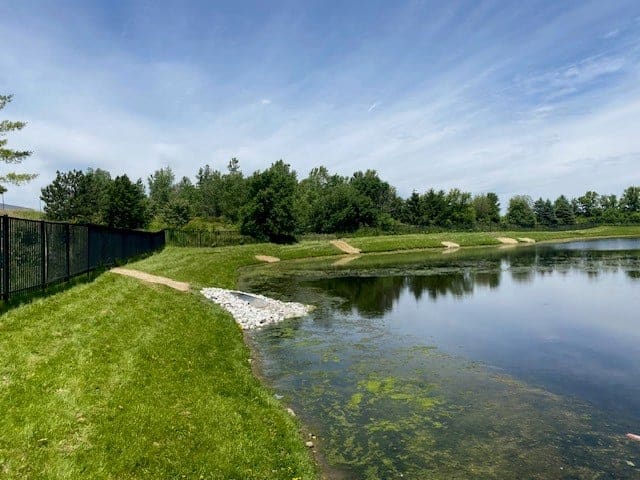
A legal description of the area containing the stormwater control structure shall be prepared and filed consistent with Section 4.4.6(G)(9) as a separate deed with the Wake County Register of Deeds along with any easements necessary for general access to the stormwater control structure. The deeded area shall include sufficient area to perform inspections, maintenance, repairs and reconstruction. The deeded area shall include, but is not limited to, detention ponds, vegetative filters, all pipes and water control structures, berms and dikes.
View State Page
Frequently Asked Questions
What is stormwater compliance in the City of Renton?
Stormwater compliance in Renton means following the City’s Stormwater Ordinance, which sets minimum requirements to protect public health, safety, and welfare throughout local watersheds. The City is the permitting authority for all land disturbing activities and will only issue construction permits to projects with a plan to manage runoff during construction. Once construction is complete, property owners are responsible for maintaining all on-site stormwater facilities and open space areas required by the approved stormwater control plan. The City operates under the NPDES program and can inspect properties and issue a Notice of Violation for any deficiency found on site.
Who is responsible for stormwater maintenance in Renton?
Property owners are responsible for maintaining all stormwater facilities and practices on their property. The City only maintains drainage facilities that have been formally accepted by the Administrator, which requires meeting a specific set of conditions including a two year maintenance period, a City inspection confirming no defects, properly conveyed easements, and City Council concurrence.
If those conditions have not been met, the facility remains the responsibility of whoever was required to build it and all persons holding title to the property. In practice, this means most private commercial and multifamily stormwater systems stay the property owner’s obligation indefinitely. AQUALIS can manage your maintenance requirements on your behalf.
What does Renton require for source control on commercial properties?
Any business or residential activity that could result in pollutants reaching the stormwater system must implement best management practices (BMPs) from the King County Stormwater Pollution Prevention Manual. Renton applies a stepped approach to BMP requirements.
First, nonstructural BMPs are required. These include operational practices like covering materials, sweeping parking lots, and managing chemicals properly.
If nonstructural BMPs are not enough to prevent contaminants from reaching stormwater, the City can require structural source control BMPs such as berms, covered storage areas, or secondary containment.
If structural BMPs are still not sufficient, treatment BMPs may be required at the property owner’s expense.
The City can provide technical assistance and information on outside financial assistance to property owners required to implement BMPs.
What are the most common stormwater compliance failures in Renton?
Based on AQUALIS’s inspection experience and Renton’s ordinance requirements, these are the issues we see most often.
Illicit connections, including historical ones. Renton explicitly prohibits connections that convey anything other than stormwater to the municipal system, including connections that were permissible under older rules. If your property has a legacy drain connection that was legal when it was made, it may still be a violation today.
Source control BMPs not implemented. Commercial properties with outdoor storage, vehicle maintenance, food preparation, or chemical use are required to have BMPs in place. Properties without them are in violation regardless of whether a discharge has actually occurred.
Facilities not maintained per the King County Surface Water Design Manual. Renton adopts this manual by reference as its maintenance standard. Sediment buildup, overgrown vegetation, and clogged inlets are common findings that indicate the standard is not being met.
Missing open and space area maintenance. Stormwater control plans frequently include requirements for maintaining green areas and open space on the property. These obligations are easy to overlook and are a common source of violations during City inspections.
How do I know if my Renton stormwater system is at risk of failure or safety violation?
Watch for these warning signs.
Water is not draining after rain. Standing water more than 72 hours after a storm suggests your system is not functioning as designed, which is an immediate maintenance issue under Renton’s ordinance.
Discolored or unusual discharge from your drainage system. Anything other than clear stormwater coming from outfall pipes or drainage features may indicate an illicit discharge, which Renton can order you to cease and remediate at your expense.
Your property has outdoor activities without BMPs in place. Vehicle maintenance, outdoor material storage, washing operations, and similar activities require source control BMPs under the Stormwater Pollution Prevention Manual. If these are not in place, you are at risk of a violation notice.
You have an old drain connection of uncertain origin. Legacy connections that predate current regulations are still prohibited. If you are not sure where all your drainage connections go, that is worth investigating before the City does.
Your facility has not been formally accepted by the City. If you assumed the City took over maintenance of your stormwater facility but never went through the formal acceptance process, the maintenance obligation is still yours. AQUALIS can help you determine the status of your facility and what obligations remain.
The information on this page is provided for general informational purposes only and is not legal advice. Regulations change frequently — AQUALIS makes no warranty as to the accuracy or completeness of this content, and any reliance on it is at your own risk. Consult a qualified professional or your local regulatory authority to confirm requirements applicable to your specific property.