

Last Updated 08/06/2026
Spartanburg, SC Municipal Code
Article 4 Stormwater Management
Sec. 30-161. - Regulations.
(a) Federal regulations governing stormwater management, as specified in State Code of Laws 40 C.F.R. 122.26, and State Code of Regulations R. 61-9 et seq., and R. 72.300 et seq., are adopted as the minimum requirements for the management of stormwater within Spartanburg County as defined in the respective regulations.
(b) The engineering division shall be responsible for day to day coordination, implementation and enforcement of this article and the SWMP as well as the long-term management of the county’s SMS4. Without limitation, the engineering division shall have the following specific powers and duties:
(1) To issue any permit, certification or license that may be required to comply with this article and federal and state regulations pertaining to stormwater management.
(2) To deny a facility connection to the SMS4 or discharge to waters of the state if state, federal regulations and this article are not met.
(3) To create and enact the Spartanburg County Stormwater Management Design Manual for approval by Spartanburg County Council. The design manual shall be used to convey design and engineering standards, construction management processes and procedures, and other aspects necessary for compliance with this article.
(4) To require the submittal of a land disturbance permit application for all construction activities that result in a land disturbance of greater than or equal to 5,000 square feet and would otherwise require a building or grading permit. These applications must include a plan to control stormwater pollutants and other components detailed in the Spartanburg County Stormwater Management Design Manual.
(5) To require design, installation and maintenance of stormwater quality best management practices for new and redevelopment projects that disturbs one acre or more of land.
(6) To require the development of a stormwater pollution prevention plan (SWPPP) for all new and redevelopment projects and enforcement of the SWPPP.
(7) To approve land disturbance plans and to require as a condition of such approvals, structural or non-structural controls, practices, devices, operating procedures, or other mechanisms to protect public and private property from flooding and erosion and attain TMDL-mandated pollutant load reductions and water quality standards.
(8) To require performance bonds of any person to secure that person’s compliance with their land disturbance permit, as well as other permits, certificates, licenses or authorizations issued or approved by the engineering division pursuant to this article, the SWMP and federal and state laws. The engineering division shall coordinate processes with the Spartanburg County Planning Department letters of credit to accommodate development phases and property ownership transfers.
(9) To comply with all federal and state regulatory requirements, promulgated or imposed pursuant to the Clean Water Act, the South Carolina Stormwater Management and Erosion Reduction Act applicable to the management of stormwater discharges to or from the Spartanburg County MS4.
(10) To conduct all activities necessary to carry out the SWMP and other requirements included in permit SCR030000 and this article, and to pursue the necessary means and resources required to properly fulfill this responsibility.
(11) To develop and implement strategic plans for complying with TMDLs. Such plans shall include initial due diligence procedures to fully assess the problem and alternative solutions so as to proceed with cost-effective solutions.
(12) To enter into agreements with other governmental entities or private persons or entities to provide or procure services to conduct and carry out such activities as authorized by this article.
(13) To maintain the small municipal separate stormwater system consistent with the provisions of the SWMP and this article.
(14) To direct, review and recommend for approval by Spartanburg County Council, the stormwater management operating budget.
(15) To direct, review and recommend for approval by Spartanburg County Council necessary changes to the existing stormwater management programs.
(16) To determine appropriate fees, to impose penalties, and to take necessary and appropriate actions to collect any fee or enforce any penalty assessed pursuant to this article and the ERP. The engineering division shall seek approval from county council on development and revision of the fee and penalty schedules.
Sec. 30-165. - Stormwater management design manual.
(a) Minimum requirements shall be established for processes and guidance regarding the evaluation and implementation of land-disturbing or pollutant discharging activities and the design of stormwater management conveyances and facilities in Spartanburg County. The engineering division shall develop additional policies, criteria, processes, specifications and standards for the proper implementation of the requirements of this article, federal and state laws and the SWMP for inclusion in the Spartanburg County Stormwater Management Design Manual. The manual shall include design standards, procedures and criteria for conducting hydrologic, hydraulic, pollutant load evaluations, and downstream impact for all components of the stormwater management system. Although the intention of the manual is to establish uniform design practices, it neither replaces the need for engineering judgment, nor precludes the use of information not presented. Other accepted engineering procedures may be used to conduct hydrologic, hydraulic and pollutant load studies if approved by the engineering division.
(b) The Spartanburg County Stormwater Management Design Manual, and all revisions and amendments to it, shall be approved by Spartanburg County Council and, upon such council approval, shall be used by Spartanburg County for conveyance and BMP design, construction and maintenance.
Sec. 30-166. - Ownership and Spartanburg County participation.
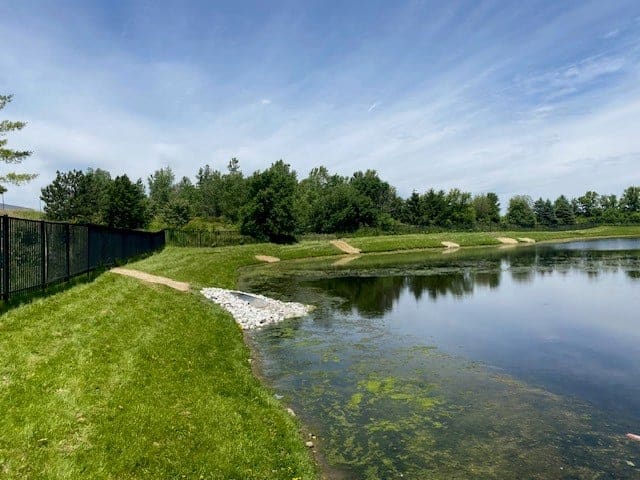
(a) All permanent stormwater management facilities shall be privately owned and maintained unless Spartanburg County accepts the facility for shared county maintenance. Spartanburg County shall accept ownership and maintenance of all or part of a stormwater system that meets county construction and maintenance standards upon dedication to Spartanburg County of said improvements in accordance with land development policies.
(b) Prior to the issuance of a land disturbance permit, the property owner or lessee shall execute a legal document entitled “Stormwater Management Facility Ownership and Maintenance Agreement” (“the covenants”). The property owner or the lessee, as the case may be, shall record the covenants in the office of the Spartanburg County Register of Deeds. The location of the facility, the recorded location of the covenants document, and a note stating the property owner’s or lessee’s responsibility shall be shown on a plat, or in the case of a lessee, as an exhibit attached to the lessee’s covenants, that is also recorded in the office of the Spartanburg County Register of Deeds. In the case of a lessee, the property owner shall be named on any covenant and be required to conduct maintenance activities upon the termination of a lease agreement.
(c) Spartanburg County shall have the right of entry to private property for the purpose of determining if a land-disturbing activity is being conducted without an approved stormwater sediment and control plan, conducting inspections and taking enforcement actions. Right of entry shall be with probable cause.
(d) Stormwater quantity and quality control facilities shall be located so that required easements can be effectively used and ownership and maintenance responsibility can be clearly defined in deeds and plats.
(e) The covenants shall specify minimum maintenance requirements to be performed at necessary intervals by the property owner or lessee, as the case may be.
(f) If a facility or any portion of the stormwater system is not being maintained as required, the county engineer or his designee will notify the property owner or lessee, as the case may be, in writing. If property owner or lessee, as the case may be, fails to repair or maintain the facility within the allotted time, the engineering division may authorize the work to be performed by the county or others. In such cases, the property owner or lessee, as the case may be, shall reimburse the county for its direct and related expenses. If the property owner or lessee, as the case may be, fails to reimburse the county, the county is authorized to file a lien for said costs against the property or the lessee’s leasehold interest, as the case may be, and to enforce the lien by judicial foreclosure proceedings.
(g) A property owner or lessee may hire or contract others to perform necessary maintenance actions, but Spartanburg County will hold the person named in the covenants as the responsible party should legal actions described in subsection (f) be necessary.
(h) When the county engineer or his designee determines that additional storage capacity or pollution reduction beyond that required by the applicant for on-site stormwater management is necessary in order to enhance or provide for the public health, safety and general welfare, to correct unacceptable or undesirable existing conditions or to provide protection in a more desirable fashion for future development, Spartanburg County may require additional stormwater controls required to prevent degradation of water quality or increase downstream flooding.
Sec. 30-167. - Maintenance, construction, inspection and notice of termination (NOT).
Maintenance of the stormwater management system is critical for the achievement of its purpose of controlling stormwater runoff quantity and quality and the short-term and long-term public health, safety and general welfare of the citizens of Spartanburg County.
(1) A permanent maintenance plan for the stormwater management system shall be included in the land disturbance permit application. As part of the maintenance plan, the property owner or lessee of such facility shall specifically agree to be responsible for permanent maintenance. In order to transfer maintenance responsibility, a letter of acceptance by the new owner(s) accepting permanent maintenance responsibility shall be filed with the engineering division.
(2) As part of the land disturbance permit application, the applicant shall submit construction and BMP maintenance and inspection schedules. Required and recommended schedules for BMP maintenance and inspection are to be provided in the stormwater management design manual.
(3) If the construction is to be phased, no stage work, related to the construction of stormwater management facilities shall commence until the preceding stage of work is completed in accordance with the approved land disturbance permit.
(4) The permittee shall notify the county engineer or his designee before commencing any work to implement the approved land disturbance permit and upon completion of any phase or designated component of the site. The contractor and/or owner shall hold a pre-construction conference a minimum of 48 hours prior to the commencement of work. All self-inspections, maintenance actions, BMP replacements, and changes to the approved land disturbance permit shall be documented and presented upon request to the county engineer or his designee.
(5) The permittee shall notify the engineering division that the site, or portion of the site, is sufficiently stabilized to begin the NOT process. If portions of the site are to be completed prior to others (e.g., phased construction), a proposed schedule shall be included in the approved land disturbance permit. The NOT process shall at a minimum require:
a. A final plat showing the location of all stormwater easements and responsible party for the maintenance of the system. References shall be made to any and all ownership and lessee covenants established for ensuring the maintenance and long-term functioning of the stormwater system. The plats shall also show conflicts with other new or existing easements;
b. Documentation from the owner of the approved land disturbance permit, including any revisions and as-built construction drawings, inspection reports, and stormwater system ownership transfers;
c. Verification from the design professional that all components of the stormwater management system meet the approved land disturbance permit and specifications or achieve the function for which they were designed. In addition, the site shall be cleared of all construction trash and debris from the stormwater system and the site as a whole;
d. A final inspection conducted by the county engineer or his designee.
(6) Permit notice of termination (NOT) procedures shall be developed by the engineering division and shall include inspection procedures to assure that the work has been carried out in accordance with the permit and this article. The project NOT process may include phasing so that portions of a project can be closed out at various time periods and provided that the necessary documentation is submitted for approval. This process and documentation requirements are detailed in the stormwater management design manual.
Sec. 30-212. - Inspections.
(a) The county engineer or his designee, bearing proper credentials and identification, may enter and inspect all properties for regular inspections, periodic investigations, monitoring, observation measurement, enforcement, sampling and testing, to effectuate the provisions of this article and the SWMP programs. The county engineer or his designee shall duly notify the owner of said property or the representative on-site and the inspection shall be conducted at reasonable times. Right of entry shall be with probable cause.
(b) Upon refusal by any property owner to permit an inspector to enter or continue an inspection, the inspector shall terminate the inspection or confine the inspection to areas concerning which no objection is raised. The county engineer or his designee shall document the refusal and the grounds for such and promptly seek appropriate compulsory process.
(c) In the event that the county engineer or his designee reasonably believes that discharges from the property into the Spartanburg County MS4 may cause an imminent and substantial threat to human health or the environment, the inspection may take place at any time and without notice to the owner of the property or a representative on-site. The inspector shall present proper credentials upon reasonable request by the owner or representative.
(d) Inspection reports shall be maintained in a permanent file located in the engineering division’s office.
View State Page
Frequently Asked Questions
Who owns and maintains stormwater facilities in Spartanburg County?
By default, the property owner. All permanent stormwater management facilities are privately owned and maintained unless Spartanburg County agrees to accept shared maintenance. The county will only take on that responsibility once the facility meets its construction and maintenance standards and is formally dedicated to the county under its land development policies.
Can Spartanburg County inspect my property for stormwater compliance?
Yes. The County Engineer or a designee has the right of entry to private property to determine whether land disturbing activity is happening without an approved plan, and to conduct inspections and enforcement actions. This right of entry requires probable cause, and the county generally notifies the owner and conducts inspections at reasonable times.
What happens if I refuse a stormwater inspection in Spartanburg County?
The inspector will end the inspection, or limit it to areas where no objection was raised, and document the refusal along with its grounds. From there, the county will promptly pursue appropriate compulsory process to gain access. If the county reasonably believes discharges from your property pose an imminent and substantial threat to human health or the environment, inspections can happen at any time without notice.
Do I need a maintenance agreement for my stormwater facility in Spartanburg County?
Yes. The Storm Water Management Facility Ownership and Maintenance Agreement spells out the minimum maintenance requirements you or your lessee need to perform, along with how often. AQUALIS can help property owners in Spartanburg County put together an agreement that meets these standards.
What happens if I don't maintain my stormwater facility in Spartanburg County?
If the County Engineer determines a facility isn’t being maintained as required, you’ll receive written notice. If you don’t repair or maintain it within the given timeframe, the county can authorize the work itself, then bill you for its direct and related expenses. If you don’t reimburse the county, it can file a lien against your property and enforce it through judicial foreclosure. AQUALIS can help property owners stay ahead of maintenance deadlines to avoid this kind of cost.
Can I hire someone else to maintain my stormwater facility in Spartanburg County?
Yes. You’re allowed to hire or contract with others to perform necessary maintenance. That said, the county will still hold the person named in your Ownership and Maintenance Agreement as the responsible party if legal action becomes necessary.
What triggers a notice of violation in Spartanburg County?
If the County Engineer determines you’ve failed to maintain a stormwater facility, or that your property is causing flooding, erosion, or a water quality violation, you’ll receive a written Notice of Violation. It states the nature of the violation, your deadline to correct it, the date of the follow-up inspection, and the proposed penalty if corrective action isn’t taken.
What are the penalties for stormwater violations in Spartanburg County, South Carolina?
Civil penalties run up to $1,000 per violation, once you’ve been properly notified, with each additional day of violation counted separately. If payment isn’t made or a settlement reached within 30 days of the county’s demand, the matter can go to Spartanburg County Circuit Court. Beyond civil penalties, negligent, willful, or intentional violations can also be charged as a misdemeanor in magistrate’s court, again with each day treated as a separate offense.
The information on this page is provided for general informational purposes only and is not legal advice. Regulations change frequently — AQUALIS makes no warranty as to the accuracy or completeness of this content, and any reliance on it is at your own risk. Consult a qualified professional or your local regulatory authority to confirm requirements applicable to your specific property.