


Last Updated 08/25/2026
Newton, NJ Municipal Code
Chapter 258 Stormwater Control
Maintenance and Repair
- Applicability. Projects subject to review as in § 258-3 of this chapter above shall comply with the requirements of § 258-17B and C below.
- General maintenance.
- The design engineer shall prepare a maintenance plan for the stormwater management measures incorporated into the design of a major development.
- The maintenance plan shall contain specific preventative maintenance tasks and schedules; cost estimates, including estimated cost of sediment, debris, or trash removal; and the name, address, and telephone number of the person or persons responsible for preventative and corrective maintenance (including replacement). The plan shall contain information on BMP location, design, ownership, maintenance tasks and frequencies, and other details as specified in Chapter 8 of the New Jersey BMP Manual, as well as the tasks specific to the type of BMP, as described in the applicable chapter containing design specifics.
- If the maintenance plan identifies a person other than the property owner (for example, a developer, a public agency or homeowners’ association) as having the responsibility for maintenance, the plan shall include documentation of such person’s or entity’s agreement to assume this responsibility, or of the owner’s obligation to dedicate a stormwater management facility to such person under an applicable ordinance or regulation.
- Responsibility for maintenance shall not be assigned or transferred to the owner or tenant of an individual property in a residential development or project, unless such owner or tenant owns or leases the entire residential development or project. The individual property owner may be assigned incidental tasks, such as weeding of a green infrastructure BMP, provided the individual agrees to assume these tasks; however, the individual cannot be legally responsible for all of the maintenance that is required.
- If the party responsible for maintenance identified under § 258-17B(3) above is not a public agency, the maintenance plan and any future revisions based on § 258-17B(7) below shall be recorded upon the deed of record for each property on which the maintenance described in the maintenance plan must be undertaken.
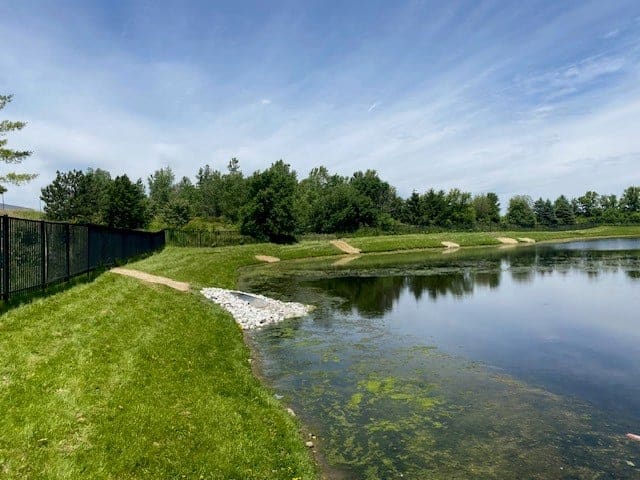
- Preventative and corrective maintenance shall be performed to maintain the functional parameters (storage volume, infiltration rates, inflow/outflow capacity, etc.) of the stormwater management measure, including, but not limited to, repairs or replacement to the structure; removal of sediment, debris, or trash; restoration of eroded areas; snow and ice removal; fence repair or replacement; restoration of vegetation, and repair or replacement of nonvegetated linings.
- The party responsible for maintenance identified under § 258-17B(3) above shall perform all of the following requirements:
- Maintain a detailed log of all preventative and corrective maintenance for the structural stormwater management measures incorporated into the design of the development, including a record of all inspections and copies of all maintenance-related work orders;
- Evaluate the effectiveness of the maintenance plan at least once per year and adjust the plan and the deed as needed; and
- Retain and make available, upon request by any public entity with administrative, health, environmental, or safety authority over the site, the maintenance plan and the documentation required by § 258-17B(6) and (7) above.
- The requirements of § 258-17B(3) and (4) above do not apply to stormwater management facilities that are dedicated to and accepted by the municipality or another governmental agency, subject to all applicable municipal stormwater general permit conditions, as issued by the Department. Maintenance and inspection guidance can be found on the Department’s website at: https://dep.nj.gov/stormwater/maintenance-guidance/.
- In the event that the stormwater management facility becomes a danger to public safety or public health, or if it is in need of maintenance or repair, the municipality shall so notify the responsible person in writing. Upon receipt of that notice, the responsible person shall have 14 calendar days to effect maintenance and repair of the facility in a manner that is approved by the municipal engineer or his designee. The municipality, in its sole discretion, may extend the time allowed for effecting maintenance and repair for good cause. If the responsible person fails or refuses to perform such maintenance and repair, the municipality or county may immediately proceed to do so and shall bill the cost thereof to the responsible person. Nonpayment of such bill shall result in a lien on the property.
- Nothing in this section shall preclude the municipality in which the major development is located from requiring the posting of a performance and/or a maintenance guarantee, in accordance with N.J.S.A. 40:55D-53.
Private Storm Drain Inlet Retrofitting
- The purpose of this section is to require the retrofitting of existing storm drain inlets which are in direct contact with repaving, repairing, reconstruction, or resurfacing or alterations of facilities on private property to prevent the discharge of solids and floatables (such as plastic bottles, cans, food wrappers and other litter) to the municipal separate storm sewer system(s) operated by the Town of Newton, so as to protect public health, safety and welfare, and to prescribe penalties for the failure to comply.
- Prohibited conduct. No person in control of private property (except a residential lot with one single-family house) shall authorize the repaving, repairing (excluding the repair of individual potholes), resurfacing (including top coating or chip sealing with asphalt emulsion or a thin base of hot bitumen), reconstructing or altering any surface that is in direct contact with an existing storm drain inlet on that property unless the storm drain inlet either:
- Already meets the design standard below to control passage of solid and floatable materials; or
- Is retrofitted or replaced to meet the standard in Subsection D below prior to the completion of the project.
- Design standards. Storm drain inlets shall comply with the following standard to control passage of solid and floatable materials through storm drain inlets. For purposes of this subsection, “solid and floatable materials” means sediment, debris, trash and other floating, suspended, or settleable solids. For exemptions to this standard see Subsection D(3) below.
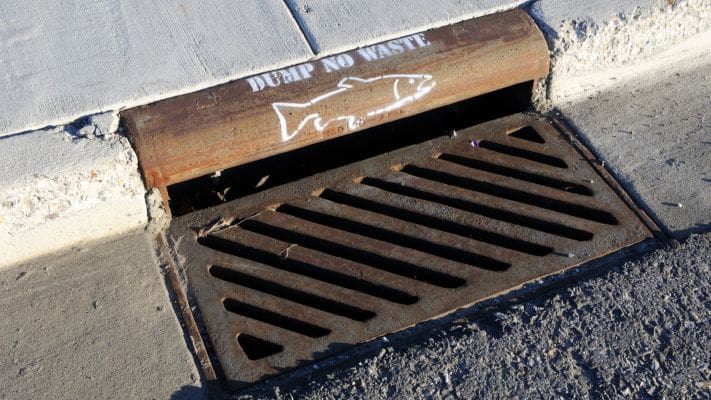
- Design engineers shall use either of the following grates whenever they use a grate in pavement or another ground surface to collect stormwater from that surface into a storm drain or surface water body under that grate:
- The New Jersey Department of Transportation (NJDOT) bicycle-safe grate, which is described in Chapter 2.4 of the NJDOT Bicycle Compatible Roadways and Bikeways Planning and Design Guidelines (April 1996); or
- A different grate, if each individual clear space in that grate has an area of no more than seven square inches or is no greater than 0.5 inches across the smallest dimension. Examples of grates subject to this standard include grates in grate inlets, the grate portion (non-curb-opening portion) of combination inlets, grates on storm sewer manholes, ditch grates, trench grates, and grates of spacer bars in slotted drains. Examples of ground surfaces include surfaces of roads (including bridges), driveways, parking areas, bikeways, plazas, sidewalks, lawns, fields, open channels, and stormwater basin floors.
- Whenever design engineers use a curb-opening inlet, the clear space in that curb opening (or each individual clear space, if the curb opening has two or more clear spaces) shall have an area of no more than seven square inches or be no greater than two inches across the smallest dimension.
- This standard does not apply:
- Where the Municipal Engineer agrees that this standard would cause inadequate hydraulic performance that could not practicably be overcome by using additional or larger storm drain inlets that meet these standards.
- Where flows are conveyed through any device (e.g., end-of-pipe netting facility, manufactured treatment device, or a catch basin hood) that is designed, at a minimum, to prevent delivery of all solid and floatable materials that could not pass through one of the following:
- A rectangular space 4 5/8 inches long and 1 1/2 inches wide (this option does not apply for outfall netting facilities); or
- A bar screen having a bar spacing of 0.5 inches.
- Where flows are conveyed through a trash rack that has parallel bars with one-inch spacing between the bars.
- Where the New Jersey Department of Environmental Protection determines, pursuant to the New Jersey Register of Historic Places Rules at N.J.A.C. 7:4-7.2(c), that action to meet this standard is an undertaking that constitutes an encroachment or will damage or destroy the New Jersey Register listed historic property.
- Design engineers shall use either of the following grates whenever they use a grate in pavement or another ground surface to collect stormwater from that surface into a storm drain or surface water body under that grate:
- Enforcement. The Town Manager, through the Public Works Supervisor, shall enforce the provisions of this section. It shall be unlawful for any reason to violate any part of this section adopted by the Town Council of the Town of Newton.
- Violations and penalties. Any person(s) who is found to be in violation of the provisions of this section shall be first notified of the violation, and if the violation is not remediated within 30 days, that person(s) shall be liable to a penalty in accord with the following schedule for each day on which the violation exists beyond the thirty-day limit:OffenseFine
First $100 per daySecond$250 per dayThird and Subsequent$500 per day
View State Page
Frequently Asked Questions
What are my ongoing maintenance obligations for a stormwater facility in Newton?
Property owners in Newton are responsible for maintaining the stormwater management measures on their site so the system keeps performing key functions like storage volume, infiltration rates, and inflow and outflow capacity. That means addressing sediment removal, vegetation restoration, and any repairs needed to keep the facility working as originally designed. AQUALIS manages this ongoing maintenance obligation for Newton property owners, so the functional parameters of the system stay within the standards the town expects.
Do I need a maintenance plan for my stormwater facility in Newton, and what does it need to cover?
Yes. Under Newton’s Chapter 58 Stormwater Control ordinance, design engineers must prepare a maintenance plan for stormwater management measures in major developments, and that plan needs to include specific preventative maintenance tasks and schedules, cost estimates, and the responsible party’s contact information. It also has to identify BMP location, design, ownership, and maintenance frequencies consistent with the New Jersey BMP Manual. AQUALIS prepares and manages these maintenance plans for Newton property owners, keeping every required detail documented and current.
Does my Newton property's maintenance plan need to be recorded anywhere?
Yes, if the responsible party for a stormwater facility in Newton is not a public agency, the maintenance plan must be recorded on the property deed. That means the maintenance obligation runs with the land and carries forward to future owners of the property. AQUALIS helps Newton property owners keep recorded maintenance obligations properly documented and confirms that deed-recorded responsibilities continue to be met over time.
How often does my stormwater facility in Newton need to be evaluated?
Newton requires that the effectiveness of a stormwater facility’s maintenance be evaluated at least once per year, with the maintenance plan adjusted as needed based on that review. This annual check is meant to catch small problems, like reduced infiltration or sediment buildup, before they become larger and more expensive to fix. AQUALIS conducts these annual evaluations for Newton property owners and updates maintenance plans whenever conditions on the ground change.
What happens if my stormwater facility in Newton falls into disrepair?
Newton can issue a written notice requiring repairs to a noncompliant stormwater facility within 14 calendar days. If the responsible party does not act, the municipality can perform the necessary work itself and bill the cost back to the property owner, and an unpaid bill can result in a lien being placed on the property. AQUALIS helps Newton property owners respond to a repair notice quickly, addressing the issue directly rather than risking municipal intervention and a lien.
What does the New Jersey BMP Manual have to do with my stormwater facility in Newton?
Newton’s maintenance plan requirements are tied directly to the New Jersey BMP Manual, particularly its guidance on BMP location, design, ownership, and maintenance frequency in Chapter 8. This means a Newton property’s maintenance obligations are shaped by both the town’s own ordinance and this statewide technical reference. AQUALIS stays current on the New Jersey BMP Manual’s requirements and applies them directly to the maintenance plans it manages for Newton property owners.
Where can I find help managing all of my stormwater compliance needs in Newton?
Between engineer-prepared maintenance plans, deed recording requirements, annual evaluations, and a municipal enforcement process that can end in liens on the property, staying compliant in Newton involves more moving parts than most owners want to track on their own. AQUALIS offers Newton property owners a single point of contact for stormwater management, covering maintenance plan development, annual evaluations, repair response, and general compliance consulting, so property owners can meet the town’s requirements without handling every detail themselves.
The information on this page is provided for general informational purposes only and is not legal advice. Regulations change frequently — AQUALIS makes no warranty as to the accuracy or completeness of this content, and any reliance on it is at your own risk. Consult a qualified professional or your local regulatory authority to confirm requirements applicable to your specific property.