


Handling a Stormwater notice of violation
Receiving a Letter of Non-Compliance or Notice of Violation (“NOV”) from your stormwater regulatory body is a serious matter and one that cannot be ignored. Proper and immediate response is critically important, and it is imperative to partner with an expert in stormwater rules, regulations and regulatory response. This expert should understand the most effective strategies to return the stormwater system to a well-functioning state, mitigating both environmental harm and regulatory exposure for the property owner. Without a seasoned and proven stormwater management partner the costs and impacts to your business or property can be devastating.

What is a Notice of Violation?
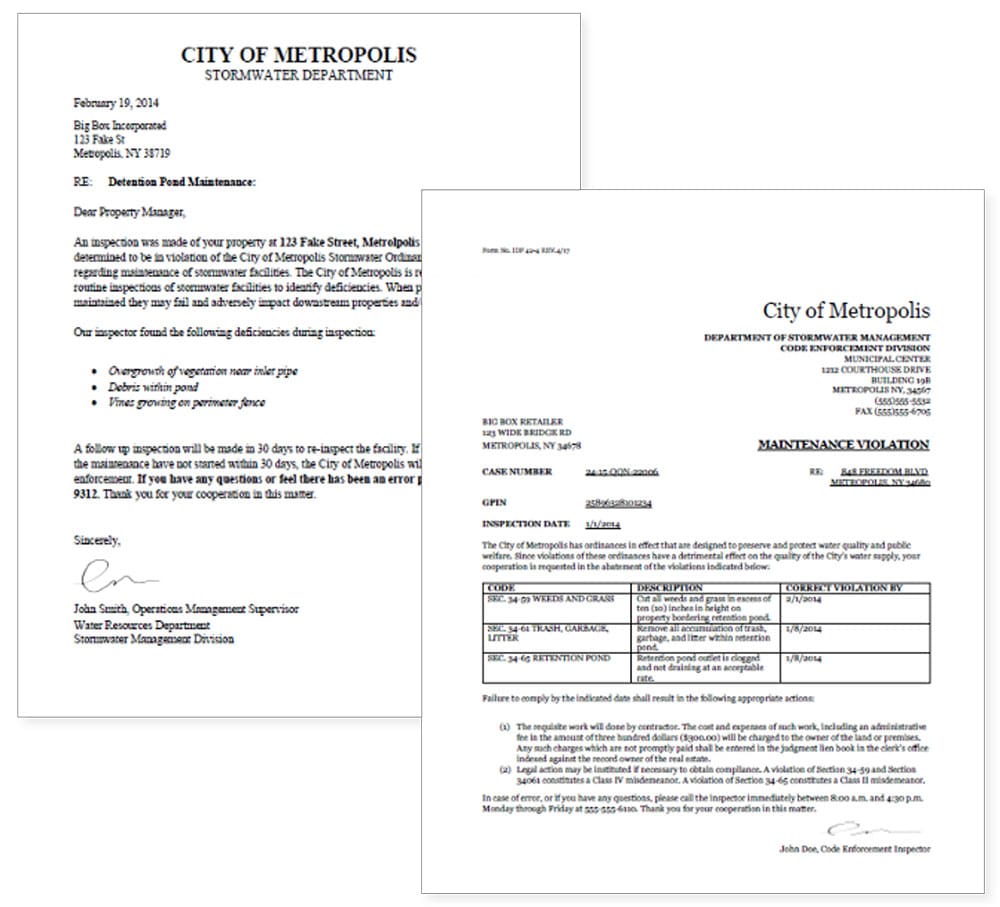
A notice of violation (“NOV”) is an official notification to inform a non-compliant property owner/manager of a violation of the stormwater management ordinance. This notice will detail what part of the stormwater ordinance was violated, when and where the violation was observed and any necessary actions required. The notice may or may not include fines and penalties depending on the severity of the violation and prior history of the responsible party. Fines and penalties can sometimes be avoided by either proving the violation did not occur or by getting your stormwater management system into compliance immediately. If the stormwater management system is receiving Stormwater Tax Credits, the violation may be cause for the credits to be rescinded. Serious or repeated violations can lead to criminal charges, and ignorance of environmental laws is not an excuse for non-compliance.
This whitepaper will discuss an overview of stormwater management NOV’s, including the various reasons NOV’s are issued, who issues them, and most importantly, what to do once a NOV is issued.
Categories of Violations
When considering why a NOV is issued, it is important to remember the basics of stormwater management:
- A system is designed and constructed to manage rainfall and storm events at a site with impervious surfaces
- This system is agreed to and approved by a regulatory body
- This system is (or should be) inspected annually and maintained and repaired so that it continually operates as designed and intended
- If the above steps are not performed, for any reason, the system is at risk of receiving a NOV
During Site Construction
- Failure to apply for permit coverage
- Failure to prepare a Storm Water Pollution Prevention Plan (SWPPP)
- Inadequate SWPPP
After Construction (post construction stormwater management)
- Failure to implement appropriate Stormwater Control Measures (SCMs)
- Failure to maintain or repair SCMs
- Failure to conduct or document inspections
- Inadequate Erosion/Sediment Controls
- Illegal Dumping/Discharge
- Illicit Connection (Connecting a Sanitary Sewage System into a Stormwater System
Non-Compliant BMP Examples

Swale with Excessive Vegetation

Erosion from Improperly Draining BMP

Outlet Clogged with Tree Debris from Beaver Activity

Erosion at Outlet

Severe Erosion of Inlet

Overgrowth of Vegetation at Retention Pond

Invasive Species Dominant

Collection of Debris, Inadequate Maintenance
Issuers of NOVs
The EPA and State governments can issue NOVs for violations of the Clean Water Act or other legislation. However, it is more likely for the NOV to be issued by the stormwater department of the local city/county government, typically following up on a local complaint or inspection by the regulatory official. Factors influencing the issuance of a NOV include:
- Frequency (and severity) of violations by property owner, manager or business
- Other types of noncompliance involved
- Degree of impact to the environment
- Whether the violation has harmed or has the potential to harm public health
Types of NOVSs
The word “NOV” is being used generically herein. Specific types of issuances from governmental bodies include:
Notice of Violation (“NOV”)
A written document issued by a regulatory body to a permittee or other regulatee informing them of the violation(s) of the applicable permit, statute, regulation and/or management agreement.
Expedited Settlement Offer (“ESO”)
A consent agreement and final penalty order issued by the EPA or a regulatory body, in specified circumstances, where violations of the applicable permit, statute, regulation and/or management agreement may be resolved quickly through an expedited process in which the violator:
- Corrects identified deficiencies
- Signs an agreement with EPA certifying that deficiencies have been corrected- pays a penalty
Administrative Order (‘AO’)
A written document issued by the EPA or a regulatory body which contains findings of fact and which directs a permittee or other regulatee to achieve compliance with the applicable permit, statute, regulation and/or management agreement.
Administrative Penalty Order (“APO”)
An order entered by the EPA or a regulatory body assessing penalties against a permittee or other regulatee for violating the applicable permit, statute, regulation and/or management agreement.
A Civil Action
A judicial action that typically seeks both penalties and injunctive relief for violating the applicable permit, statute, regulation and/or management agreement.
Fictional NOV Examples
What to Do After Receiving a Notice of Violation?
Upon receiving a NOV, it is important to act thoughtfully but quickly — every day a site is found out of compliance is generally considered an individual incident, and if there are fees that go along with non-compliance “incidents”, these fees can accumulate quickly.
- Read the entire notice carefully. If you do not understand any part of it or believe something is incorrect, contact a stormwater management company such as AQUALIS for clarification and assistance.
- Prevent further immediate environmental damage referenced in the NOV by taking the necessary corrective measures (example, repair the leak, clean up the spill, remove the nuisance vegetation, etc.), even if these corrective measures are interim steps before a more complete response.
- If you perfectly understand the reasoning behind the NOV and the impacts of the needed corrective actions, respond to the NOV and regulatory body in writing. Explain the cause of the violation, how you plan to clean up the damage with a specific timeline, any interim steps you have taken, and how you plan to prevent future violations via permanent corrective measures. If you feel the notice of violation was unwarranted you may appeal the violation as detailed in the notice. Note – this course of action can be risky if the NOV is not fully understood. As stormwater experts, we recommend at the minimum consulting with a stormwater management expert in your region, like AQUALIS to ensure that all steps to correct the violation are being considered and appropriate action falls into the compliant regulations.
- If you do NOT perfectly understand the reasoning behind the NOV and the impacts of the needed actions, seek the counsel of a stormwater management company such as AQUALIS. The first communication with a regulatory body is important, and establishes the baseline for the entire management of the NOV. As a nationwide provider with regional expertise, we have regulator relationships established that assist in the communication process and meeting all compliant standards.
- After making contact with the regulatory body, confirm that they agree with the corrective actions in your response and then carry out the corrective actions. Upon the completion of the corrective actions, submit a completion report with before/after photo documentation of the stormwater management issue and resolution.
Please note that in the experience of AQUALIS, most regulatory bodies do not issue NOV’s frivolously. If the stormwater management system violations are serious enough to warrant a NOV, professional and immediate response is required. If you or your organization has received a NOV, we strongly recommend that you engage an experienced stormwater management organization such as AQUALIS.
Our stormwater experts will manage the NOV process to minimize costs from fines, to minimize environmental liability, and to prevent future noncompliance. Our team will visit the site to assess the situation and develop a plan to deal with the violation in the most expeditious and cost-effective manner, more than likely involving a combination of our inspection, maintenance and repair services. Whether it is a minor problem such as excessive vegetation or a more major problem such as a sinkhole, our experienced staff will offer turnkey service in managing all aspects of the NOV response. As one might expect, we have found that regulatory bodies respond more favorably to communication from stormwater experts than from those inexperienced in the field.
Let AQUALIS Help With Your NOV
With the stormwater regulatory changes of the last decade, owners and property managers of properties with more than one acre roofed or paved have a clear and direct responsibility relative to stormwater management. In addition to this legal responsibility, taking care of the surrounding environment is also the right thing to do, and is good for business. However clear and direct the legal responsibility is, the various requirements, rules, regulations, and nuances of this business make it a sometimes arduous and confusing undertaking, and never more so than in response to a NOV from a regulatory body.
We hope that this whitepaper has provided the reader with an understanding of stormwater management NOV’s. Receiving a NOV is never pleasant, but upon the receipt of a NOV, the next step is the most important. A well-planned and thorough response to a NOV will keep the matter small and manageable; ignoring the NOV, or not understanding the ramifications of the NOV, may lead to a large, confusing and expensive undertaking.
If you have received a stormwater NOV, we at AQUALIS are ready to help, and ready to answer all questions about how to get started. Please visit aqualisco.com for more information by submitting a free consultation request or call us directly at 855.890.6390 to find out more information about avoiding NOV’s with the nationwide leader in stormwater management