
Permeable pavements maintenance and rehabilitation
Urbanization has significantly altered the natural water cycle by increasing impervious surfaces. Impervious surfaces not only result in more stormwater runoff, but they also reduce evapotranspiration and infiltration capacity, making stormwater management more challenging. In response, stormwater best management practices (BMPs), also known as low impact development (LID), nature-based solutions or green infrastructure, have been widely implemented. BMPs alleviate the flow and volume of stormwater to aging gray infrastructure (e.g., pipes and culverts,) by providing opportunities for stormwater to evapotranspire and infiltrate via plants and soil.
Some common BMPs include bioretention systems and rain gardens. However, not all sites have the available green space to implement soil and plant based BMPs. In such cases, water resource engineers turn to the very land uses that contribute to imperviousness (i.e., pedestrian walkways, sidewalks, driveways, parking lots and bike paths). Where green space is limited, permeable pavements are often selected to manage stormwater runoff volume and pollutants.
The purpose of this white paper is to inform the audience about the maintenance requirements for each type of permeable pavement, and the potential rehabilitation efforts if maintenance is neglected. This information will help determine which type of permeable pavement aligns best with your budget and the level of effort you are willing to invest.

What are Permeable Pavements?
Permeable pavements are stormwater control systems that allow water to infiltrate through the surface of the pavement and into the ground. Permeable pavement is an umbrella term that includes porous asphalt, pervious concrete and permeable interlocking concrete pavement (PICP).
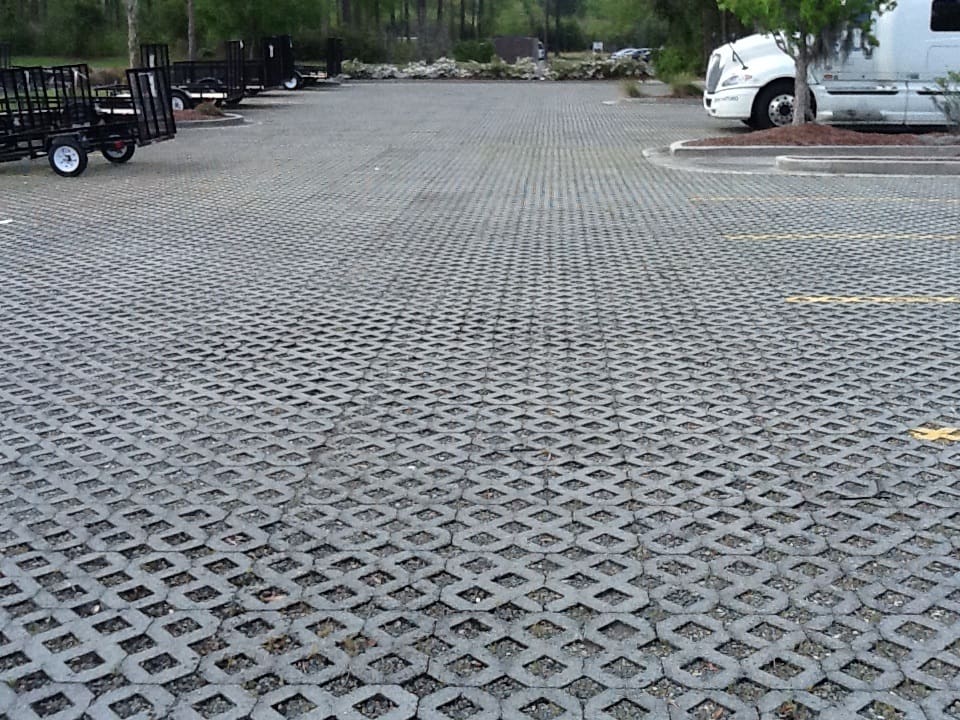
- Permeable interlocking concrete pavement (PICP) consists of manufactured concrete units (pavers) with small openings between permeable joints filled with highly permeable, small-sized aggregates.
- Porous asphalt is sometimes referred to as pervious, permeable, popcorn or open-graded asphalt.
- Pervious concrete may be called porous, gap-graded or enhanced porosity concrete.
General Operations and Maintenance
1. Inspection
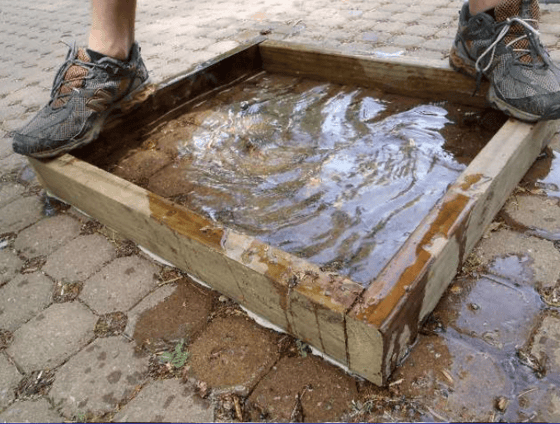
A key to the operations and maintenance of all pavers is to spot signs of degradation before it is too late through regular inspections. Inspections should occur at least once per year, preferably after a storm event, to evaluate the following:
- Pavement condition: inspect for settlement, deformation or cracking.
- Surface infiltration: inspect for sedimentation or evidence of ponding.
- Drainage: inspect observation wells 72 hours after a rain event of 0.5 inches or greater to verify that the storage reservoir is draining down effectively.
- Outfalls: inspect underdrain outfall locations for obstructions and erosion.
- Run-on areas: inspect run-on areas for adequate cover and stability.
If water ponds over the paver and remains longer than one hour after a rainstorm, the inspector should conduct the standard infiltration test, ASTM 1781, to determine the surface infiltration rate.
The information will be used to assist in predicting future maintenance needs and be part of an overall management system for the pavement. Based on the results of the inspection, it may be appropriate to conduct remedial maintenance.

2. Routine Maintenance
The following table outlines the general routine maintenance requirements for permeable pavements.
Routine Maintenance Requirements
| |||
| Porous Asphalt | Pervious Concrete | PCIP | |
Clean and flush underdrain system
| X | X | X |
Clean drainage outfall features
| X | X | X |
Replenish aggregate in joints
| X | ||
Repair surface deformations
| X | ||
Pressure wash at low angle to the surface followed by high suction
| X | X | X |
3. Remedial Maintenance
If ASTM C1781 test results are below 10 in./hr, vacuum surface to remove sediment (typically ½ to 1 in. or 13 to 25 mm deep) using a full or true vacuum machine (not regenerative air).
Stormwater management is the overall program for stormwater. Stormwater maintenance, sometimes called “preventive maintenance”, is a customized program to meet the needs of the specific stormwater system and to ensure its continued functionality for as long as possible.
To develop a maintenance plan, the property owner or manager must consider a few questions:
- What do the stormwater site plans dictate relative to maintenance?
- What are the needs of the specific SCMs on site? (Consideration must be given to vegetation, aquatic vegetation, nuisance conditions, topography, access, etc.
- Are there any maintenance requirements based on the location or the functioning of the system?
- What is the property owner’s budget allocated toward maintenance?
Maintenance is typically the responsibility of the property owner, and as noted, is often outsourced. The municipality or regulatory body in which the stormwater system is located often requires maintenance. If there is indeed a maintenance agreement with the local regulatory body, it is very important to understand the specific details of the maintenance agreement in order to ensure complete regulatory compliance.
Types of Permeable Pavement
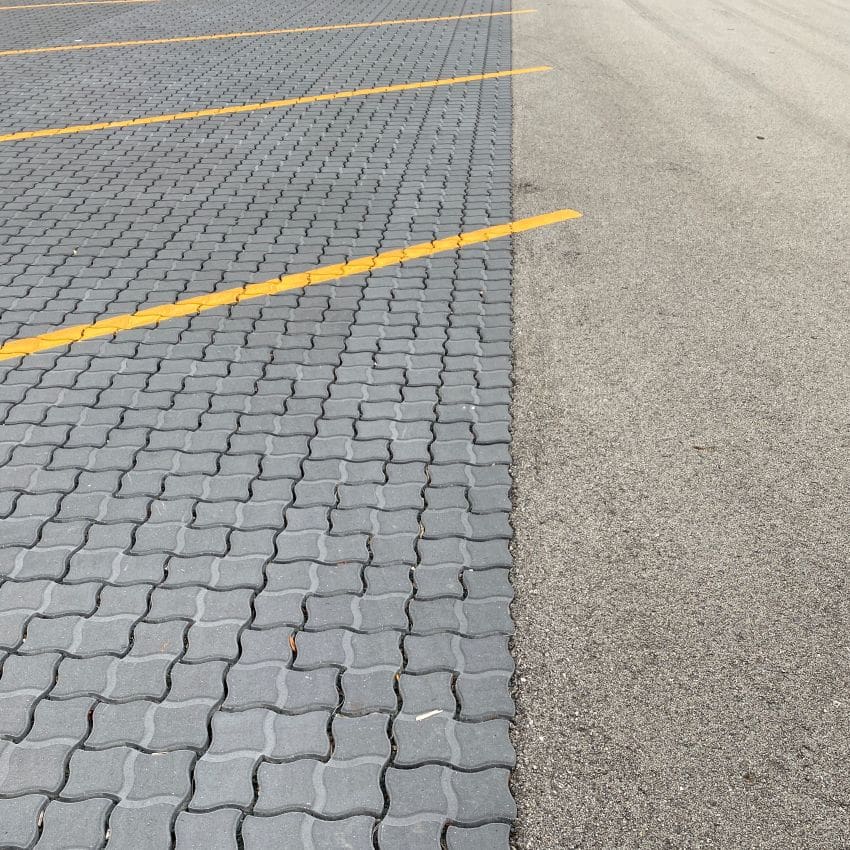
PICP (Permeable Interlocking Concrete Pavement)
One of the proponents for implementation of PICP over pervious concrete and porous asphalt is the ease of remedial maintenance to sustain the system over long periods of time.
Post jet vac, PICP are typically restored to acceptable infiltration rates (typically 10 in/hr), but the following must be completed as needed:
- Refill joints with clean aggregate, sweep surface clean and test infiltration rate again per ASTM C1781 to minimum 50% increase or minimum 10 in/hr (250 mm/hr).
- Repair and/or reinstallation of damaged units; this may require removal and reinstallation of adjacent paving units.
- Repair localized settlement greater than ½ in. (13 mm) and rutted pavement areas. Repair outflow features, piping, energy dissipaters, erosion protection systems, etc. as required

Porous Asphalt
Sediment accumulation in porous asphalt tends to go deep and can become very challenging to remove. If pressure washing and vacuuming the surface does not result in an increase in infiltration rates, a few options are available to rehabilitate the porous asphalt.
- Milling the top 2.5 cm of the porous asphalt and subsequently reinstalling the porous asphalt have been found to restore porous asphalt permeability.
- Replacement.
Pervious Concrete
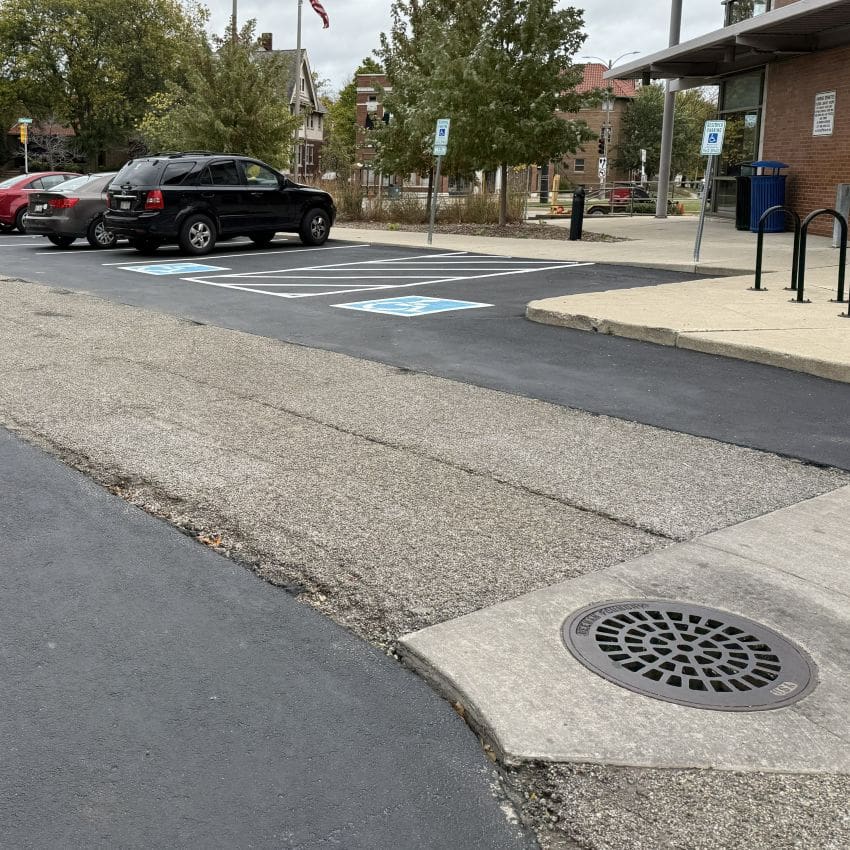
If pressure washing and vacuuming the surface does not result in an increase in infiltration rates, replacement of failed section or panel may be required.
Case Study
Permeable Interlocking Concrete Pavement (PICP)
Site Background
The Milwaukee War Memorial parking area was renovated in 2022 as part of a green infrastructure initiative designed to manage stormwater onsite and reduce runoff to Lake Michigan. The project involved the installation of 13,362 square feet of permeable pavement in conjunction with bioswales and native landscaping.
Together, these systems were designed to capture and infiltrate more than 210,000 gallons of stormwater runoff, improving water quality while reducing localized flooding and erosion.
To protect performance over time, an operations and maintenance (O&M) program was established for the pavement, including:
- Trash and debris removal twice per year
- Weed removal twice per year
- Annual mechanical sweeping
- Joint material replenishment every five years
- Joint vacuuming every ten years or as needed
- Annual power washing of the concrete surface
Inspection Findings
The site had three sections of permeable pavement. Initial inspection results were that some areas, particularly the low spots in the permeable pavement areas, were significantly clogged with sediment. The most extreme clogging occurred at a section that has a significant slope. To judge the level of clogging and therefore cleaning necessary, AQUALIS conducted an infiltration test (ASTM 1781). Both downstream and middle locations failed to meet performance standards of greater than 10 inches per hour.
The upstream section remained functional, reinforcing a common stormwater pattern: sediment accumulation increases as runoff flows downslope, clogging lower pavement areas first.



Conducting Maintenance
Maintenance of the permeable pavers was conducted using a high-pressure washer and vacuum surface cleaner. The high-pressure washer breaks up and loosens compacted sediment so the vacuum could remove the sediment and clogged joint stone. After the clogged joint material and debris were removed, new clean joint material was swept into the joints.
Maintenance infiltration tests were conducted to verify post maintenance infiltration rates. Three tests were performed in pavement area in accordance with testing standard ASTM C1781.
Table 1. Infiltration rate of sampling locations
| Sampling Location | Infiltration Rate (in/hr) | ||
| Pre Maintenance | Post Maintenance | ||
| P2-1 | < 3.91 | 272 | |
| P2-2 | < 4.89 | 242 | |
| P2-3 | 13.8 | 130 | |
After maintenance, infiltration rates increased more than 20 to 70 times in previously clogged areas. Removing clogged joint material and replacing it with clean aggregate proved highly effective, immediately restoring system performance.
While routine litter control and vegetation inspections were already in place, AQUALIS recommended enhancements to prevent future clogging including parking lot sweeping after fall leaf drop and spring snow removal. Bi-annual sweeping will prevent the accumulation of sediment that runs into and clogs the pavers.

Case Study
Porous Asphalt
Site Background
The site is a parking lot in Milwaukee, Wisconsin where porous asphalt was installed in 2006 as a stormwater management system. The pavement includes approximately 3,881 square feet of porous asphalt over an 18-inch stone reservoir layer totaling 5,749 square feet.
The system was designed to allow surface runoff to pass through the pavement and stone edge into the reservoir layer, then flow through an underdrain and into a hydrodynamic separator before discharging to the City storm sewer.
Pavement Before Maintenance

Hydrodynamic Separator Before Maintenance

Pavement After Maintenance

Hydrodynamic Separator After Maintenance

Inspection Findings
An initial inspection was conducted, and the porous asphalt was visibly clogged with sediment. The pavement was installed in 2006 and is at the end of its expected design life, and it is evident that maintenance was not regularly conducted. An infiltration test was performed in accordance with ASTM C1701. This test showed the asphalt failed to infiltrate.
Conducting Maintenance
Maintenance of the porous asphalt was performed with a high-pressure washer and vacuum surface cleaner. Infiltration testing was conducted after the first pass of the surface cleaner. After the first cleaning pass, the surface remained visibly clogged and infiltration testing again showed no measurable infiltration. To evaluate whether additional effort could improve performance, one area was cleaned more aggressively. A follow-up infiltration test in this area produced an infiltration rate of 6.7 inches per hour, which remained below the required 10 inches per hour standard. The aggressively cleaned area was the only location where water visibly drained.

Cost-Benefit and Rehabilitation Considerations
While surface washing and vacuuming did not significantly restore infiltration, other rehabilitation methods may provide improved outcomes.
Research and industry experience indicate that the top 2 centimeters of porous asphalt are most impacted by sediment clogging. One effective rehabilitation approach is to:
- Mill off the top 2 centimeters of pavement
- Replace with a new porous asphalt surface layer
This process removes clogged pore space entirely and restores infiltration capacity. With routine maintenance following rehabilitation, pavement life can be extended approximately 10 additional years before full replacement is required.
Comparison
A lifecycle cost analysis compared porous asphalt and PICP over a 30-year service period:
Porous Asphalt
Porous asphalt assumed to require surface milling and overlay at 15 years, with full replacement at every 30 years
Permeable Interlocking Concrete Pavement (PICP)
PICP assumed to last 30 years before replacement
When accounting for maintenance and rehabilitation needs, annual maintenance costs for porous asphalt were nearly double those of PICP. The main reason for the difference in cost is the more frequent washing needed for porous asphalt. Anecdotal evidence from years of experience in the green infrastructure industry has indicated that PICP has better infiltration rates over time and is easier to unclog before it needs replacement.
Case Study
Pervious Concrete
The site is a parking lot in Milwaukee, WI where the pervious concrete was constructed in 2018. The system consists of approximately 2,178 SQFT of 12” thick stone reservoir layer with 6-in pervious concrete slabs installed on top. During rain events, surface runoff flows through the pervious concrete and stone edge into a stone storage area that eventually discharges into the city storm sewer.
Inspection Findings
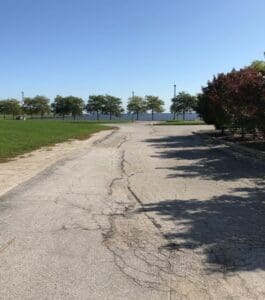
An initial inspection revealed the pervious concrete was visibly clogged with sediment, indicating a lack of regular maintenance since its installation in 2018. The surface no longer appeared to be functioning as designed for effective stormwater infiltration.
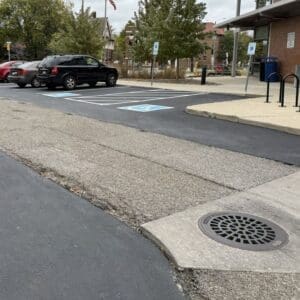
At the edge between the pervious concrete and adjacent asphalt pavement, multiple potholes were observed. These were likely the result of material deterioration caused by prolonged exposure to excessive deicing salts. Additionally, a noticeable accumulation of sediment was present along the boundary areas. This sediment buildup appeared to be associated with recent mill-and-overlay work on the adjacent asphalt, where the new asphalt surface does not match the grade of the existing pervious concrete. The resulting elevation difference has created drainage issues, preventing water from flowing properly onto the pervious concrete in some areas.
Maintenance Recommendations
Basic maintenance at a minimum of two times per year (Spring and Fall) will prevent build up above and below the surface. More frequent cleaning may be necessary based on site conditions and adjacent ground/pavement surfaces.
Since the pervious pavement at this site is failing and has not been maintained for years, our recommendation is to remove the current porous concrete system and replace it with either a similar pre-cast pervious concrete slab system, permeable pavers or a pre-treatment device that directs the flow through the stone storage layer.
Before Repair
After Repair

In Conclusion
Permeable pavements are excellent green alternatives to impervious surfaces, particularly in areas where space is limited for managing stormwater runoff volume and pollutants. Like any infrastructure, the effectiveness of permeable pavements depends heavily on detailed inspection and consistent maintenance. As illustrated in the presented case studies, neglected porous pavement can become ineffective, rendering typical maintenance methods, such as jet vacuuming, insufficient. In such cases, rehabilitation may be necessary, involving milling and overlaying with new porous asphalt to extend the pavement’s service life.
While the initial construction cost of PICP is higher than that of porous asphalt, PICP typically incurs lower maintenance costs. Additionally, in the event of damage or failure, PICP is often easier and less costly to rehabilitate compared to porous asphalt.
Ultimately, property owners should consult stormwater experts and base their decision on what best fits their specific budget. Important questions to consider include:
- What is the redevelopment budget?
- What is the annual maintenance budget?
- How much can be reserved for future rehabilitation in case of damage or failure?
Regardless of the chosen permeable pavement solution, AQUALIS has the expertise to design, install, inspect, maintain and rehabilitate your system.