

Last Updated 08/14/2026
Excerpt from Code of Ordinance
10.08.045 – Rates—Stormwater utility users.
(a) The rates and charges of the stormwater utility shall be as follows:
The stormwater system user fee is applicable to all utility customers with accounts within the stormwater service area. All customers classified by the utility as being single-family residential (SFR) shall pay a monthly SFR base charge. All non SFR customers shall be charged based upon the amount of runoff generated by the customer or the monthly SFR base charge, whichever is greater. The amount of runoff subject to the stormwater utility rate for all Non SFR customers shall be determined by a calculation based upon the following formula, minus any credits, as approved by the utilities service board:

The monthly SFR base charge shall be $7.50.
(b) These rates and charges shall be billed monthly, and all provisions of the Indiana Code, the Bloomington Municipal Code and the city utilities department “Rules, Regulations and Standards of Service” which apply to the payment and collection of rates and charges for wastewater services shall apply equally to the rates and charges for stormwater utilities services.
10.21.110 – Post-construction controls for new development or redevelopment.
On areas that undergo new development or redevelopment, site construction resulting in disturbance of one acre or more total land area, post-construction control measures in the form of structural and/or non-structural best management practices are required. Specifically, post-construction stormwater pollutant loading should not exceed pre-construction pollutant loading. Pre-construction refers to the site immediately before the planned land disturbance and development activities occur. Pre-construction is not intended to be interpreted as that period before any human-induced land disturbance activity has occurred. Post-construction pollutant loadings will be controlled through the six minimum control measures under the city’s stormwater NPDES permit. Post-construction stormwater best management practices (BMPs) shall follow the Indiana Storm Water Quality Manual as a guidance document. The city shall have full technical and administrative approval authority on the application and design of all post-construction BMPs, conditions, definitions, and submittal requirements of construction plans and specifications and other related documents. The minimum measures are implemented to meet the terms defined in 327 IAC 15-5-6.5(a)(8) which are enumerated below.
The post-construction stormwater pollution prevention plan (SWP3). The SWP3 must include the following information:
(a) A description of potential pollutant sources from the proposed land use that may reasonably be expected to add a significant amount of pollutants to stormwater discharges.
(b) Location, dimensions, detailed specifications, and construction details of all post-construction stormwater quality measures.
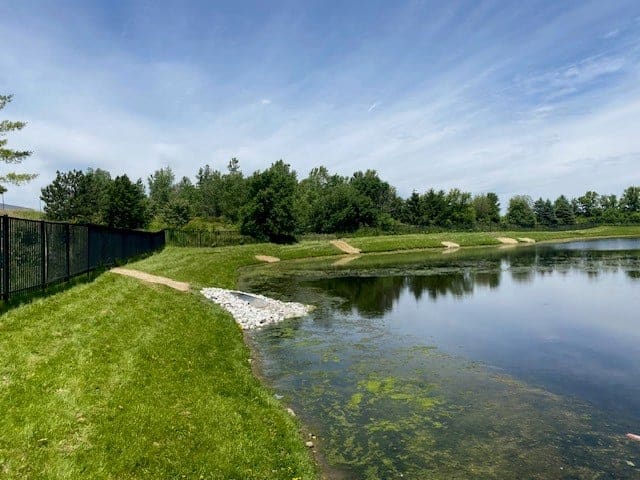
(c) A description of measures that will be installed to control pollutants in stormwater discharges that will occur after construction activities have been completed. Such practices include infiltration of run-off, flow reduction by use of open vegetated swales and natural depressions, buffer strip and riparian zone preservation, filter strip creation, minimization of land disturbance and surface imperviousness, maximization of open space, and stormwater retention and detention ponds.
(d) A sequence describing when each post-construction stormwater quality measure will be installed.
(e) Stormwater quality measures that will remove or minimize pollutants from stormwater run-off.
(f) Stormwater quality measures that will be implemented to prevent or minimize adverse impacts to stream and riparian habitat.
(g) A narrative description of the maintenance guidelines for all post-construction stormwater quality measures to facilitate their proper long term function. This narrative BMP description shall be made available to future parties who will assume responsibility for the operation and maintenance of the post-construction stormwater quality measures.
10.21.120 – Enforcement.
Enforcement of this chapter shall be subject to the severity of the infraction and the construction site operator’s efforts to comply. The city shall reserve the right to interpret enforcement on a case by case basis. Tiered enforcement will be practiced at the mayor’s discretion. The tiered enforcement may include:
(a) Verbal warning to the construction site operator to make corrections.
(b) Written warning to the construction site operator to make corrections within a specified period of time. The period of time shall take into account issues such as the severity of the problem, pending weather, seasonal conditions, and the level of effort necessary to correct the problem.
(c) Warning of noncompliance with directions to the construction site operator that site conditions require immediate action.
(d) Stop Work Order. If abatement of a violation and/or restoration of affected property is required, the notice shall set forth a deadline within which such remediation or restoration must be completed. Said notice shall further advise that, should the violator fail to remediate or restore within the established deadline, the work will be done by a designated governmental agency or a contractor and the expense thereof shall be charged to the violator.
View State Page
Frequently Asked Questions
How does Bloomington calculate a stormwater fee for non-residential properties?
Single-family residential customers pay a flat monthly base charge of $7.50. Non-SFR customers are billed based on their actual runoff, calculated by a formula tied to impervious area, but they never pay less than that same $7.50 base charge even if the calculation would come out lower. So the SFR rate effectively functions as a floor for every account in the stormwater service area, not just a residential default.
What does a post-construction SWP3 need to include in Bloomington?
The plan has to identify potential pollutant sources from the proposed land use, detail the location and specifications of every post-construction stormwater quality measure, and lay out the sequence for when each one gets installed. It also needs a narrative description of long-term maintenance guidelines, and that narrative specifically has to be made available to whoever takes over operation and maintenance responsibility down the line, so the documentation is built to outlive the original developer.
What's the pollutant-loading standard for new development in Bloomington?
Post-construction stormwater can’t carry more pollutant load than the site generated immediately before the planned land disturbance began. That baseline is measured against conditions right before construction started, not some earlier, undeveloped state of the land, so a site that was already partially developed doesn’t get held to a stricter “natural” standard than what actually existed before the current project.
How does Bloomington enforce stormwater violations on construction sites?
Enforcement is tiered and left to the mayor’s discretion based on the severity of the issue and how well the operator is cooperating. It typically starts with a verbal warning, moves to a written warning with a correction deadline, then a formal warning that site conditions need immediate action, and can escalate to a stop work order. If remediation is required and the deadline passes, the city can perform the work itself and bill the responsible party for the cost.
The information on this page is provided for general informational purposes only and is not legal advice. Regulations change frequently — AQUALIS makes no warranty as to the accuracy or completeness of this content, and any reliance on it is at your own risk. Consult a qualified professional or your local regulatory authority to confirm requirements applicable to your specific property.