

Last Updated 07/23/2026
Excerpt from Chesapeake Ordinance
Article VII Stormwater Management
Sec. 26-345. –Erosion and Stormwater management program established.
The guidelines for erosion and sediment control planning are those contained in the most recent edition of the Virginia Stormwater Management Handbook, and the conservation standards shall be used by the applicant making a submission under the provisions of this article in preparing his or her erosion and sediment control plans. The director, in considering the adequacy of such submitted plan, shall be guided by the same guidelines and standards.
Any plan approved prior to July 1, 2014, that provides for stormwater management intended to address any flow rate capacity and velocity requirements for natural or manmade channels shall satisfy the flow rate capacity and velocity requirements for natural or manmade channels if the practices are designed to:
(1) Detain the water quality volume and to release it over 48 hours;
(2) Detain and release over a 24-hour period the expected rainfall resulting from the one-year, 24-hour storm; and
(3) Reduce the allowable peak flow rate resulting from the 1.5-, two- and ten-year, 24-hour storms to a level that is less than or equal to the peak flow rate from the site assuming it was in a good forested condition, achieved through multiplication of the forested peak flow rate by a reduction factor that is equal to the runoff volume from the site when it was in a good forested condition divided by the runoff volume from the site in its proposed condition, and shall be exempt from any flow rate capacity and velocity requirements for natural or manmade channels, as defined in regulations promulgated pursuant to Virginia Code § 62.1-44.15:54 or 62.1-44.15:65.
For any land-disturbing activity approved on or after July 1, 2014, the flow rate capacity and velocity requirements of this subsection shall be satisfied by compliance with water quantity requirements in the Virginia Erosion and Stormwater Management Act (§ 62.1-44.15:24 et seq. of the Virginia Code) and attendant regulations, unless such land-disturbing activities are in accordance with the grandfathering provisions of the Virginia Erosion and Stormwater Management Program (VESMP) Permit Regulations
Sec. 26-349. - Long-term maintenance of permanent stormwater management facilities.
(a) The administrator shall require the provision of long-term responsibility for and maintenance of private stormwater management facilities and other techniques specified to manage the quality and quantity of runoff. Such requirements shall be set forth in an instrument recorded in the local land records prior to State Permit termination or earlier as required by the administrator and shall at a minimum:
(1) Be submitted to the administrator for review and approval prior to the approval of the stormwater management plan;
(2) Be stated to run with the land;
(3) Provide for all necessary access to the property for purposes of maintenance and regulatory inspections;
(4) Provide for inspections and maintenance and the submission of inspection and maintenance reports to the administrator; and
(5) Be enforceable by all appropriate governmental parties.
(b) At the discretion of the administrator, such recorded instruments need not be required for stormwater management facilities designed to treat stormwater runoff primarily from an individual residential lot on which they are located, provided it is demonstrated to the satisfaction of the administrator that future maintenance of such facilities will be addressed through an enforceable mechanism at the discretion of the administrator.
(c) If a recorded instrument is not required pursuant to subsection (b) above, the administrator shall develop a strategy for addressing maintenance of stormwater management facilities designed to treat stormwater runoff primarily from an individual residential lot on which they are located. Such a strategy may include periodic inspections, homeowner outreach and education, or any other method targeted at promoting the long-term maintenance of such facilities. Such facilities shall not be subject to the requirement for an inspection to be conducted by the administrator or designee.
Sec. 26-366. - Pesticides, herbicides, and fertilizers.
(a) Pesticides and herbicides.
(1) It shall be unlawful to use any pesticide or herbicide not approved by the U.S. Environmental Protection Agency (EPA).
(2) It shall be unlawful to use any pesticide or herbicide in a fashion not in accordance with manufacturer’s recommendations or label directions as approved by the U.S. Environmental Protection Agency (EPA).
(3) Use of any pesticide, herbicide, or fungicide, the manufacture of which has been either voluntarily discontinued, or has been prohibited by the Environmental Protection Agency, is prohibited, and the use thereof shall be unlawful.
(4) It shall be unlawful for any person to apply pesticide or herbicide in any right-of-way or public easement without written permission from the city. Pesticide use when permitted shall follow recommendations as listed in the current edition of the Virginia Pesticide Management Guide as published by the Virginia Cooperative Extension.
(b) Fertilizers. To avoid algae growth of water bodies and contamination of aquifers:
(1) Fertilizers shall be applied in a manner which does not exceed manufacturer’s recommendations for frequency and rate; and
(2) Fertilizers shall not be applied to impervious areas subject to runoff.
View State Page
Frequently Asked Questions
What is stormwater compliance in the City of Chesapeake?
Stormwater compliance in Chesapeake means following the City’s Virginia Stormwater Management Program (VSMP) and the Chesapeake Bay Preservation Act, which together set minimum requirements for how development and existing land uses manage runoff. Chesapeake sits within a coastal watershed where portions of the City fall within designated Preservation Areas with stricter protections for the Bay, its tributaries, buffer areas, and other state waters.
The City is the permitting authority for all land-disturbing activities and will only issue construction permits to projects with an approved stormwater management plan. Once construction is complete, property owners are responsible for maintaining all on-site stormwater control facilities. The City operates under the NPDES program and can inspect properties and issue a Notice of Violation for any deficiency found on site.
Who is responsible for long-term stormwater maintenance in Chesapeake?
For all private stormwater management facilities, the City requires a maintenance instrument, typically a recorded maintenance agreement, that must be filed in the local land records before the state stormwater permit is terminated. This instrument must run with the land, provide access for inspections and maintenance, require submission of inspection and maintenance reports to the City, and be enforceable by all appropriate governmental parties.
Because it is recorded with the land, this obligation transfers to every future owner of the property. If you purchased a property with stormwater facilities and were not made aware of the maintenance agreement at closing, the obligation is still yours. AQUALIS can locate your recorded instrument, assess the current condition of your facilities, and build a maintenance program that keeps you in compliance.
How often does Chesapeake inspect stormwater facilities?
The City conducts post-construction inspections of stormwater management facilities at minimum once every five years under its state-approved inspection program. Inspections may also occur during construction at multiple stages, including for compliance with the approved erosion and sediment control plan, the stormwater management plan, the pollution prevention plan, and any TMDL-related control measures.
The City may also enter your property at reasonable times to conduct inspections, obtain information, or initiate corrective actions if a permittee has failed to act after proper notice. AQUALIS recommends conducting your own annual inspections so any issues are identified and addressed well before the City’s five-year inspection cycle arrives.
What are the penalties for stormwater violations in Chesapeake?
Virginia law sets the civil penalty ceiling at $32,500 per day per violation. Each day of violation of each requirement is a separate offense. The court considers the degree of harm caused and the economic benefit the violator gained from noncompliance.
Misdemeanor charges. Willful or negligent violations can result in up to 12 months in jail and fines between $2,500 and $32,500.
Felony charges. Knowingly violating the ordinance in a way that places another person in imminent danger of death or serious bodily harm carries 2 to 15 years imprisonment and fines up to $250,000 for individuals. For businesses, the fine can reach the greater of $1,000,000 or three times the economic benefit gained from the offense. Those maximums double for a second conviction.
Stop work orders and permit revocation. If a permittee fails to comply with a notice within the specified time, the administrator can issue a stop work order or revoke the permit outright.
Emergency orders. If a violation presents an imminent and substantial danger of causing harmful erosion or sediment discharge, the City can post an emergency order at the site directing an immediate stop to all land-disturbing activities without advance notice or hearing.
Can stormwater fees be reduced in Chesapeake?
Yes. The City of Chesapeake collects stormwater fees twice a year and offers fee credits for non-residential properties that implement qualifying Best Management Practices (BMPs). By actively managing stormwater runoff on your property, you reduce the burden on the City’s public stormwater system and may qualify for a reduction in your utility fee assessment.
AQUALIS can review your property’s existing stormwater facilities and help determine whether they qualify for credits under Chesapeake’s program. Maintaining your BMPs in good working condition is also typically a requirement to retain any credits you have already earned.
How do I know if my Chesapeake stormwater system is at risk of failure or safety violation?
Watch for these warning signs.
No maintenance agreement on file or unknown status. Every private stormwater facility in Chesapeake is required to have a maintenance instrument recorded in the land records. If you cannot locate yours or are unsure whether one was recorded, that is an active compliance gap.
Your five-year inspection is approaching or overdue. The City inspects all stormwater facilities at least every five years. Knowing the condition of your system before the City arrives gives you time to address any deficiencies without facing enforcement action.
Water is not draining after rain. Standing water more than 72 hours after a storm suggests your stormwater facilities are not functioning as designed.
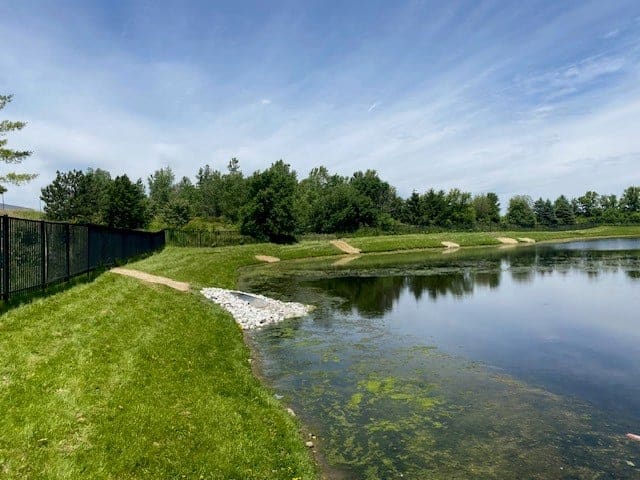
Visible deterioration in BMPs. Sediment accumulation in detention ponds, overgrown or failing vegetation in bioretention areas, clogged sand filters, and structural damage are all signs maintenance is overdue and put you at risk during a City inspection.
Your property is in a Chesapeake Bay Preservation Area. If your property falls within a designated Preservation Area, additional protections and requirements apply beyond the standard VSMP program. If you are unsure whether your property is in a Preservation Area, that is worth confirming before any development, redevelopment, or maintenance activity begins.
The information on this page is provided for general informational purposes only and is not legal advice. Regulations change frequently — AQUALIS makes no warranty as to the accuracy or completeness of this content, and any reliance on it is at your own risk. Consult a qualified professional or your local regulatory authority to confirm requirements applicable to your specific property.