

Last Updated 08/11/2026
The City of Cordele has enacted a Stormwater Ordinance in order to establish minimum stormwater management requirements and controls to protect and safeguard the general health, safety, and welfare of the public residing in watersheds within this jurisdiction. The City of Cordele is the permitting authority for all land disturbing activities and requires the land owner to maintain all on-site stormwater control facilities and all open space areas (e.g. parks or “green” areas) required by the approved stormwater control plan. The City of Cordele will only provide construction permits to projects that establish a plan to manage stormwater runoff occurring during the construction process. The City of Cordele, under the NPDES program, also has the authority to inspect properties for noncompliance and can issue a notice of violation (NOV) for any deficiency or infraction onsite. Property owners are responsible for the maintenance of any stormwater facilities or practices located on the property. The City of Cordele has the authority to inspect stormwater facilities and practices in order to ascertain that they are properly maintained and functioning.
Cordele Municipal Code
Sec. 18-437. – Stormwater local design manual.
The city will utilize the policy, criteria and information including technical specifications and standards in the latest edition of the LDM, for the proper implementation of the requirements of this article. The LDM may be updated and expanded periodically, based on improvements in science, engineering, monitoring and local maintenance experience.
(Ord. No. 0-06-19, 11-7-06)
Sec. 18-439. – Requirements for stormwater management plan.
All stormwater management plans submitted to the city shall be submitted in accordance with the provisions as outlined in this article and the LDM. A statement prepared by the design professional to this effect shall accompany and be made a part of any plan or any revision thereto.
The stormwater management plan shall be prepared under the supervision of, and certified by, a professional engineer, professional land surveyor, or registered landscape architect with competency in hydrology and hydraulics, currently registered in the state. The plan shall conform to the requirements of this article.
Upon receipt of the stormwater management plan, the city shall perform appropriate reviews, and shall either approve the stormwater management plan or return comments and reasons for rejection.
(Ord. No. 0-06-19, 11-7-06)
Sec. 18-440. – Permit procedures and requirements.
(a) Permit application requirements. No owner or developer shall perform any land development activities without first meeting the requirements of this article prior to commencing the proposed activity. Unless otherwise exempted by this article, or granted a waiver to meeting the minimum requirements outlined in the LDM, a site development permit application shall be accompanied by the following items in order to be considered:
1. Stormwater concept plan and consultation meeting certification if required by the city;
2. Stormwater management plan;
3. Inspection and longterm maintenance agreement;
4. Performance bond, if applicable; and,
5. Site development permit application and applicable review fees.
(b) Stormwater concept plan and consultation meeting. Projects shall require a stormwater concept plan and consultation prior to submittal of design plans for review by the city manager. The stormwater concept plan shall meet the requirements outlined in the LDM. For the purposes of this section, any proposed development activity that meets any of the following criteria shall be required to perform a stormwater concept plan and consultation meeting prior to submittal of engineering plans for review.
(1) Any residential subdivision with greater than one hundred (100) lots, unless such development contains two-acre or greater lots.
(2) Any nonresidential development with a new disturbed area of five thousand (5000) square feet or greater.
(3) Any nonresidential development regardless of size which has an impervious surface coverage that covers fifty (50) percent or more of the property excluding those lands contained within undisturbed buffers including, but not limited to, floodplains, stream buffers and undisturbed buffers between dissimilar zonings.
(4) Any nonresidential development regardless of size which is defined as a hot spot land use or activity.
(c) Stormwater management plan requirements. A stormwater management plan must be submitted in accordance with the LDM.
(d) Modifications for off-site facilities. The stormwater management plan for each land development project shall provide for stormwater management measures located on the site of the project, unless provisions are made with the city to manage stormwater by an off-site, or regional facility. The off-site or regional facility:
(1) Must be located on property legally dedicated for the purpose,
(2) Must be designed and adequately sized to provide a level of stormwater quantity and quality control that is equal to or greater than that which would be afforded by on-site practices, and
(3) There must be a city-approved, legally-obligated entity responsible for long-term operation and maintenance of the off-site or regional stormwater facility. In addition, on-site measures shall be implemented, where necessary, to address stormwater management issues upstream and downstream from the development site to the off-site or regional facility.
A stormwater management plan must be submitted to the city which shows the adequacy of the off-site or regional facility.
To be eligible for a modification, the applicant must demonstrate to the satisfaction of the city that the use of an off-site or regional facility will not result in the following impacts to upstream or downstream areas:
(1) Increased threat of flood damage to public health, life, and property;
(2) Deterioration of existing culverts, bridges, dams, and other structures;
(3) Accelerated stream bank or streambed erosion or siltation;
(4) Degradation of in-stream biological functions or habitat; or
(5) Water quality impairment in violation of state water-quality standards, and/or violation of any state or federal regulations.
(Ord. No. 0-06-19, 11-7-06)
Sec. 18-441. – Post-development stormwater management performance criteria.
The following performance criteria shall be applicable to all stormwater management plans, unless otherwise provided for in this article per the submission of a statement of compliance with state and federal regulations prepared by a design professional.
(1) Water quality. Stormwater runoff generated from a site shall be adequately treated before discharge. It will be presumed that a stormwater management system complies with this requirement if:
a. The system is sized for the volume from the site, as defined in the LDM;
b. Appropriate structural stormwater controls or nonstructural practices are selected, designed, constructed and preserved in accordance with the specific criteria in the LDM; and, runoff from hotspot land uses and activities identified in the LDM are adequately treated and addressed through the use of appropriate structural stormwater controls, nonstructural practices and pollution prevention practices identified in the LDM.
(2) Stream channel protection. Protection of stream channels from bank and bed erosion and degradation shall be provided by using the following approaches:
a. Preservation, restoration and/or reforestation (with native vegetation) of the applicable stream buffer; and, erosion prevention measures such as energy dissipation and velocity control; and
b. All design and construction work that is undertaken proximate to stream channels (including the buffer areas) shall be in strict conformance with current local, state and federal regulations.
(3) Flood protection. Flood and public safety protection shall be provided by controlling and safely conveying storm events such that flooding is not exacerbated for the storm events specified in the LDM and in accordance with applicable requirements of this article.
(4) Drainage system guidelines. A system emphasizing a natural, as opposed to an engineered, drainage strategy shall be encouraged. The applicability of a natural approach depends upon such factors as site storage capacity, open channel hydraulic capacity, maintenance needs/resources and regulatory permitting factors. Stormwater conveyance facilities may include but are not limited to culverts, stormwater drainage pipes, catch basins, drop inlets, junction boxes, headwalls, gutters, swales, channels, ditches, and energy dissipaters shall be provided when necessary for the protection of public and private properties adjoining project sites. Stormwater conveyance facilities that are designed to carry stormwater runoff from more than one (1) parcel, existing or proposed, shall meet the following requirements:
a. Methods to calculate stormwater flows shall be in accordance with the LDM;
b. All culverts, pipe systems and open channel flow systems shall be sized in accordance with the stormwater management plan using the methods included in the LDM; and,
c. Design and construction of stormwater conveyance facilities shall be in accordance with the criteria and specifications found in the LDM.
(Ord. No. 0-06-19, 11-7-06)
Sec. 18-442. – Maintenance of facilities.
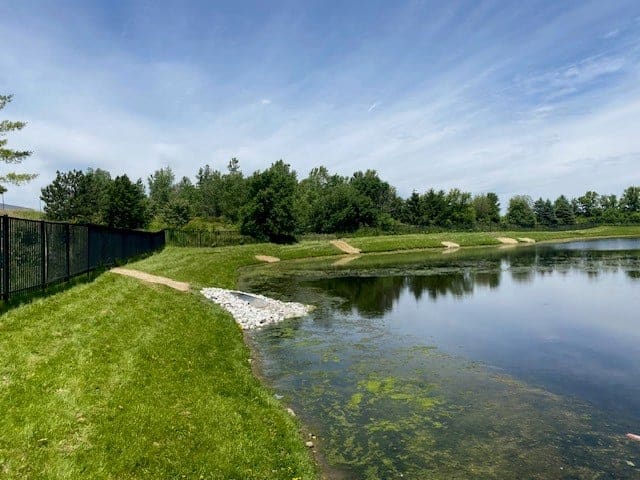
Stormwater detention facilities which are owned by the city are deemed to be an essential and integral part of the city stormwater management program and detention facilities known as “stormwater holding ponds” may be maintained by the city. Stormwater management facilities known as “holding ponds” owned by others which are built to satisfy this article may be maintained by the city, provided the owners thereof shall meet the requirements of all of the provisions of this article. No stormwater detention/retention facility shall be accepted for maintenance by the city until the owner provides an fee simple warranty deed conveying the holding pond to the city, and providing to the city in said warranty deed a description of a twenty-foot permanent, non-exclusive easement for access to and from said holding pond. The fee simple warranty deed shall be accompanied by two (2) recordable plats signed by a certified land surveyor or engineer, and such plat shall be referred to as a part of the legal description of the deed.
An inspection and maintenance agreement shall be executed for all private on-site stormwater management facilities prior to approval of the final plat. Such agreement shall be in form and content acceptable to the city, and shall provide that all inspection, maintenance and repair procedures of such facilities shall be the responsibility of the property owner. Such agreement shall provide for access to the facility by virtue of a nonexclusive perpetual easement in favor of the city at reasonable times for regular inspection and/or maintenance by the city.
The agreement shall provide that preventive maintenance inspections of infiltration systems, retention, or detention structures may be made by the city, at its option.
The agreement shall provide that if, after an inspection, the condition of a facility presents an immediate danger to the public health, safety or general welfare because of unsafe conditions or improper maintenance, the city shall have the right, but not the duty, to take such action as may be necessary to protect the public health, safety, general welfare and adjacent properties from damage. If it is determined that such deficient conditions are the result of neglected maintenance, or other action caused by the property owner, then any cost incurred by the city shall be paid by the property owner.
The maintenance agreement shall be recorded by the property owner in the land records of Crisp County, Georgia prior to approval of the final plat.
The agreement shall provide that the city shall notify the property owner(s) of the facility of any violation, deficiency or failure to comply with this article. The agreement shall also provide that upon a failure to correct violations requiring maintenance work, within thirty (30) days after notice thereof, in writing, the city may provide for all necessary work to place the facility in proper working condition. The owner(s) of the facility shall be assessed the costs of the work performed by the city pursuant to this subsection, and there shall be a lien on all property of the owner, which lien, when filed in the county real estate records, shall have the same status and priority as liens for nonpayment of ad valorem taxes. Should such a lien be filed, portions of the affected property may be released by the city following the payments by the owner of such portion of the property of such owner’s pro-rata share of the lien amount based upon the acreage to be released with such release amount to be determined by the city commission.
(Ord. No. 0-06-19, 11-7-06; Ord. No. 0-08-02, 2-19-08)
Sec. 18-443. – Inspection.
The city manager shall be responsible for determining whether a development is proceeding in accordance with the approved stormwater management plan. Periodic inspection of the development site shall be made by the city manager to ensure that the stormwater management plan is properly implemented.
Upon completion of the construction phase on the project, and prior to approval of the final plat the developer shall provide an as-built survey and an as-built design certification for each stormwater management facility. A certified record drawing of the facility shall be prepared based upon this as-built survey and certified by the design professional who prepared the stormwater management plan. Based on the actual parameters established on the record drawing, an addendum to the stormwater management plan shall be prepared which demonstrates that the facility, as constructed, complies with the requirements of the approved stormwater management plan.
Following final plat approval, the city manager may conduct periodic inspections of the stormwater facility. Inspection reports including documented deficiencies and needed maintenance requirements will be included on the inspection reports and provided to the property owner to undertake appropriate action.
(Ord. No. 0-06-19, 11-7-06)
View State Page
Frequently Asked Questions
Which Cordele development projects need a stormwater concept plan before design review?
Not every project does, but several triggers require one. A residential subdivision exceeding 100 lots, unless the lots run two acres or larger, needs it, as does any nonresidential development disturbing 5,000 square feet or more. Nonresidential projects also trigger the requirement regardless of size if impervious surface covers 50% or more of the property outside protected buffers, or if the use is classified as a stormwater hotspot. Any of these means a concept plan and consultation meeting with the city manager has to happen before engineering plans go in for review.
Can a Cordele development manage stormwater off-site instead of building an on-site system?
Yes, but the bar is specific. The off-site or regional facility has to sit on property legally dedicated for that purpose, be sized to provide quantity and quality control equal to or better than on-site practices would, and have a city-approved entity legally obligated to operate and maintain it long-term. The applicant also has to demonstrate the arrangement won’t increase flood risk, degrade existing culverts or bridges, accelerate stream erosion, or violate state water quality standards upstream or downstream.
How does Cordele handle ownership and maintenance of a stormwater holding pond?
The city will only accept a holding pond for its own maintenance after the owner conveys it by fee simple warranty deed, along with a 20-foot permanent, non-exclusive access easement, and provides two recordable plats confirming the description. Short of that transfer, every private on-site facility needs a recorded inspection and maintenance agreement putting inspection, maintenance and repair responsibility on the property owner, with the city retaining a nonexclusive perpetual easement for its own periodic inspections.
What happens if a Cordele stormwater facility isn't maintained?
The city notifies the owner in writing of any violation or deficiency, and if it isn’t corrected within 30 days, the city can perform the necessary work itself and bill the owner for the cost. That cost becomes a lien on the owner’s property with the same priority as unpaid ad valorem taxes. If the facility poses an immediate danger to public health or safety, the city can also step in right away to protect adjacent properties, and if the deficiency traces back to the owner’s neglect, that cost gets passed along too.
The information on this page is provided for general informational purposes only and is not legal advice. Regulations change frequently — AQUALIS makes no warranty as to the accuracy or completeness of this content, and any reliance on it is at your own risk. Consult a qualified professional or your local regulatory authority to confirm requirements applicable to your specific property.
Did you receive an NOV? Have an urgent need? We can help.
Notices of Violation (NOVs) or Corrective Notices should be taken seriously. Contact AQUALIS today to learn how to resolve the issue and comply with regulations.