


Last Updated 08/14/2026
Fargo Stormwater Laws and Regulations
Excerpt- Fargo code of Ordinances
37-0101. – Purpose.
This chapter sets forth uniform requirements for storm water management systems within the city of Fargo. In the event of any conflict between the provisions of this chapter or other regulations adopted by the city of Fargo, Cass County, State of North Dakota or Federal authorities, the more restrictive standard prevails. The objectives of this chapter are as follows:
A. To promote, preserve, and enhance the natural resources within the city of Fargo from adverse or undesirable impacts occasioned by development or other activities;
B. To protect and promote the health, safety, and welfare of the people and property through effective storm water quantity and quality management practices.
C. To regulate land development activity, land disturbing activity, or other activities that may have an adverse and/or potentially irreversible impact on storm water quantity, water quality and/or environmentally sensitive lands and to encourage compatibility between such uses;
D. To establish detailed review standards and procedures for land development activities throughout the city of Fargo, thereby achieving a balance between urban growth, development, and the protection of water quality; and
E. To provide for adequate storm water system analysis and design as necessary to protect public and private property, water quality and existing natural resources.
ARTICLE 37-02 – PERMANENT STORM WATER MANAGEMENT
An owner must submit to the city engineer a plan for storm water management and control including detention and retention facilities. The plan shall be submitted, and approval obtained from the city engineer prior to the owner (a) obtaining approval of an application for a plat, pursuant to §20-0907 of the Land Development Code of the city, or (b) engaging in any land disturbing activity. Said plan may include, in the discretion of the city engineer, arrangements for further planning and implementation of permanent facilities for storm water management and control by subsequent owners of the property being platted or by the current owner at a later time. Plans submitted for review shall at a minimum contain the total acreage of the development, total impervious area being added by the improvement, and a calculation showing the water detention/retention capacity of the facility. Construction of one or two dwelling unit buildings [E1]shall be exempt from the requirements of this article. Projects administered by the city engineering department that include storm water facilities shall be designed under the guidance of the city engineer and shall be approved by a registered professional engineer, but shall be exempt from the requirements of this section.
37-0202. – Methodologies and computations.
Storm water control facilities and erosion/sediment control features shall be designed in conformance with the city’s storm water management and control policy approved by resolution of the board of city commissioners.
37-0203. – Operation, maintenance and inspection.
All storm water management systems shall be designed to minimize the need for maintenance, to provide easy vehicle (typically eight (8) feet or wider) and personnel access for maintenance purposes, and to be structurally sound. All storm water management systems shall have a plan of operation and maintenance that assures continued effective removal of pollutants carried in storm water runoff. The city engineer may inspect all public and private storm water management systems at any time. Inspection records will be kept on file at the city engineer’s office. It shall be the responsibility of the applicant to obtain any necessary easements or other property interests to allow access to the storm water management system for inspection and maintenance purposes.
37-0204. – Easements.
Easements may be required as conditions to the issuance of an erosion and sediment control permit. If a storm water management system involves directing some or all of the site’s runoff to a drainage easement, the applicant or his designated representative shall obtain from the property owners any necessary easements or other property interests concerning the flowing of such water.
37-0205. – Record drawings.
The owner shall provide the city engineer notice, in writing, any changes or material modifications to the original permitted design in the form of as-built, or record, drawings. The record drawings shall contain the final configuration for all improvements as constructed. A professional engineer registered in the state shall certify the record drawings. If no significant or material changes occurred between the approved plan and final construction, the record drawings need not be submitted to the city engineer. The owner, however, is responsible to retain copies of said drawings and provide them to the city engineer upon request. Failure to provide these drawings upon written request constitutes a violation of this chapter.
37-0403. – Violations.
All of the following represent violations of this chapter and of law and will be subject to the remedies and penalties provided in this article, the Fargo Municipal Code and state law, where applicable. The city includes the extraterritorial zoning jurisdiction of the city as provided in Section 37-0104.
A. Land disturbing activity without required permit or approval. No person shall initiate within the city any land development activity, land disturbing activity, or other activity resulting in an increase in storm water quantities, degradation of storm water quality, or restriction of flow in any storm sewer system, open ditch or natural channel, storm water easement, water body, or wetland outlet, without having first complied with the terms of this chapter.
B. Authorities inconsistent with requirements. No person shall engage in land disturbing activities on an owner’s land in contravention of the plans set forth in an approved SWPPP, an erosion and sediment control permit, any conditions for such plan or permit, any provision of this chapter or any other term, condition, or qualification imposed by city engineer, or other decision-making body, imposed or stated as part of a permit, certificate, or other form of authorization. This section applies to all persons including owners, their contractors and any utility companies or their contractors engaging in land disturbing activities.
C. Permanent facilities inconsistent with requirements. It is a violation of this article to erect, construct, reconstruct, remodel, alter, maintain, move, or use any permanent storm water management or control facility in violation or contravention of this chapter or of an approved plan as provided in this chapter.
D. No person shall cause a prohibited discharge within the city.
E. The owner shall cause to be removed sediments transported or tracked from owner’s land onto city streets by vehicles or construction traffic before the end of the each work day and failure to do so shall be a violation of this chapter.
F. As to construction activities on owner’s land, the owner shall comply with the requirements of the erosion and sediment control permit, and with the following, and failure to do so shall be a violation of this chapter:
- Site dewatering. Water pumped from the site shall be treated by temporary sedimentation basins, grit chambers, sand filters, upflow chambers, hydro-cyclones, soil concentrators, sediment bags or other appropriate controls as approved by the city engineer. Water may not be discharged in a manner that causes erosion, sedimentation, or flooding on the site, on downstream properties, in the receiving channels, or in any wetland.
- Waste and material disposal. All waste and unused building materials (including garbage, debris, cleaning wastes, wastewater, petroleum based products, paints, concrete or concrete wash water, toxic materials, or other hazardous materials) shall be properly disposed of off-site and shall not be allowed to be carried by runoff into a receiving channel, storm sewer system, or wetland.
- Tracking management. The use of clay or other cohesive soils to construct access roads or ramps over curbs or onto paved streets shall not be allowed.
- Water quality protection. The construction contractor, including the general contractor and all subcontractors, shall be required to control oil and fuel spills and chemical discharges to prevent such spills or discharges from entering any watercourse, sump, sewer system, water body, or wetland.
H. One or two dwelling unit building. Construction of a one or two dwelling unit building must comply with in-place BMPs and any existing permitted SWPPP for the subdivision, including NPDES permit requirements and failure to do so shall be a violation of this chapter.
I. Utility service lines. Utility companies or contractors working in a street right-of-way to repair existing or install new utilities that involve land disturbing activities shall obtain an excavation permit from the city engineer, in accordance with Chapter 18 of the Fargo Municipal Code. With respect to utility companies that are working in a street right-of-way and are engaging in land disturbing activities, in addition to the requirements of Chapter 18, including the obligation of obtaining an excavation permit, the excavation permittee shall implement storm water protection measures and utilize construction methods to minimize the potential for sediment or other contaminants to enter the city’s storm sewer system. The utility company or contractor shall provide street sweeping as necessary to prevent sediments from their activities from entering the storm sewer system. All sediments or other materials shall be removed from the site within one working day of completion of utility installation on the site. All disturbed vegetation shall be replaced with seed or sod within seven (7) days of completion of utility installation on the site or other appropriate means of erosion and sediment control shall be implemented and maintained until the restoration is complete. All seeded or sodded areas shall be maintained by the utility company or contractor until vegetation is established except in the case of a utility repair for a private residence. For utility repairs to private residences the homeowner shall be responsible for the maintenance of vegetation until it is established. The contractor shall provide the homeowner with a “Sediment and Erosion Control for New Homeowners” fact sheet from the ND State Health Department. The city will make available guidelines for acceptable temporary protection BMPs until the requirements for final stabilization are met.
J. Illicit connections. Storm water systems are designed to carry uncontaminated storm water. Legal connection to the city’s storm water system includes sump pumps lawfully connected to the storm sewer system under chapter 17, and uncontaminated storm water conveyances (such as roof drains). All other connections shall be considered illicit connections and therefore constitute a prohibited discharge and a violation of this chapter.
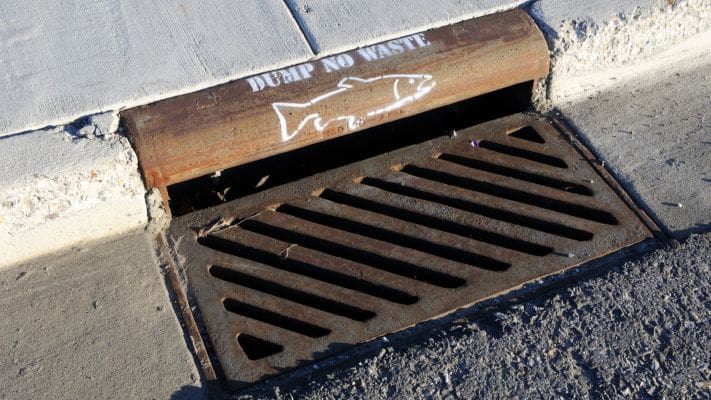
K. Illicit dumping. The dumping or disposal of debris materials such as grass clippings, vegetative materials, tree branches, stumps, earth fill, rocks, concrete chunks, metal, other demolition or construction materials, or structures, any chemicals, or other materials that could degrade the quality of waters within the system by dumping in a manner that allows them to come into contact with storm water is prohibited. It is a violation of this chapter to allow such a discharge to occur.
37-0404. – Management of site vegetation.
All landowners shall provide for the installation and maintenance of vegetation on their property as follows regardless as to whether or not an erosion and sediment control permit has been approved or is necessary under this chapter and failure to do so shall be a violation of this chapter. All unimproved areas shall be covered either by plants or vegetative growth or, in the alternative, by other means of storm water protection approved by the city engineer. The term unimproved area means all areas other than driveways, sidewalks, patios, areas occupied by structures and landscaped areas.
37-0405. – Enforcement procedures.
The following enforcement procedures shall apply to violations of this article, in addition to the procedures set forth in Article 1-04 pertaining to administrative enforcement.
A. Non-emergency matters. In the case of violations of this article that do not constitute an emergency, the city engineer may:
- Issue a notice of violation;
- Issue an administrative order; or,
- Issue an administrative order with fine;
All notices and orders shall be issued to the property owner and to any other person who is alleged to be in violation of this article or of the terms of any permit or condition granted and to any applicant for any relevant permit.
B. Emergency matters. In the case of violations of this article that do constitute an emergency situation, the city shall use all remedies, penalties and enforcement powers available under this article without prior notice, but the city engineer must send notice simultaneously with beginning enforcement action to the property owner, to any other person who is party to the agreement and to applicants for any relevant permit and must advise persons affected by the action taken that a hearing will be held within seven days from the date of such action. At the hearing, the administrative enforcement board will determine whether there were appropriate grounds for the action taken, and whether the action taken should continue.
C. Administrative compliance orders—Procedure. Persons receiving an administrative order or an administrative order with fee shall have 10 days, or such longer period as the city engineer allows, to correct the violation. If the violation is not corrected within the required time-frame, the city engineer and city attorney shall use all penalties, remedies and enforcement powers available under this article. Any notice or order issued by the city engineer must be given in the manner required by the administrative enforcement ordinance, Article 1-04 of the Fargo Municipal Code.
D. Administrative compliance order with fee/administrative complaint or citation—Procedure. The city engineer shall include in the administrative complaint the amount of administrative fee to be paid by the person against whom the citation or complaint is issued. The authorized city employee or representative issuing the administrative citation need not issue an administrative order before issuing an administrative complaint.
E. Order to show cause—Hearing. In the event the city engineer has issued an administrative order or an administrative order with fee, if the violation is not corrected by timely compliance, the city engineer may order any person who causes or allows an unauthorized discharge to show cause before the administrative enforcement board why sewer service should not be shut off. A notice shall be served on the offending party, specifying the time and place of a hearing to be held by the administrative enforcement board regarding the violation, and directing the offending party to show cause before said board why an order should not be made directing the shut off of service. The notice of the hearing shall be served personally or by registered or certified mail (return receipt requested) at least 10 days before the hearing in accordance with the provisions of Article 1-04. The hearing before the administrative enforcement board shall be held in the same manner, and under the same rules and procedures as provided in Article 1-04.
View State Page
Frequently Asked Questions
Do I need a permanent stormwater management plan before my subdivision plat is approved in Fargo?
Yes. A permanent stormwater management plan must be submitted to the City Engineer before plat approval, including the total acreage of the development and the total impervious area being added.
Are all properties in Fargo required to have permanent stormwater facilities?
Most are, but one and two dwelling unit residential buildings are exempt from permanent facility requirements.
What records do I need to keep for my stormwater facility in Fargo?
If significant modifications are made to a facility, record drawings certified by a registered professional engineer are required. Owners must retain copies of these records and provide them upon written request. Failure to do so is itself a violation.
What happens if I violate Fargo's stormwater ordinance?
The city can issue a notice of violation, pursue administrative orders with or without fines, and shut off service for continued non-compliance. In urgent situations, the city can take emergency enforcement action without prior notice, though a hearing must be held within 7 days.
How can AQUALIS help with stormwater compliance in Fargo?
AQUALIS helps property owners develop the operations and maintenance plans and access easements Fargo’s permanent facility requirements call for, maintains record drawings and documentation for city requests, manages vegetation and sediment control obligations, and helps resolve notices of violation within the city’s correction window.
The information on this page is provided for general informational purposes only and is not legal advice. Regulations change frequently — AQUALIS makes no warranty as to the accuracy or completeness of this content, and any reliance on it is at your own risk. Consult a qualified professional or your local regulatory authority to confirm requirements applicable to your specific property.