

Last Updated 08/17/2026
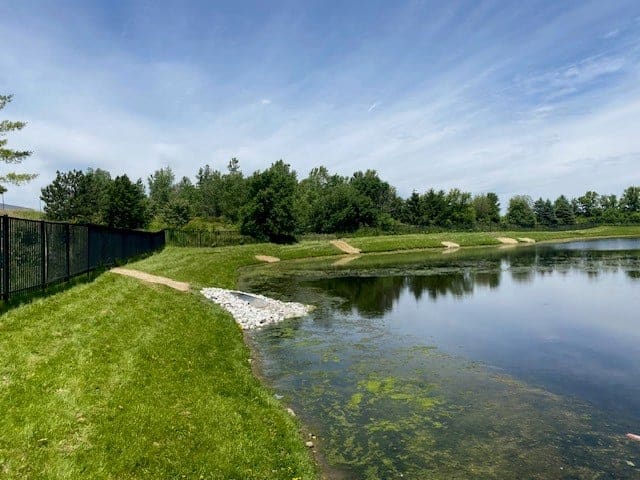
The City of Lenexa, Kansas, has created a stormwater management program that treats stormwater as a community asset rather than a problem. The City’s innovative program, “Rain to Recreation” has become a model for other communities throughout the country. It is an environmentally sound approach that balances flood control needs and federal regulatory requirements with citizens’ desire for recreational opportunities and preservation of the natural environment. The program developed an innovative and stable funding package which consists of a 1/8 cent sales tax, a stormwater utility fee, and a capital development charge.
In 1998, the City began developing the new stormwater management program. Several factors occurred during that year that highlighted the need for such a program. First, a major storm hit the Kansas City area, causing flooding and loss of life. Although Lenexa generally did not have major flooding issues, the city was not spared during this storm.
Second, development of previously untouched areas began, at an accelerated pace. And third, it became clear that the City, along with hundreds of other cities, would be subject to the National Pollutant Discharge Elimination System (NPDES) Phase II of the Clean Water Act.
The Watershed Management Plan provided direction in the form of policies, practices, and projects. In the early years of the Program, staff concentrated on incorporating watershed principles and practices into development planning and review and in providing guidance for the development community. The City adopted an Erosion and Sediment Control ordinance in 2001 to protect streams and waterways during the rapid development movement in western Lenexa. In 2002, Lenexa became the first city in the Kansas City Metropolitan area to adopt a Stream Setback Ordinance. This ordinance defines streams by an environmental condition rating and stream order to determine setback distances and introduces another innovative approach to environmental management, supporting quality of life issues.
The City also initiated and collaborated with the Kansas City Chapter of the American Public Works Association (APWA) and the Mid America Regional Council (MARC) to develop regional standards related to water quality. As a result, two products were developed and adopted by APWA in November 2003. The first product was a revised APWA Section 5600 Storm Drainage Systems and Facilities Design Criteria with emphasis on open conveyance and stream protection strategies. The second was a Manual of Best Management Practices (BMPs) for Stormwater Quality. The Lenexa City Council adopted both APWA products in April 2004, the first municipality in the metropolitan area to do so.
Excerpt from Stormwater Ordinance
Section 4-5-E-8 PUBLIC AND PRIVATE RESPONSIBILITIES.
- Public Responsibilities:
- Administration: The administration of these regulations shall be the responsibility of the Community Development Director, who shall review and approve stormwater management plans as provided herein.
- Operation And Maintenance Of the Public Stormwater Management System: The City shall be responsible, during and after construction, for the Operation and Maintenance of the Public Stormwater Management System.
- Private Responsibilities:
- Each developer of land within the City has the responsibility to provide on the developer’s property all approved stormwater runoff management facilities to ensure the adequate drainage and control of stormwater on the developer’s property both during and after construction of such facilities.
- Each developer or owner has the responsibility and duty before and after construction to properly operate and maintain any on-site stormwater runoff control facility which has not been accepted for maintenance by the City. Such responsibility is to be transmitted to subsequent owners through appropriate covenants or maintenance agreements as detailed in this Article.
- The City Council, in its sole discretion, may accept dedication of any existing or future Stormwater Management Facility for maintenance, provided such facility meets all the requirements of this Article and includes adequate and perpetual access and sufficient area, by easement or otherwise, for regular inspection and maintenance. Upon acceptance the Stormwater Management Facility shall become part of the Public Stormwater Management System.
View State Page
Frequently Asked Questions
What makes Lenexa's stormwater program different from most cities' approach?
Lenexa built its “Rain to Recreation” program to treat stormwater as a community asset rather than just a problem to manage, funding it through a combination of a 1/8 cent sales tax, a stormwater utility fee and a capital development charge. That funding structure was a direct response to 1998, when a major storm hit the Kansas City area, rapid development was accelerating in western Lenexa, and the city knew it would soon fall under NPDES Phase II requirements. It’s become a model other communities look to, largely because it balances flood control and regulatory compliance with recreational and environmental goals rather than treating them as competing priorities.
Who's responsible for maintaining a private stormwater facility in Lenexa?
The developer or property owner is, both before and after construction, for any on-site facility the city hasn’t formally accepted for maintenance. That obligation doesn’t disappear at a sale either: it has to be transmitted to subsequent owners through covenants or maintenance agreements. The City Council can accept a facility for public maintenance at its sole discretion, but only if it meets every requirement in the ordinance, including perpetual access and enough easement area for regular inspection and upkeep.
Does Lenexa have design standards beyond the standard Kansas City metro stormwater rules?
Yes, and the city has been ahead of the curve on several of them. Lenexa adopted an Erosion and Sediment Control ordinance in 2001 to protect streams during its rapid western development, and became the first city in the Kansas City metro to adopt a Stream Setback Ordinance in 2002, which sets setback distances based on a stream’s environmental condition rating and order. Lenexa was also the first municipality in the metro area to adopt the region’s APWA Section 5600 Storm Drainage Systems design criteria and its BMP manual for stormwater quality, both in April 2004.
What triggers a stormwater management plan review in Lenexa?
Any development on private property requires the developer to provide, on their own land, all the approved stormwater runoff management facilities needed for adequate drainage and control, both during and after construction. The Community Development Director administers this review and approval process directly, so a project’s stormwater plan has to clear that office before construction can proceed.
The information on this page is provided for general informational purposes only and is not legal advice. Regulations change frequently — AQUALIS makes no warranty as to the accuracy or completeness of this content, and any reliance on it is at your own risk. Consult a qualified professional or your local regulatory authority to confirm requirements applicable to your specific property.