

Last Updated 08/20/2026
Section 26: Illicit Discharges to Municipal Separate Storm Sewer System
26.1 Purpose
The purpose of the bylaw is to eliminate non-stormwater discharges to the Town of Framingham’s municipal separate storm sewer system. Non-stormwater discharges contain contaminants and supply additional flows to the Town’s storm drain system. Both increased and contaminated stormwater runoff are major causes of:
- impairment of water quality and flow in lakes, ponds, streams, rivers, wetlands and groundwater;
- contamination of drinking water supplies;
- alteration or destruction of aquatic and wildlife habitat; and
- flooding.
Regulation of illicit connections and discharges to the municipal separate storm sewer system is necessary for the protection of the Town of Framingham’s natural resources, municipal facilities, and to safeguard the public health, safety, welfare and the environment.
The objectives of the bylaw are:
- To prevent pollutants from entering the Town’s municipal separate storm sewer system (MS4);
- To prohibit illicit connections and unauthorized discharges to the MS4;
- To require the removal of all such illicit connections;
- To comply with state and federal statutes and regulations relating to stormwater discharges; and
- To establish the legal authority to ensure compliance with the provisions of the bylaw through inspection, monitoring, and enforcement.
26.3 Applicability
This bylaw shall apply to flows entering the municipally owned storm drainage system, a watercourse, and any Wetland Resource Areas located within the boundaries of the Town of Framingham.
26.7 Prohibited Activities
Illicit Discharges. No person shall dump, discharge, cause or allow to be discharged any pollutant or non-stormwater discharge into the municipal separate storm sewer system (MS4), into a watercourse, or into the Wetland Resource Areas.
Illicit Connections: No person shall construct, use, allow, maintain or continue any illicit connection to the municipal storm drain system, regardless of whether the connection was permissible under applicable law, regulation or custom at the time of connection.
Obstruction of Municipal Storm Drain System (MS4). No person shall obstruct or interfere with the normal flow of stormwater into or out of the MS4 without prior consent from the Applicable Authority. No person shall dump or dispose of yard waste (leaves, grass clippings, etc.) into the open watercourses (swales, brooks and streams) that make up the MS4.
Other Prohibited Activities.
- No person shall discharge, or cause to be discharged, water or any other liquid, on to the streets, sidewalks, or ways of the Town in such a manner as to cause an obstruction of traffic or to endanger travel by freezing or otherwise.
- Drains – No one shall tie any pump, cellar, yard, roof or area drain directly into the storm water drainage system without approval from the Applicable Authority.
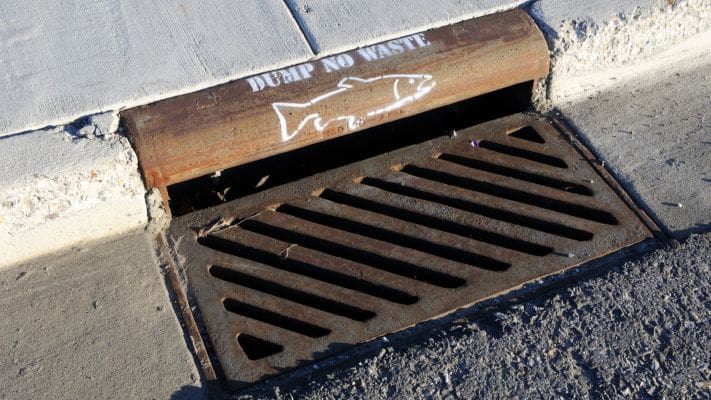
- Catch Basins – No person shall directly or indirectly pump, discharge or cause or allow to be discharged into any catch basin, any solid waste, construction debris, paint or paint product, antifreeze, hazardous waste, oil, gasoline, grease and all other automotive and petroleum products, solvents and degreasers, drain cleaners, commercial and household cleaners, soap, detergent, ammonia, food and food waste, grease or yard waste, animal feces, dirt, sand gravel or other pollutant. Any person determined by the Applicable Authority to be responsible for the discharge of any of the above substances to a catch basin and any other portions of the storm water system impacted according to Town standards and requirements or paying the cost for such cleaning. In addition, the person shall be responsible for paying any penalties assessed by the Town.
- Septage – No person shall discharge or cause or allow to be discharged any septage, or septage tank or cesspool overflow into the Town’s storm water drainage system.
- Storage & Disposal of Hazardous Material – No one shall dispose of anything other than clear water into the Town’s storm drainage system. The disposal of waste, gasoline or any other hazardous material into the storm drainage system is strictly prohibited and is in violation of state and federal pollution laws.
- Private Drainage Systems – It is prohibited for anyone with a private drainage system from tying into the public storm water disposal system without written approval from the Applicable Authority. The maintenance of any and all private drainage systems shall be the responsibility or the owners.
26.8 Exemptions
Discharges or flows resulting from firefighting activities or other authorized hydrant use are exempt.
The following non-stormwater discharges or flows are exempt from the prohibitions of this bylaw provided that the source is not a significant contributor of a pollutant to the municipal storm drain system:
- Waterline flushing;
- Water from exterior foundation drains, footing drains (not including active groundwater dewatering systems), crawl space pumps, or air conditioning condensation;
- Discharge from landscape irrigation or lawn watering;
- Water from individual residential car washing;
- Discharge from dechlorinated swimming pool water (less than one ppm chlorine) provided the water is allowed to stand for one week following last chlorination prior to draining and the pool is drained in such a way as not to cause a nuisance;
- Discharge from street sweeping;
- Flow from potable water sources;
- Springs;
- Natural flow from riparian habitats and wetlands;
- Diverted stream flow;
- Rising groundwater;
- Uncontaminated groundwater infiltration as defined in 40 CFR 35.2005(20), or uncontaminated pumped groundwater (e.g. sump pump), provided that the operator seeks written approval from the Applicable Authority prior to discharge, and thereafter discharges in accordance with the applicable laws and regulations to be issued by the Applicable Authority;
- Dye testing, provided verbal notification is given to the Applicable Authority prior to the time of the test;
- Non-stormwater discharge permitted under an NPDES permit, waiver, or waste discharge order administered under the authority of the United States Environmental Protection Agency, provided that the discharge is in full compliance with the requirements of the written approval, waiver, or order and applicable laws and regulations; and
- Discharge for which advanced written approval is received from the Applicable Authority as necessary to protect the public interest.
26.9 Emergency Suspension of Storm Drainage System Access
The Applicable Authority may suspend municipal storm drain system access to any person or property without prior written notice when such suspension is necessary to stop an actual or threatened discharge of pollutants that presents imminent risk or harm to the public health, safety, welfare or the environment. In the event any person fails to comply with an emergency suspension order, the Applicable Authority ma take all reasonable steps to prevent or minimize harm to the public health, safety, welfare or the environment.
A person commits an offense if the person reinstates water service, sanitary sewer service, and or MS4 access to premises terminated pursuant to this bylaw, without the prior written approval of the Applicable Authority.
26.10 Industrial or Construction Activity Discharges
NPDES Stormwater Permit
Any person subject to an industrial or construction activity NPDES storm water discharge permit shall comply with all provisions of such permit. Proof of compliance with said permit may be required in a form acceptable to the Applicable Authority prior to the allowing of discharges to the MS4.
Monitoring of Discharges
Upon notice of an alleged illicit discharge or connection, the Applicable Authority have the right to investigate any facility that has storm water discharges associated with industrial activity, including construction activity. The exercise of this right does not constitute a replacement or substitution for enforcement by federal or state agencies for facilities that are adequately regulated either under a NPDES permit or, if a violation is determined to have occurred, under 310 CMR 40.00, the Massachusetts Contingency Plan.
Watercourse Protection
Every person owning property through which a watercourse passes, or such person’s lessee, shall keep and maintain that part of the watercourse within the property free of trash, debris, and other obstacles that would pollute, contaminate, or significantly retard the flow of water through the watercourse. In addition, the owner or lessee shall maintain existing privately owned structures within or adjacent to a watercourse so that such structures will not become a hazard to the use, function, or physical integrity of the watercourse. Failure by the property owner to maintain the watercourse does not constitute an obligation on the part of the Town to assume this responsibility.
26.11 Notification of Spills
Notwithstanding other requirements of local, state or federal law, as soon as a person responsible for a facility or operation, or responsible for emergency response for a facility or operation has information of or suspects a release of materials at that facility or operation resulting in or which may result in discharge of pollutants to the municipal drainage system or Wetland Resource Areas, the person shall take all necessary steps to ensure containment, and cleanup of the release. In the event of a release of oil or hazardous materials, the person shall immediately notify the municipal fire and police departments. In the event of a release of non-hazardous materials, the reporting person shall notify the Applicable Authority not later than the next business day. The reporting person shall provide to the Applicable Authority written confirmation of all telephone, facsimile or in-person notifications within three business days thereafter. If the discharge of prohibited materials is from a commercial or industrial facility, the facility owner or operator of the facility shall retain on-site a written record of the discharge and the actions taken to prevent its recurrence. Such records shall be retained for at least three years.
26.12 Enforcement
The Applicable Authority or an authorized agent of the Applicable Authority shall enforce this bylaw, regulations, orders, violation notices, and enforcement orders, and may pursue all civil and criminal remedies for such violations.
26.13 Entry to Perform Duties
To the extent permitted by state law, or if authorized by the owner or other party in control of the property, the Applicable Authority may enter upon privately owned property for the purpose of performing their duties under these regulations and may make or cause to be made such examinations, surveys or sampling as the Applicable Authority deems reasonably necessary.
26.14 Civil Relief
If a person violates the provisions of this bylaw, regulations, written approval, notice or order issued thereunder, the Applicable Authority may seek injunctive relief in a court of competent jurisdiction restraining the person from activities which would create further violations or compelling the person to perform abatement or remediation of the violation.
26.15 Orders
The Applicable Authority may issue a written order to enforce the provisions of this bylaw or the regulations thereunder, which may include: (a) elimination of illicit connections or discharges to the MS4; (b) performance of monitoring, analyses, and reporting; (c) that unlawful discharges, practices, or operations shall cease and desist; (d) remediation of contamination in connection therewith; and (e) implementation of source control or treatment BMPs.
If the enforcing person determines that abatement or remediation of contamination is required, the order shall set forth a deadline by which such abatement or remediation must be completed. Said order shall further advise that, should the violator or property owner fail to abate or perform remediation within the specified deadline, the Town may, at its option, undertake such work, and expenses thereof shall be charged to the violator.
Within thirty (30) days after completing all measures necessary to abet the violation or to perform remediation, the violator and the property owner will be notified of the costs incurred by the Town, including administrative costs. The violator or property owner may file a written protest objecting to the amount or basis of costs with the Applicable Authority within thirty (30) days of receipt of the notification of the costs incurred. If the amount due is not received by the expiration of the time in which to file a protest or within thirty (30) days following a decision of the Applicable Authority affirming or reducing the costs, or from a final decision of a court of competent jurisdiction, the costs shall become a special assessment against the property owner and shall constitute a lien on the owner’s property for the amount of said costs. Interest shall being to accrue on any unpaid costs at the statutory rate provided in G.L. Ch. 59, Sec. 57 after the thirty-first day at which the costs first become due.
26.16 Non-Criminal Disposition
As an alternative to criminal prosecution or civil action, the Town may elect to utilize the non-criminal disposition procedure set forth in G.L. Ch. 40, sec. 21D in which case the Applicable Authority shall be the enforcing person. For non-criminal disposition, the penalty for the first violation shall be one hundred dollars ($100), the penalty for the second violation shall be two hundred dollars ($200), and the penalty for the third and subsequent violations shall be three hundred dollars ($300). Each day or part thereof that such violation occurs or continues shall constitute a separate offense.
26.17 Criminal Penalty
Any person who violates any provision of this bylaw, regulation, order or written approval issued thereunder, shall be punished by a fine not to exceed three hundred dollars ($300) per violation. Each day or part thereof that such violation occurs or continues shall constitute a separate offense.
26.18 Appeals
The decisions or orders of the Applicable Authority shall be final. Further relief shall be to a court of competent jurisdiction.
View State Page
Frequently Asked Questions
What does Framingham's stormwater bylaw regulate?
Section 26 of the town bylaws targets illicit discharges and illicit connections to the municipal separate storm sewer system, along with obstructions to the system’s normal flow. The bylaw exists to prevent contaminated and increased runoff from impairing water quality, contaminating drinking water supplies, damaging aquatic habitat, and contributing to flooding.
What counts as an illicit discharge in Framingham?
Dumping or discharging any pollutant or non-stormwater flow into the municipal storm sewer system, a watercourse, or a wetland resource area is prohibited. This includes tying drains directly into the storm system without approval, discharging waste, paint, oil, gasoline, solvents, or cleaning products into a catch basin, and connecting a private drainage system to the public one without written approval.
Are any discharges exempt from Framingham's illicit discharge bylaw?
Yes. A number of non-stormwater flows are exempt as long as they aren’t significant pollutant contributors, including waterline flushing, landscape irrigation, dechlorinated swimming pool discharge, street sweeping runoff, natural spring flow, and rising or uncontaminated groundwater. Firefighting activity and other authorized hydrant use are also exempt.
What happens if a spill or release threatens Framingham's storm drainage system?
Anyone responsible for a facility that has, or may have, a release resulting in prohibited discharge must take immediate steps to contain and clean it up. Oil or hazardous material releases require immediate notification to the fire and police departments, while non-hazardous releases must be reported to the enforcing authority by the next business day, followed by written confirmation within three business days. Commercial and industrial facilities must keep a written record of any discharge and the corrective action taken for at least three years.
What penalties does Framingham impose for stormwater bylaw violations?
The town can pursue non-criminal disposition, with penalties starting at $100 for a first violation, rising to $200 for a second, and $300 for a third and any after that. Criminal penalties can also apply, capped at $300 per violation. Either way, each day a violation continues counts as a separate offense.
Can Framingham perform stormwater remediation and bill the property owner?
Yes. If a violator or property owner doesn’t complete required abatement or remediation by the deadline in an enforcement order, the town can do the work itself and charge the cost, including administrative expenses, to the responsible party. Unpaid costs become a lien on the property, with interest accruing after 30 days.
The information on this page is provided for general informational purposes only and is not legal advice. Regulations change frequently — AQUALIS makes no warranty as to the accuracy or completeness of this content, and any reliance on it is at your own risk. Consult a qualified professional or your local regulatory authority to confirm requirements applicable to your specific property.