With the wet well cleaned and prepared, AQUALIS rebuilt the mechanical side of the station, meaning the pumps and the piping system that move wastewater out of the wet well and into the broader sanitary system.
All of the in-well hardware was replaced in stainless steel, including the base elbows that anchor each pump to the floor of the wet well and the guide rail system that supports the pumps in their operating position. Stainless steel is the appropriate material for this environment. The inside of a wet well is one of the most corrosive places a piece of metal can sit, and standard hardware breaks down quickly under those conditions. Specifying stainless steel up front significantly extends the service life of the rebuild.
Two new 20-horsepower submersible cutter pumps were installed on the new base elbows. Cutter pumps are designed for sanitary service and shred the rags, wipes and solids that commonly enter wastewater systems, preventing the clogs that drive the majority of emergency service calls. The pumps lower onto the base elbows along the guide rails and seat automatically, which means future routine maintenance can be performed by hoisting them from grade. No confined space entry is required for standard service, which directly reduces the long-term cost of operating the station.
The discharge plumbing was upgraded throughout to Schedule 80 PVC, a heavy-walled pipe rated for the pressure and chemical exposure of sanitary applications. AQUALIS paired the new piping with industrial PVC check valves, which prevent wastewater from flowing back into the wet well after the pumps shut off, and ball isolation valves, which allow individual sections of the system to be taken out of service without shutting down the entire station.
During demolition, the crew identified that the station was tied into a force main, a pressurized sewer line that had not been visible during the initial assessment. AQUALIS coordinated with the property team on site, evaluated the condition and installed new isolation and check valves directly in the wet well while leaving the existing valves in place. The decision avoided additional excavation, preserved the integrity of the broader sanitary system and kept the project on schedule.
Electrical and Controls Upgrade
The electrical system is what tells the pumps when to run, protects them from damage and notifies the facility team when something is wrong. At this site, every part of it was replaced.
AQUALIS started with a new electrical disconnect, the switch that allows power to the station to be safely shut off for service. It was specified in a NEMA 4X-rated enclosure, meaning the cabinet is sealed against rain, washdown and corrosion. NEMA 4X is the appropriate rating for outdoor lift station environments, and equipment rated below it tends to fail prematurely.
A new duplex control panel followed, housed in a stainless-steel NEMA 4X cabinet. The panel functions as the brain of the station. It manages both pumps, alternates them to keep wear distributed evenly and includes a layered set of protections designed to extend pump life and prevent unexpected failure:
- Audible and visual alarms notify site personnel the moment the station enters a fault condition, allowing issues to be addressed before they become overflows.
- Motor overload protection shuts a pump down if it begins drawing more current than expected, an early indicator of a clog or a failing motor.
- Phase monitoring continuously checks the incoming three-phase power and prevents the pumps from running under conditions that can burn out a motor in seconds.
- Motor saver relays add a second layer of protection by detecting voltage irregularities and shutting the pumps down before damage occurs.
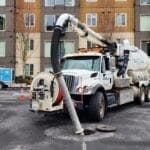
To run new wiring between the wet well and the control panel, AQUALIS used hydro-excavation rather than conventional trenching. Hydro-excavation exposes the ground using pressurized water and vacuum extraction, which significantly reduces the risk of striking and damaging other underground utilities at the site.
Four new weighted mechanical floats were installed inside the wet well and wired into the control panel. The floats rise and fall with the wastewater level and tell the panel when to start the pumps, when to stop them and when to trigger an alarm. AQUALIS handled all of the wiring in-house, which kept the entire installation under one accountable team.
Commissioning and Testing
Once the rebuild was complete, the station went through full commissioning. AQUALIS verified valve operation, confirmed the floats were triggering at the correct levels and confirmed proper pump rotation. A complete set of electrical readings was recorded for both pumps, including line voltage under load, amp draw and winding insulation resistance, all of which fell within manufacturer specification and confirmed healthy motors and a properly configured system.
The station was returned to AUTO operation and the commissioning data was documented to give the facility a clear performance baseline going forward.
Rehabilitation Outcome
The completed overhaul restored the lift station to fully operational, code-compliant condition. Every category on the post-completion inspection scored “Good Condition,” including site security, control panel performance, wet well and valve condition and pump operation.
The facility now operates a station built around the right materials for the application: stainless steel where corrosion is the threat, Schedule 80 PVC where pressure and chemical exposure are and NEMA 4X-rated electrical equipment where moisture is. The work is supported by a one-year labor and materials warranty.
Through detailed planning, disciplined safety execution and sound engineering judgment in the field, AQUALIS delivered a durable, long-term solution and continues to serve as a trusted partner for lift station rehabilitation work at industrial and commercial facilities across the country.

 Regenerative Stormwater Conveyance Improves Highway Drainage in Kenosha, Wis.The Root-Pike Watershed Initiative Network Kenosha County, and others worked with AQUALIS to design and implement an innovative solution for stormwater control along Highway KR.
 Sinkhole Leads to Stormwater System Repair in Durham, N.C.The tenant on this property noticed a depression that opened to the ground below and notified the property owners.