

Last Updated 07/21/2026
Excerpts from the City of Longview Stormwater Ordinance
Chapter 17.80 Stormwater Management
Additional Provisions
1. Low Impact Development
Low impact development (LID) shall be the preferred and commonly used approach to site development. This includes the use of LID principles in site design and the selection and use of on-site stormwater management LID practices and BMPs, as feasible and practicable.
2. Construction Erosion and Sediment Control
All new development, redevelopment, and land disturbing activities, regardless of size, shall implement appropriate erosion and sediment control BMPs to protect the public right-of-way, the storm drainage system, receiving waters, and adjoining properties from the deposition of materials, discharge of sediments, and damage.
3. Drainage
Any new development or redevelopment, regardless of size, shall conform to city standards for drainage and shall not create a nuisance or impact to adjoining properties or the public right-of-way.
4. Source Control
Any new development or redevelopment, regardless of size, that is identified by the city to have the potential to be a source of pollutants shall implement appropriate stormwater source control measures based upon the proposed activities identified and submit a plan that includes applicable source control BMPs.
5. Flow Control
- Projects exempt from Minimum Requirement No. 7 in accordance with LMC § 17.80.030(2)(f) shall address flow control by:
- Controlling (attenuating) the post-development peak discharge rate to the predevelopment rate for the 25-year, 24-hour return frequency storm event using on-site flow control BMPs; or
- Mitigating postdevelopment discharges by an alternate means, as approved by director, such as a fee-in-lieu for use of regional detention, or public improvement project to improve the downstream capacity of the storm drainage system. The applicant must demonstrate that the conveyance system between the project site and receiving water has sufficient hydraulic capacity.
- Projects required to address Minimum Requirement No. 7 shall meet the provisions for flow control in the SWMMWW.
6. Postconstruction Soil Quality and Depth
Disturbed areas that are replanted with landscaping, lawn or native vegetation shall meet minimum soil quality and depth criteria following the city of Longview Stormwater Management Guidelines.
7. Outfalls to CDID No. 1 Waterbodies
Any stormwater discharge or outfall to waterbodies owned, operated, or maintained by CDID No. 1 requires a permit for such discharge or outfall from CDID No. 1. The city will not approve any stormwater site plan containing a discharge or outfall to CDID No. 1 waterbodies until approval is granted by CDID No. 1.
8. Public Stormwater Infrastructure
All new development and redevelopment, regardless of size, that includes stormwater infrastructure in the public right-of-way shall meet the standards included in the city’s Stormwater Management Guidelines, and Standard Plans and Details.
9. Landscaping and Open Space Plan
A detailed landscaping and vegetation plan is required for projects with landscaping used within and adjacent to stormwater facilities, and for the use of planted and/or native vegetation as part of a LID-based approach or BMP. The landscaping plan shall include the relevant plant and vegetation specifications, the arrangement of planted areas, native vegetation areas and other landscaped features on the site plan; information necessary to construct the landscaping elements shown on the plan drawings; descriptions of the stabilization and management techniques used to establish vegetation; and a description of what practices will be employed to ensure that adequate vegetative cover is preserved.
10. Long-Term Maintenance Agreement and Plan
- Designation of Responsible Party. The maintenance agreement shall designate the legal entity (responsible party or parties) responsible for the long-term maintenance of stormwater facilities and BMPs;
- Transfer of Responsibility. The maintenance agreement shall include provisions to transfer the responsibility for long-term maintenance of stormwater facilities and BMPs to future occupants or owners or successors in title;
- Right of Entry. The terms of the maintenance agreement shall provide for the city to enter the property at reasonable times and in a reasonable manner for the purpose of inspection to ensure compliance with the maintenance agreement and plan;
- Maintenance Plan. The maintenance plan shall include a list of routine inspection and remedial maintenance tasks, a schedule for undertaking those tasks, and the applicable minimum performance standards describing the criteria for when additional maintenance actions, including repairs, are required.
17.80.130 Maintenance of stormwater BMPs and facilities.
- Long-Term Maintenance Required. Stormwater BMPs, facilities, and other stormwater infrastructure, approved by the city and constructed after 2009, shall be maintained according to the approved maintenance agreement and plan required under LMC § 17.80.080(10), or the minimum maintenance standards included in the SWMMWW.
- Responsible Party. All required long-term maintenance activities shall be undertaken by the party or parties identified in the approved maintenance agreement, unless such responsibility is transferred to the city as provided in LMC § 17.80.120, or to another entity as provided in the maintenance agreement.
- Inspections. The city shall inspect privately maintained facilities for compliance with the requirements of this chapter. If the party or parties responsible for long-term maintenance fail to maintain their facilities to acceptable standards, the city shall issue a written notice specifying required actions to be taken in order to bring the facilities into compliance.
- Records of Maintenance Activities. The party or parties responsible for long-term maintenance shall make records of all maintenance and repairs, and shall retain the records for at least five years. These records shall be made available to public works during on-site inspections and at other reasonable times upon request.
View State Page
Frequently Asked Questions
What is stormwater compliance in the City of Longview?
Stormwater compliance in Longview means following the City’s stormwater ordinance, which sets minimum requirements for managing runoff on your property. The City is the permitting authority for all land disturbing activities and will only issue construction permits to projects with an approved stormwater management plan. Once construction is complete, property owners are responsible for maintaining all on-site stormwater facilities and open space areas required by that plan. The City operates under the NPDES program and can inspect properties and issue a Notice of Violation for any deficiency found on site.
Does stormwater compliance apply to my Longview project?
It depends on the size of your project. Longview uses specific thresholds to determine what is required.
Smaller projects with at least 500 square feet but less than 2,000 square feet of new or replaced hard surface, or land disturbance between 5,000 and 7,000 square feet, must submit a site drainage plan and a construction stormwater pollution prevention plan meeting Minimum Requirement No. 2.
Mid-size projects with at least 2,000 square feet but less than 5,000 square feet of new or replaced hard surface, or land disturbance of 7,000 square feet or more, must meet Minimum Requirements 1 through 5.
Larger projects with 5,000 square feet or more of new or replaced hard surface, conversion of three quarters of an acre or more of native vegetation to lawn, or conversion of two and a half acres or more to pasture, must meet all nine minimum requirements.
If you are unsure which tier applies to your project, AQUALIS can review your plans and help you navigate the permitting process.
Who is responsible for long-term stormwater maintenance in Longview?
Responsibility for long-term maintenance falls on whoever is identified in the approved maintenance agreement for the property. For most commercial and multifamily properties, that is the property owner. This obligation applies to all stormwater BMPs, facilities, and infrastructure approved by the City and constructed after 2009.
Maintenance responsibility can only be transferred to the City or another party if specifically provided for in the maintenance agreement. Without that, the obligation stays with the property owner regardless of who occupies the site. AQUALIS can manage your long-term maintenance obligations on your behalf.
Why does stormwater maintenance matter for Longview property owners?
Longview’s ordinance requires that all stormwater facilities be maintained to the standards in the approved maintenance agreement and the Stormwater Management Manual for Western Washington. When those standards are not met, the City issues a written notice identifying what needs to be corrected and by when. Violations are enforceable under Chapter 1.33 of the Municipal Code as well as state and federal law.
Longview also applies a more stringent standards rule: where City requirements conflict with other adopted technical guidance, whichever standard is most protective of water quality applies. This means that as state or federal stormwater standards are updated, Longview’s requirements can effectively become more demanding without a separate local ordinance change.
Beyond regulatory consequences, stormwater facilities that are not maintained stop working, leading to flooding, erosion, and property damage that is almost always more costly than routine upkeep.
How do I know if my Longview stormwater system is at risk?
Watch for these warning signs.
Water is not draining after rain. Standing water more than 72 hours after a storm suggests your system is not functioning as designed.
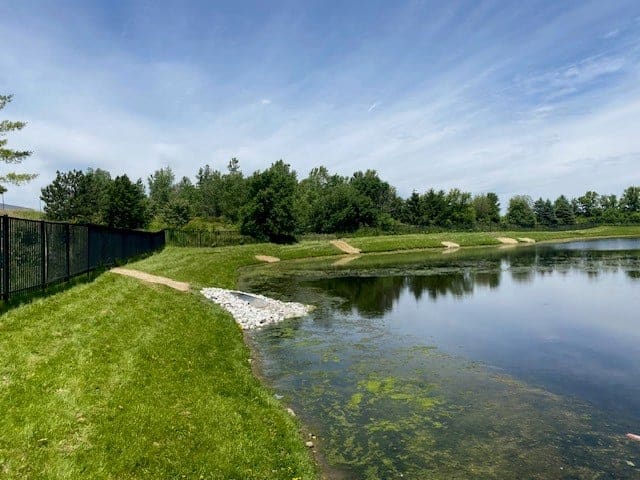
Visible deterioration. Sediment buildup in ponds or catch basins, overgrown or failing vegetation in swales and bioretention areas, and clogged inlets or outlets are signs maintenance is overdue.
Your maintenance records are incomplete or missing. Longview requires that maintenance and repair records be kept for at least five years and made available to the City during inspections. If your records are incomplete or you cannot locate them, that is an active compliance gap.
Your project crossed a threshold but you are not sure what was required. If land disturbing work was done on your property and you are unsure whether the correct stormwater submittals were filed or the right level of requirements was met, it is worth confirming before the City does.
Upcoming sale or change in ownership. Maintenance obligations in Longview are tied to the approved maintenance agreement and stay with the property. If you are buying or selling, an AQUALIS assessment can confirm the condition of stormwater facilities and any outstanding obligations before they transfer.
The information on this page is provided for general informational purposes only and is not legal advice. Regulations change frequently — AQUALIS makes no warranty as to the accuracy or completeness of this content, and any reliance on it is at your own risk. Consult a qualified professional or your local regulatory authority to confirm requirements applicable to your specific property.