

Last Updated 04/10/2026
Green Bay Code of Ordinances
Article III- STORMWATER MANAGEMENT
Sec. 16-81- Stormwater management performance standards
(b) Stormwater management plan. The responsible party shall develop and implement a written post-construction stormwater management plan that incorporates the requirements of this section.
(e) Stormwater discharge quantity. Unless otherwise provided for in this article, all land development activities subject to this article shall establish on-site management practices to control the peak flow rates of stormwater discharged from the site as described in this article. The amount of peak discharge control previously required for the site shall not be reduced as a result of the proposed development or land disturbance. Infiltration of stormwater runoff shall be in accordance with Wis. Admin. Code Ch. NR 151 and WDNR Technical and Guidance Standards.
(f) Stormwater discharge quality. Unless otherwise provided for in this article, all land development activities subject to this article shall establish on-site management practices to control the quality of stormwater discharged from the site. On-site management practices shall be used to meet the following minimum standards established for each development district:
(1) Stormwater management measures in the Urban Expansion District and Urban Reserve District shall be designed to remove, on an average annual basis, a minimum of 80 percent of the total suspended solids load from the proposed on-site development when compared to the proposed on-site development without stormwater management measures. The effectiveness of the stormwater management measures shall be evaluated using criteria provided by the Director.
(2) Stormwater management measures for developments in the Urban Service District smaller than five acres shall be designed to remove, on an average annual basis, a minimum total suspended solids load of 40 percent for redevelopment sites and a minimum of 80 percent for new development from the proposed on-site development when compared to the proposed on-site development without stormwater management measures. The effectiveness of the stormwater management measures shall be evaluated using criteria provided by the Director.
(3) The Director may require stormwater management measures in the Urban Service District for developments five acres or larger to be designed to remove, on an average annual basis, a minimum of 80 percent of the total suspended solids load from the proposed on-site development when compared to the proposed on-site development without stormwater management measures. The effectiveness of the stormwater management measures shall be evaluated using criteria provided by the Director.
(4) Discharge of urban stormwater pollutants to natural wetlands shall have pretreatment and vegetative buffers, unless otherwise exempted by the Director.
Sec. 16-82. – Permitting requirement and procedures and fees.
(b) Permit application and fee. Unless specifically excluded by this article, any landowner operator or responsible party desiring a permit shall submit to the Director of Public Works a permit application made on a form provided by the City of Green Bay for that purpose.
(1) Unless otherwise exempted or excluded by this article, a permit application must be accompanied by the following to be considered by the Director:
a. A stormwater management plan;
b. A maintenance plan and a maintenance agreement;
c. Any easements which may be required;
d. A copy of plans and specifications for all stormwater facilities;
e. Certification by a professional engineer;
f. Any payment of a fee-in-lieu, as provided for under Section 16-81(m);
g. A nonrefundable permit administration fee; and
h. Performance securities, if applicable by subsection (d) of this section.
(2) The stormwater management plan shall be prepared to meet the requirements of Section 16-83 and the maintenance agreement shall be prepared to meet the requirements of Section 16-84.
Sec. 16-85. – Enforcement and penalties.
(a) Any land development activity initiated after the effective date of the ordinance from which this article is derived by any person, firm, association, or corporation subject to these provisions shall be deemed a violation unless conducted in accordance with said provisions.
(b) The Director of Public Works may issue a citation or a notice of violation of any noncomplying land disturbing construction activity or post-construction runoff in order to correct any violation of this article. A notice or violation shall describe the nature of the violation, remedial actions needed, a schedule for remedial action, and additional enforcement action that may be taken.
(c) Upon receipt of written notification from the Director of Public Works, a permittee, landowner or responsible party shall correct work that does not comply with the stormwater management plan or other provisions of the permit within 30 days or a permittee, landowner or responsible party shall make corrections as necessary to meet the specifications and schedule set forth by the Director of Public Works in the notice.
View State Page
Frequently Asked Questions
What is stormwater compliance in the City of Green Bay?
Stormwater compliance in Green Bay means following Article III of the City’s Code of Ordinances, which sets the rules for how development and construction projects manage runoff before, during, and after construction.
If you are planning any land-disturbing activity such as grading, excavation, construction, or changes to existing drainage, you need a permit from the Director of Public Works before work begins. As part of that permit, you must submit a written stormwater management plan describing how runoff will be controlled on your property. Once construction is complete, you are responsible for maintaining those stormwater systems so they continue to meet the City’s standards.
Who is responsible for stormwater compliance in Green Bay?
No land-disturbing or development activity may begin without a permit from the Director of Public Works. If work starts without one, that is an automatic violation regardless of who performed the work.
AQUALIS can help you prepare your stormwater management plan, navigate the permitting process, and handle ongoing maintenance so you stay in compliance.
Does Green Bay require ongoing inspections of stormwater facilities?
If you are unsure what your agreement requires, or if your property changed hands and you do not have a copy, AQUALIS can help you track down the original permit documents and set up a maintenance program that keeps you compliant.
As a general best practice, AQUALIS recommends inspecting your system at least twice a year to identify problems before they trigger a violation or require expensive repairs.
AQUALIS recommends proactive semi-annual inspections to identify issues before they result in a notice of violation or require costly repairs.
Why does stormwater maintenance matter for Green Bay property owners?
Green Bay’s stormwater systems are designed to meet specific performance standards, and those standards only hold if the systems are properly maintained. Two risks come with deferred maintenance.
Violation notices. The Director of Public Works can issue a notice of violation for any stormwater system that is not meeting the City’s requirements. Once you receive one, you have 30 days to fix the problem, or you must follow a remediation schedule set by the City on the City’s timeline.
Performance failures. Green Bay requires most new development to remove at least 80 percent of total suspended solids (TSS) from runoff before it leaves your property. Sediment buildup, clogged outlets, and overgrown vegetation all reduce your system’s ability to hit that target, even if it was working correctly when it was first installed.
What are the most common stormwater compliance failures in Green Bay?
Based on AQUALIS’s inspection experience and Green Bay’s ordinance requirements, these are the issues we see most often.
Starting work without a permit. Green Bay requires a permit before any land-disturbing activity begins. Beginning without one is an immediate violation.
Incomplete permit applications. A complete application must include a stormwater management plan, a maintenance plan, a signed maintenance agreement, and an engineer certification. Missing any of these elements can delay or void your permit.
Systems that no longer meet TSS removal standards. On-site practices must remove at least 80 percent of TSS for most new development and 40 percent for smaller Urban Service District redevelopment projects. Systems that are not maintained to their original design specifications will fall short of these thresholds.
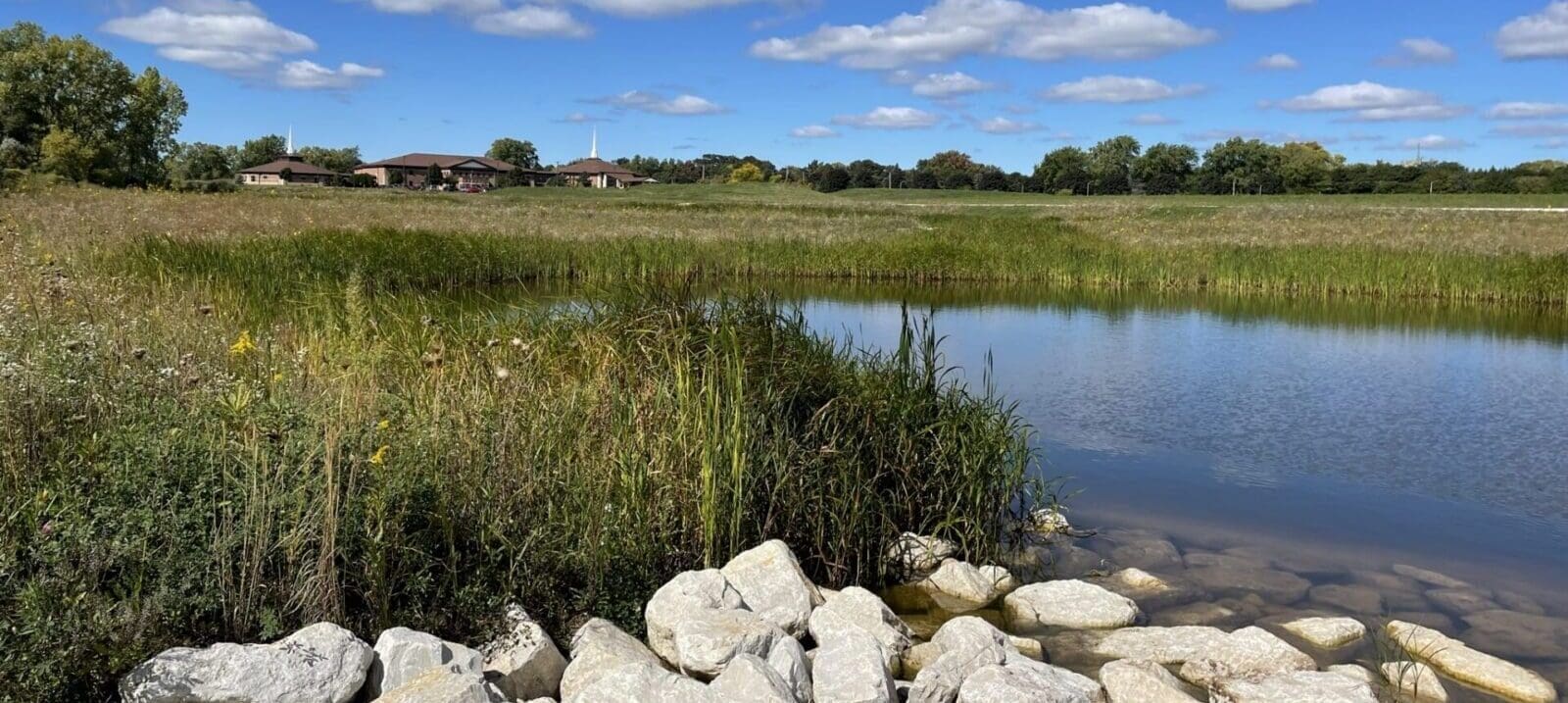
Neglected vegetative buffers. Properties near wetlands must include pretreatment and vegetative buffers. These buffers are a common source of maintenance failures if they are not regularly managed.
No maintenance agreement on file. A signed maintenance agreement is required at permit issuance. Properties that have changed hands or where records have been lost may be operating without a valid agreement, which is an independent compliance issue.
How do I know if my Green Bay property's stormwater system is at risk?
Watch for these warning signs.
Water that will not drain. Standing water that remains more than 72 hours after rain suggests your system is not functioning properly.
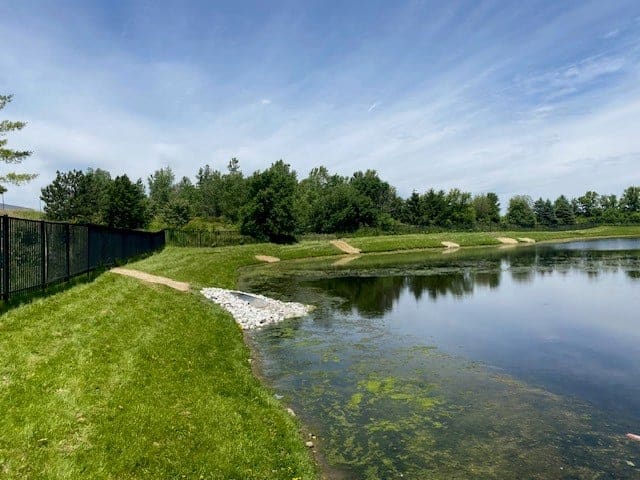
Visible deterioration. Erosion around pond banks, sediment building up in detention areas, or discolored water coming from outfall structures.
Missing records. If you cannot find your stormwater management plan, maintenance agreement, or engineer certification, those gaps need to be addressed. Green Bay requires these documents, and missing records are frequently discovered during City inspections or property sales.
Unpermitted past work. If land-disturbing work was done on your property without a permit from the Director of Public Works, that may be treated as a violation under Section 16-85 regardless of when it occurred.
Upcoming sale or refinancing. Stormwater compliance documentation is increasingly part of commercial due diligence. An AQUALIS assessment before a transaction starts is much easier than resolving issues once a buyer or lender raises them.
Can stormwater fees be reduced for Green Bay property owners?
Many municipalities offer stormwater utility fee reductions for property owners who actively manage runoff on-site. Green Bay’s ordinance includes a fee-in-lieu provision that allows certain properties to pay a fee instead of building on-site management systems, but properties that do have approved on-site systems may qualify for utility fee credits in return.
AQUALIS can review your property and help determine whether your existing stormwater measures qualify for any credit programs offered by the City. Contact your local AQUALIS representative for a property-specific assessment.
How does stormwater compliance affect my Green Bay property's value?
Stormwater compliance status can show up in property transactions in ways that are not obvious until you are already in the process.
Due diligence. Commercial buyers and lenders are increasingly asking whether stormwater permits are active, maintenance agreements are current, and no open violations exist. Gaps in any of these can slow down or complicate a transaction.
Repair costs. Systems that no longer meet Green Bay’s performance standards may need to be upgraded or reconstructed to regain compliance. Those costs typically surface during environmental assessments and affect how a buyer values the property.
Open violations. A notice of violation from the Director of Public Works is a matter of public record and can affect insurability and a buyer’s perception of risk.
The information on this page is provided for general informational purposes only and is not legal advice. Regulations change frequently — AQUALIS makes no warranty as to the accuracy or completeness of this content, and any reliance on it is at your own risk. Consult a qualified professional or your local regulatory authority to confirm requirements applicable to your specific property.