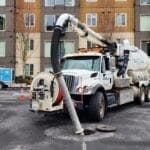
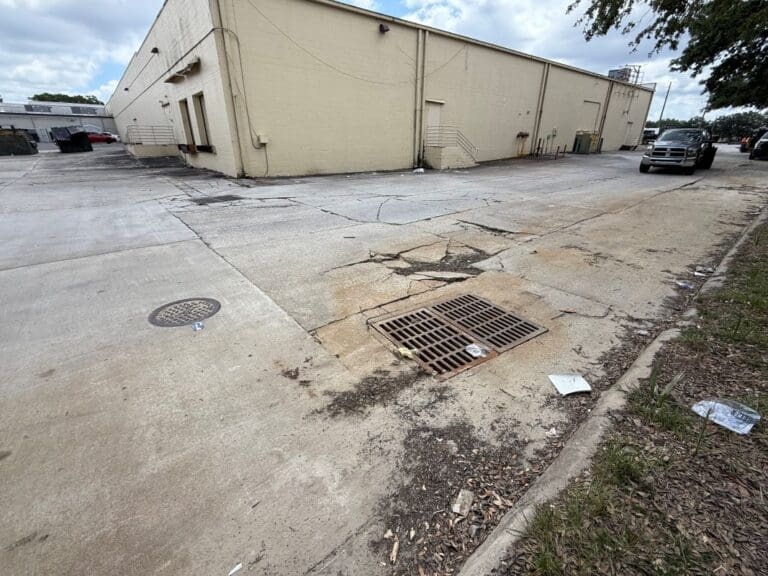
That is what investigators found at this property. An inspection camera sent through roughly 1,000 feet of pipe found water and sediment leaking in at multiple joints, evidence that the pipe had separated and was letting groundwater migrate in and out. One stretch of pipe had sagged enough that it could no longer drain properly, and sediment had collected in the low point, choking off flow. As soil around the leaking joints slowly washed into the pipe, it left a void in the ground above, and that void eventually gave way under the weight of the parking lot pavement, creating the sinkhole. About 56 feet of pipe near the sinkhole could not even be inspected because sediment and standing water were too deep for the camera to pass through.
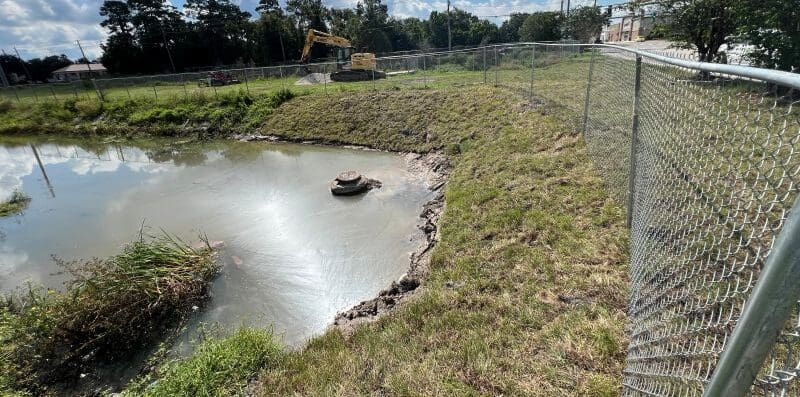
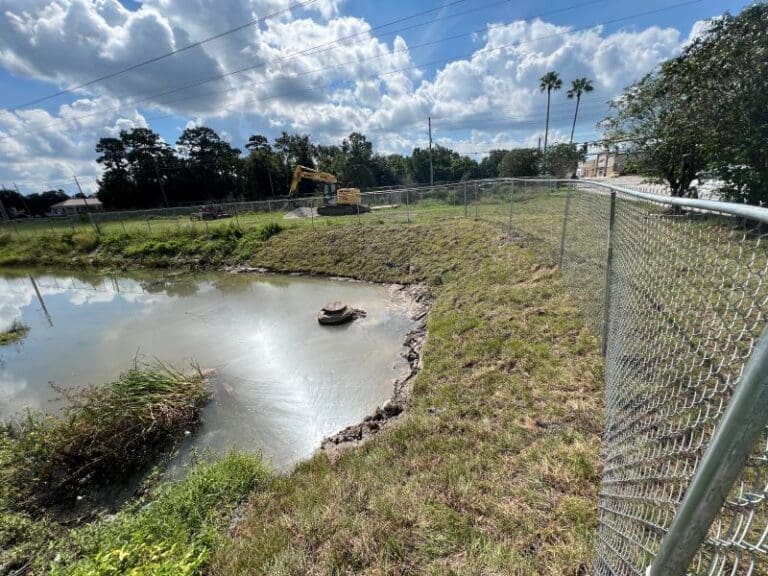
A second, related problem turned up at the retention pond. The inlet pipe leading into the pond changed materials partway along its run, transitioning from concrete pipe to corrugated metal pipe, and that metal section had corroded and collapsed. The same process that created the sinkhole played out again here: once the pipe lost its shape, the soil packed around and above it lost its support, and the pond’s slope began sliding into the void left behind. The erosion on the pond bank and the sinkhole were connected as constant strain on the system can lead to further failures. Both were symptoms of the same underlying cause, a stormwater pipe network that had lost structural integrity and capacity in more than one place.
Addressing the Root Cause of the Failure
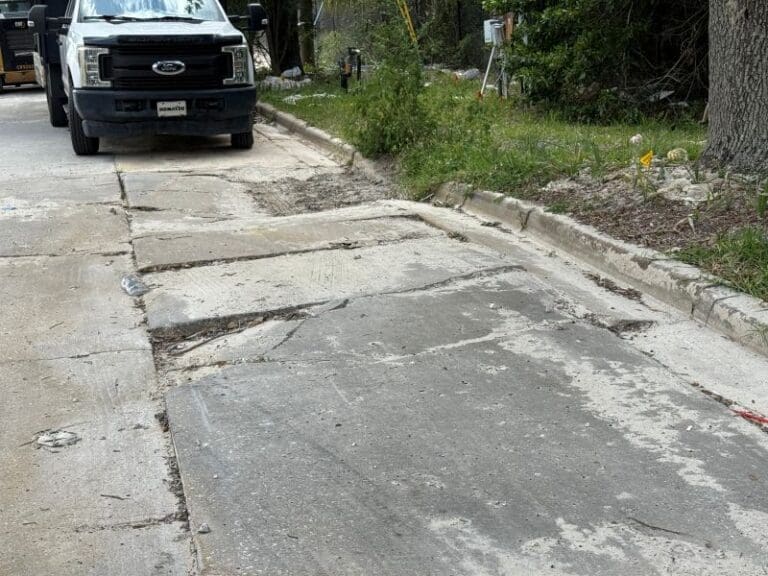
AQUALIS approached the repair in two phases. In phase one, crews cut out the damaged asphalt and curb above the sinkhole, dug down to the pipe and pumped out groundwater so the area could be worked safely below the water table. They removed 60 feet of damaged pipe, installed new pipe in its place and rebuilt the curb, sub-base and asphalt above it. A nearby section of cracked concrete around a catch basin was also cut out, repoured and finished.
At the retention pond, crews removed the collapsed metal pipe and replaced it with 40 feet of new concrete pipe, a stronger, longer-lasting material better suited to wet, below-grade conditions. They then repaired the eroded slope, pulling washed-out soil back into place, adding fill where needed and covering the bank with sod to hold the soil once it was back at grade.
With the damaged sections replaced and the slopes stabilized, AQUALIS moved into phase two, lining the rest of the pipe system. Rather than digging up the entire 735 feet of pipe, crews used a trenchless lining process, a suitable choice for the less damaged pipe. A fiber liner soaked in resin was pulled through the existing pipe and cured in place with steam, creating a smooth, seamless layer inside the old pipe that seals off cracks, gaps and leaking joints along its full length, not just the sections that had already failed. The relined pipe restores the system’s original capacity and keeps groundwater and sediment from finding a new way in, which is what prevents this kind of damage from resurfacing somewhere else down the line. A final camera inspection confirmed every problem area had been addressed before the crew left the site.
The completed repairs gave the property a stormwater system built to handle heavy rain for years to come, with minimal disruption to daily operations during the work. By identifying both the visible damage and the underground cause connecting it, AQUALIS delivered a long-term fix instead of a temporary patch, protecting the property, its tenants and the surrounding community from further sinkholes or pond failure.
Preventing Future Stormwater Pipe Failures
Problems like this rarely happen all at once. They build slowly, joint by joint and inch of sediment by inch of sediment, often for years before they surface as a sinkhole or a collapsed pipe. That means most of this kind of damage is preventable with the right maintenance schedule.
Routine camera inspections are the most effective tool available, because they provide a visual inside of the pipe before a small joint separation turns into the kind of erosion that undermines a parking lot or a pond bank. Inspecting a stormwater system every few years, or after any major storm, can catch sediment buildup and joint damage early, while the fix is still a cleaning or a spot repair rather than a full excavation.
Retention ponds and the pipes that feed them need their own routine of upkeep as well. Pond banks should be checked regularly for erosion, especially around inlet and outlet pipes, since a slope that starts sliding is often a sign that the pipe beneath it has already lost its shape. Clearing accumulated sediment from catch basins and pipe low points on a set schedule keeps the system’s capacity where it needs to be, so it can move water as fast as it arrives during a storm instead of backing up and adding pressure to already weak spots.
Property owners who schedule preventative maintenance, rather than waiting for a visible failure, typically spend far less over the life of the system. A camera inspection and a sediment cleanout cost a fraction of an excavation, pipe replacement and pond repair, and they catch problems while the pipe is still structurally sound enough to fix without disrupting the property above it.

 Regenerative Stormwater Conveyance Improves Highway Drainage in Kenosha, Wis.The Root-Pike Watershed Initiative Network Kenosha County, and others worked with AQUALIS to design and implement an innovative solution for stormwater control along Highway KR.
 Sinkhole Leads to Stormwater System Repair in Durham, N.C.The tenant on this property noticed a depression that opened to the ground below and notified the property owners.