

Last Updated 07/20/2026
Excerpt from City of Kirkland Code of Ordinances
Title 15 Water and Sewage; Chapter 15.52 Surface Water Management
Source control best management practices
BMPs shall be applied to any business or residential activity that might discharge contaminants to a public drainage facility, natural drainage system, surface and storm water, or ground water. Contaminants shall be controlled by implementing appropriate source control BMPs, as described in the 2021 King County Stormwater Pollution Prevention Manual. Discharges associated with activities not addressed in the 2021 King County Stormwater Pollution Prevention Manual shall be controlled using BMPs reviewed and accepted by the city. Failure to implement such practices shall constitute a violation of this chapter.
Operation and maintenance of drainage facilities
(1) Any person or persons holding title to a residential or nonresidential property containing drainage facilities shall be responsible for the continual operation, maintenance, and repair of said drainage facilities in accordance with the criteria set forth in Appendix A of the 2021 King County Surface Water Design Manual and the City of Kirkland Addendum to the 2021 King County Surface Water Design Manual.
(1) The drainage facilities serve more than one individual house or property;
(7) The person or persons holding title to the properties served by the drainage facilities shows proof of the correction of any defects in the drainage facilities, including provision of maintenance access, as required by the public works director.
Inspection and sampling
(A) Inspections for compliance with the provisions of this chapter shall be allowed as follows
Construction and Development Inspection.
The public works director or designee shall have the right to enter onto the property of any site for which a development permit has been issued, during regular business hours, or at any other time reasonable in the circumstances, for the purpose of review of erosion control practices and drainage facilities, and to insure compliance with the terms of such permit. Inspection procedures shall be as outlined in subsection (b) of this section.
Inspection for Cause.
Whenever there is cause to believe that a violation of this chapter has been or is being committed, the public works director or designee shall have the right to enter the property to inspect the property during regular business hours, and at any other time reasonable in the circumstances. Inspection procedures shall be as outlined in subsection (b) of this section.
Inspection for Maintenance and Source Control Best Management Practices.
The public works director or designee shall have the right to enter the property to inspect drainage facilities in order to ensure continued functioning of the drainage facilities for the purposes for which they were constructed, and to ensure that maintenance is being performed in accordance with the standards of this chapter and any maintenance schedule adopted during the plan review process for the property. The public works director or designee also may enter the site for the purposes of observing source control best management practices. The property owner or other person in control of the site shall allow any authorized representative of the public works director or designee access during regular business hours, or at any other time reasonable in the circumstances, for the purpose of inspection, sampling, and records examination.
(b) Inspection Procedure. Prior to making any inspections, the public works director or designee shall present identification credentials, state the reason for the inspection and request entry of the owner or other person having charge or control of the property, if available, or as provided below.
(1) If the property or any building or structure on the property is unoccupied, the public works director or designee shall first make a reasonable effort to locate the owner or other person(s) having charge or control of the property or portions of the property and request entry.
(2) If, after reasonable effort, the public works director or designee is unable to locate the owner or other person(s) having charge or control of the property, and has reason to believe the condition of the site or of the drainage facilities creates an imminent hazard to persons or property, the inspector may enter.
(c) Water sampling and analysis for determination of compliance with this chapter shall be allowed as follows:
(1) Sample Collection. When the public works director or designee has reason to believe that a violation exists or is occurring on a property, the public works director shall have the authority to set up on the site such devices as are necessary to conduct sampling, inspection, compliance monitoring, or flow measuring operations.
(2) Sample Analysis. Analysis of samples collected during investigation of potential violations shall be analyzed by a laboratory certified by the State Department of Ecology as competent to perform the required analysis using standard practices and procedures.
(3) Cost of Sample Collection and Analysis. If it is determined that a violation of this chapter exists on the site, the owner of the property shall pay the city’s actual costs for collecting samples and for laboratory analysis of those samples. If it is found that a violation does not exist, the city will pay such charges.
View State Page
Frequently Asked Questions
What is stormwater compliance in the City of Kirkland?
Stormwater compliance in Kirkland means following Chapter 15.52 of the City Code, which sets minimum requirements for how development projects manage runoff. The City is the permitting authority for all land disturbing activities and will only issue construction permits to projects with an approved stormwater management plan. All drainage facilities must be clean and fully operational before the City grants final permit approval. Once construction is complete, property owners are responsible for maintaining all on-site stormwater facilities. The City operates under the NPDES program and can inspect properties and issue a Notice of Violation for any deficiency found on site.
What is stormwater compliance in the City of Kirkland?
The property owner is responsible for all drainage facilities on their property that are not within the public right-of-way or in easements formally accepted by the City. This includes flow control facilities, water quality facilities, roof downspout drains, and driveway drains.
Before the City grants final approval of any drainage permit, the property owner must submit an irrevocable license to enter. This document confirms the owner is responsible for maintenance, grants City inspectors the right to access the property, and authorizes the City to order repairs if the owner does not act or if the site poses a public health risk.
AQUALIS can manage your stormwater maintenance obligations on your behalf.
Why does stormwater maintenance matter for Kirkland property owners?
Kirkland’s ordinance places full maintenance responsibility on the property owner, with real financial consequences when maintenance lapses.
You pay for sampling if a violation is found. If the City has reason to believe a violation exists and collects water samples from your property, you are responsible for the City’s actual costs of sample collection and laboratory analysis if a violation is confirmed. If no violation is found, the City covers those costs.
The City can order repairs at any time. The irrevocable license to enter that is required at permit approval specifically authorizes the public works director to order repair or cleaning of drainage facilities if the owner does not take action or if the site poses a threat to public health and safety.
Blocking or filling drainage is an automatic violation. No person may obstruct, fill, grade, or use any drainage facility for debris disposal. Any such activity is a violation regardless of intent.
What are the most common stormwater compliance failures in Kirkland?
Based on AQUALIS’s inspection experience and Kirkland’s ordinance requirements, these are the issues we see most often.
Drainage facilities obstructed or filled. Using catch basins, swales, or other drainage features for debris storage or disposal is one of the most common violations and is explicitly prohibited under the ordinance.
Drainage modifications made without a permit. Any change to an existing drainage facility requires City approval. Unpermitted alterations are an automatic violation, including informal changes like rerouting a downspout or filling a low-lying drainage area.
Source control BMPs not implemented. Businesses and property owners with activities that could discharge contaminants, such as vehicle maintenance, outdoor storage, or carwashing, are required to implement source control best management practices. Failing to do so is a violation of the ordinance.
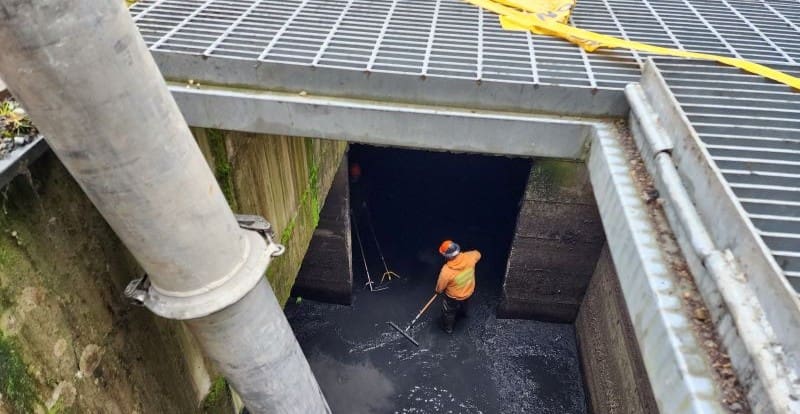
Maintenance not meeting King County manual standards. All drainage facilities in Kirkland must be maintained per Appendix A of the King County Surface Water Design Manual. Sediment buildup, overgrown vegetation, and clogged outlets are common findings that indicate the standard is not being met.
No irrevocable license to enter on file. Properties permitted after the ordinance’s adoption are required to have a recorded irrevocable license to enter. Properties that changed hands may be missing this document, which can create complications during inspections or transactions.
How do I know if my Kirkland stormwater system is at risk?
Watch for these warning signs.
Water is not draining after rain. Standing water more than 72 hours after a storm, or water backing up near your building, suggests your drainage system is not functioning as designed.
Visible blockages or debris. Anything obstructing inlets, catch basins, or outlet structures is a violation under Kirkland’s ordinance and needs to be cleared promptly.
Drainage modifications without permits. If changes were made to drainage facilities on your property without City approval, that is an active violation regardless of when it occurred.
Business activities near drainage. If your property has outdoor activities like vehicle maintenance, material storage, or washing operations, and you do not have source control BMPs in place, you are likely out of compliance.
No irrevocable license to enter on file. If you are unsure whether this document was recorded for your property, it is worth confirming. AQUALIS can help you identify any gaps and get your documentation in order before a City inspection or property transaction surfaces the issue.
The information on this page is provided for general informational purposes only and is not legal advice. Regulations change frequently — AQUALIS makes no warranty as to the accuracy or completeness of this content, and any reliance on it is at your own risk. Consult a qualified professional or your local regulatory authority to confirm requirements applicable to your specific property.