

Last Updated 07/20/2026
Excerpt from Federal Way Municipal Code
Tile 16 SURFACE WATER MANAGEMENT
Inspections
(1) Activities. All activities regulated by this title, except those exempted under FWRC 16.15.020, shall be inspected by the director or his or her designee(s). The director or designee shall inspect projects at various stages of the work requiring approval to determine that adequate control is being exercised. Stages of work requiring inspection include, but are not limited to, preconstruction; installation of BMPs; land disturbing activities; installation of utilities, landscaping, retaining walls and completion of project. When required by the director, a special inspection and/or testing shall be performed. Any applicant who has obtained the approval of the director under this title shall permit the director or designee access to the property, when requested, to permit the inspections required by this section.
(2) Stormwater facilities. The director shall develop and implement a regular inspection program, including a master inspection and maintenance schedule, for all public and private stormwater facilities in Federal Way. Inspections shall be no less frequently than annual. Inspections may be scheduled more frequently if determined by the director to be necessary for any reason. If, during the course of the inspection program, additional existing stormwater facilities are discovered, they shall be added to the master inspection and maintenance schedule.
(3) Water quality. The director or designee may inspect BMPs, examine surface and groundwater, or sample surface or groundwater as often as is necessary to determine compliance with this title.
Inspection and maintenance records.
(1) Records for new facilities. Records of new public or private stormwater facilities shall include the following:
(a) As-built plans and locations.
(b) Findings of fact for any exemption granted by the city of Federal Way.
(c) Operations and maintenance requirements and records of inspections, maintenance actions and frequencies.
(d) Engineering reports, if prepared prior to or during construction of the facility.
(2) Records for existing facilities. Upon the request of the director, all owners of existing storm drainage systems shall provide the director with all inspection, maintenance and repair records for their facilities, as well as any existing record drawings or diagrams of their storm drainage systems.
Reporting
The director shall report annually to the Federal Way city council about the status of the inspections. The annual report may include, but need not be limited to, the portions of the components found in and out of compliance, the need to upgrade components, enforcement actions taken, compliance with the inspection schedule, the resources needed to comply with the schedule, and comparisons with previous years.
Core and special requirements
Discharge at the natural location
All surface and stormwater runoff from a project must be discharged at the natural location so as not to be diverted onto or away from downstream properties. The manner in which runoff is discharged from the project site must not create a significant adverse impact to downhill properties or drainage systems.
Off-site analysis
All proposed projects must submit an off-site analysis report that assesses potential off-site drainage impacts associated with development of the project site and proposes appropriate mitigations of those impacts. The initial permit submittal shall meet the requirements outlined in the KCSWDM and the Federal Way Addendum
Flow control
All proposed projects, including redevelopment projects, must provide on-site flow control facilities to mitigate the impacts of increased storm and surface water runoff generated by the addition of new impervious surfaces, new pervious surfaces and replacement impervious surfaces. These facilities shall, at a minimum, meet the performance criteria for one of the area-specific flow control standards and be implemented according to the applicable flow control implementation requirements described in the KCSWDM. Flow control BMPs must be provided as directed in the KCSWDM.
Conveyance system
All engineered conveyance system elements for proposed projects must be analyzed, designed, and constructed to provide a minimum level of protection against overtopping, flooding, erosion, and structural failure as specified in the KCSWDM.
Erosion and sediment control
All proposed projects that will clear, grade, or otherwise disturb the site must provide erosion and sediment controls to prevent, to the maximum extent possible, the transport of sediment from the project site to downstream drainage facilities, water resources, and adjacent properties. To prevent sediment transport, erosion and sediment control (ESC) measures that are appropriate to the project site must be applied and performed as described in the KCSWDM. Both temporary and permanent erosion and sediment controls shall be implemented as described in the KCSWDM.
Maintenance and operation
Maintenance and operation of all drainage facilities is the responsibility of the applicant or property owner, except those facilities for which Federal Way is granted an easement, tract, or right-of-way and officially assumes maintenance and operation as described in the KCSWDM. Drainage facilities must be maintained and operated in compliance with Federal Way maintenance standards.
Financial guarantees and liability
All drainage facilities constructed or modified for projects (except downspout infiltration and dispersion systems), and any work performed in the right-of-way, must comply with the financial guarantee requirements in FWRC Title 19.
Water quality
All proposed projects, including redevelopment projects, must provide water quality (WQ) facilities to treat the runoff from new and/or replaced pollution-generating impervious surfaces and pollution-generating pervious surfaces. Redevelopment projects may also be required to provide WQ facilities to treat existing pollution-generating impervious surfaces. WQ facilities shall be selected and implemented according to the KCSWDM.
Flow control BMPs
All proposed projects, including redevelopment projects, must provide on-site flow control BMPs to mitigate the impacts of storm and surface water runoff generated by new impervious surfaces, new pervious surfaces, existing impervious surfaces, and replaced impervious surfaces targeted for mitigation as specified in the following sections. Flow control BMPs must be selected and applied according to the KCSWDM.
Ownership of stormwater facilities.
(1) Public stormwater facilities.
(a) Stormwater facilities in rights-of-way or dedicated easements or tracts. The city of Federal Way shall own, operate and maintain all elements of the storm drainage system in the right-of-way and in easements or tracts granted or dedicated to, and accepted by, the city of Federal Way.
(b) Existing stormwater facilities on private property. The city of Federal Way will not acquire or accept (via dedication, grant of easement, or other conveyance) existing components of the stormwater conveyance system located on private property, except when the components are needed for city of Federal Way construction projects identified in the capital facility plan or annual capital improvement program.
(c) New stormwater facilities. The city of Federal Way will accept ownership and responsibility for new retention/detention systems (via dedication, grant of easement, or other conveyance) only if all of the following conditions are met:
(i) Public ownership of the system will provide a public benefit;
(ii) An easement or dedication of the property is offered by the property owner at no cost;
(iii) The system meets city standards;
(iv) There is access for city of Federal Way maintenance from a public right-of-way;
(v) The city of Federal Way has adequate resources to maintain the system; and
(vi) The system serves a subdivision (as opposed to a short plat or commercial property).
(2) Private stormwater facilities. Stormwater systems located on private property shall be the responsibility of the owner to operate, inspect, maintain and improve.
Maintenance responsibility.
Generally
All stormwater facilities shall be maintained in accordance with this title and Appendix A and Chapter 6 of the KCSWDM. Drainage facilities shall be maintained so that they operate as intended. Systematic, routine preventive maintenance is preferred.
Public Stormwater Facilities
The responsibility of the city of Federal Way shall be limited to maintenance and operation of the city of Federal Way stormwater system, and the city of Federal Way assumes no responsibility for maintenance and operation of private systems.
Private Stormwater Facilities
Property owners are responsible for the maintenance, operation or repair of stormwater drainage systems and BMPs. Property owners shall maintain, operate and repair these facilities in compliance with the requirements of this title and Appendix A and Chapter 6 of the KCSWDM.
New Subdivisions and New Short Plats
In new subdivisions and short plats, maintenance responsibility for private drainage facilities shall be specified on the face of the subdivision or short plat.
Existing Subdivisions and Existing Short Plats
If a private drainage facility serves multiple lots and the responsibility for maintenance has not been specified on the subdivision plat, short plat or other legal document, maintenance responsibility shall rest with the homeowners’ association, if one exists, or otherwise with the owners of the properties served by the facility. If owners of the properties served by the facility cannot be located, maintenance responsibility shall rest with the owner(s) of the property on which the facilities are located.
Minimum maintenance standards.
The following are the minimum standards for the maintenance of stormwater facilities:
- All stormwater facilities shall be inspected at regular intervals and maintained and repaired in accordance with Appendix A and Chapter 6 of the KCSWDM, the approved designs for stormwater facilities, stormwater permits which may be issued by the city of Federal Way, the State Department of Ecology, or the Environmental Protection Agency (EPA), applicable construction standards, and the minimum requirements as stated in the stormwater management manual.
- Where maintenance and repair is necessary to correct health or safety problems, to prevent harmful materials from entering the stormwater system, or to remove harmful materials that have entered the stormwater system, such work shall be completed by the owner or operator of the stormwater system or stormwater facility within 24 hours of discovery of the need for maintenance or repair. When maintenance and repair is found necessary to prevent water quality degradation, such work shall be completed within 14 calendar days of discovery of the need for maintenance or repair. For other related problems, maintenance or repairs shall be completed within 30 calendar days of discovery or repair.
- Where lack of maintenance is causing or contributing to a water quality problem, immediate action shall be taken to correct the problem. Within one month, the director shall revisit the facility to assure that it is being maintained.
- Should the public works director have reasonable cause to believe that the situation at a private stormwater facility is so adverse or hazardous so as to preclude written notice, he or she may take the measures necessary to eliminate the hazardous situation; provided, that he or she shall first make a reasonable effort to locate the owner before acting. In such instances the owner of the property and/or the person responsible for the maintenance of the facility shall be obligated for the payment of all costs incurred. If costs are incurred and a bond pursuant to this title or other city requirement has been posted, the public works director shall have the authority to collect against the bond to cover costs incurred.
- Illicit discharges to the stormwater system are prohibited, unless such discharges are authorized in accordance with Chapter 173-216 WAC (State Waste Discharge Permit Program) or Chapter 173-220 WAC (National Pollutant Discharge Elimination System Program).
- Harmful and prohibited materials, as defined in this title, shall not be allowed to enter any stormwater system. All such substances shall be stored, handled and disposed in a manner that will prevent them from entering the stormwater system. Further, storage, handling and disposal shall be conducted in accordance with Chapters 173-303 and 173-304 WAC.
GENERAL WATER QUALITY AND ENFORCEMENT
Quality of water entering streams and lakes.
(1) Generally. The quality of any water entering any stream or lake or Puget Sound directly from the subject property must meet the water quality standards established under the authority of Chapter 90.48 RCW, and contained within Chapter 173-201 WAC, which standards are hereby incorporated by reference.
Quality of water entering the public stormwater system.
All water directly entering the public stormwater system from the subject property must meet the following water quality standards:
(1) Fecal coliforms levels may not exceed a geometric mean of 50 organisms per 100 milliliters, with not more than 10 percent of the samples exceeding 100 organisms per 100 milliliters.
(2) Dissolved oxygen must exceed 9.5 milligrams per liter.
(3) The concentration of total dissolved gas may not exceed 110 percent of saturation at any point of sample collection.
(4) The pH must be within the range of 6.5 to 8.5. In addition, the water leaving the subject property may not change the pH of the public stormwater system by more than 0.2 units.
(5) The temperature of the water entering the public storm sewer system may not exceed 16.0 degrees Celsius as a result of human activity. In addition, temperature increases in the public storm sewer system may not, as a result of human activity, exceed t = 23/(T + 5).
(6) The turbidity of the water leaving the subject property may not exceed five NTUs (Nephlometric Turbidity Units) over the background turbidity when the background turbidity is 50 NTUs or less, or have more than a 10 percent increase in turbidity when the background turbidity is more than 50 NTUs.
(7) The water leaving the subject property may not contain toxic or deleterious materials except those which result from reasonable and safe activities which are associated with and accessory to an allowable use conducted on the subject property.
Special enforcement provisions.
The director shall report annually to the Federal Way city council about the status of the inspections. The annual report may include, but need not be limited to, the portions of the components found in and out of compliance, the need to upgrade components, enforcement actions taken, compliance with the inspection schedule, the resources needed to comply with the schedule, and comparisons with previous years.
Enforcement.
Violations
Notwithstanding the requirements of Chapter 16.50 FWRC and FWRC 16.55.010, if a person has properly designed, constructed, implemented, and is maintaining BMPs according to the BMP manual, is carrying out AKART as required or approved by the director, and/or has modified existing practices as specified by the director, and contaminants continue to enter surface water, stormwater or groundwater; or the person can demonstrate that there are no additional contaminants being discharged from the site above the background conditions of the water entering the site, then that person shall not be in violation of water quality provisions of this chapter. Said person, however, remains liable for any prohibited discharges through illicit connections, dumping, spills, improper maintenance of BMPs, or other discharges in violation of this chapter that allow contaminants to enter surface water, stormwater or groundwater.
Additional Procedures
The director, in consultation with other departments of Federal Way government, will develop and implement additional guidance information which describes the goals, objectives, policies, and procedures for a water quality investigation and enforcement program. These procedures will describe how the city will characterize, investigate and respond to reports or instances of noncompliance with this title and shall identify by title the official(s) responsible for implementing the enforcement procedures. These procedures will also include direction on removing the source of discharge, notification of appropriate authorities, notification of property owner, and the means of providing technical assistance for eliminating the discharge. In addition, these procedures will include escalating enforcement and legal actions.
Sampling and Analysis
Whenever the director determines that any person has violated or is violating the provisions of this chapter, the director may require the person responsible for the violation to sample and analyze any discharge, surface and stormwater, groundwater, and/or sediment, in accordance with sampling and analytical procedures or requirements determined by the director. A copy of the analysis shall be provided to the Federal Way surface water management division.
Summary Abatement
Whenever any violation of this chapter causes or creates a condition which constitutes an immediate and emergent threat to the public health, safety or welfare or to the environment, the director may summarily and without prior notice abate the condition. Notice of such abatement, including the reason for it, shall be given to the person responsible for the violation as soon as reasonably possible after the abatement. The costs of such summary abatement shall be recoverable via procedures for recovery of abatement costs as set forth in Chapter 1.15 FWRC, Civil Enforcement of Code.
View State Page
Frequently Asked Questions
What is stormwater compliance in the City of Federal Way?
Stormwater compliance in Federal Way means following the City’s stormwater ordinance, which sets minimum requirements for managing runoff on your property. The City is the permitting authority for all land disturbing activities and requires an approved stormwater management plan before any construction permit is issued. Once construction is complete, property owners are responsible for maintaining all on-site stormwater facilities. The City operates under the NPDES program and can inspect properties and issue a Notice of Violation for any deficiency found on site.
Who is responsible for stormwater compliance in Federal Way?
If your stormwater system is on private property, it is your responsibility to operate, inspect, maintain, and improve it. The City is only responsible for facilities in public rights-of-way or in easements it has formally accepted. Everything else is on the property owner.
For subdivisions and short plats, maintenance responsibility must be specified in the recorded plat documents. If it is not specified and no homeowners association exists, responsibility rests with the owners of the properties the system serves. AQUALIS can manage your stormwater maintenance obligations on your behalf.
How often does Federal Way inspect stormwater facilities?
Federal Way’s ordinance requires that all public and private stormwater facilities be inspected at least once per year as part of a City managed inspection program. Inspections can occur more frequently if the City determines it is necessary. If a facility is discovered that was not previously on the City’s schedule, it gets added and is subject to the same annual minimum.
In addition to City inspections, property owners are required to inspect their own facilities at regular intervals and keep records of those inspections. AQUALIS recommends inspecting at least twice a year so you are not caught off guard during a City visit.
Why does stormwater maintenance matter for Federal Way property owners?
Federal Way’s ordinance sets firm repair timelines once a problem is identified, and the consequences of missing them escalate quickly.
24 hours to make repairs when there is a health or safety risk, or when harmful materials are entering or have entered the stormwater system.
14 days to complete repairs when the issue is causing water quality degradation.
30 days for all other maintenance and repair needs.
If you do not act within these timelines, the City can step in, make the repairs itself, and bill you for the full cost. If you do not pay, the City can collect against any bond you have posted. Illicit discharges to the stormwater system are also prohibited, and you are responsible for all cleanup costs if one occurs on your property.
Can stormwater fees be reduced in Federal Way?
Yes. Federal Way offers utility fee credits for properties with on-site stormwater quantity and quality controls. However, these credits come with an important condition: if you refuse to allow the City to inspect your stormwater facility, or if you commit a violation of the stormwater ordinance, the City can cancel your credits immediately. A notice will be mailed to you, and you have 10 days to request reconsideration. The director’s decision on reconsideration is final.
Similarly, properties that have received a reduced development intensity classification because of an on-site detention facility can have that classification adjusted if they refuse inspections or commit violations.
AQUALIS can help ensure your facilities are properly maintained so your credits stay intact.
What are the most common stormwater compliance failures in Federal Way?
Based on AQUALIS’s inspection experience and Federal Way’s ordinance, these are the issues we see most often.
Missed repair timelines. Federal Way’s 24 hour, 14 day, and 30 day repair windows are specific and enforceable. Property owners who are unaware of these timelines or who defer maintenance often find themselves in violation before they realize it.
BMPs not maintained per the King County manual. Federal Way requires all stormwater facilities to be maintained in accordance with Appendix A and Chapter 6 of the King County Surface Water Design Manual. Systems that have not been maintained to those standards are out of compliance, even if they appear to be functioning.
Illicit discharges. Non-stormwater materials entering the drainage system are prohibited. Property owners are responsible for all cleanup costs, regardless of how the discharge occurred.
Refusing or obstructing a City inspection. This triggers immediate cancellation of any utility fee credits and can result in enforcement action.
Missing inspection and maintenance records. The City can request records at any time. Properties without documentation of inspections, maintenance actions, and repairs cannot demonstrate compliance even if the physical system is in good condition.
How do I know if my Federal Way stormwater system is at risk?
Watch for these warning signs.
Water is not draining after rain. Standing water more than 72 hours after a storm, or water backing up near your building, suggests your system is not performing as designed.
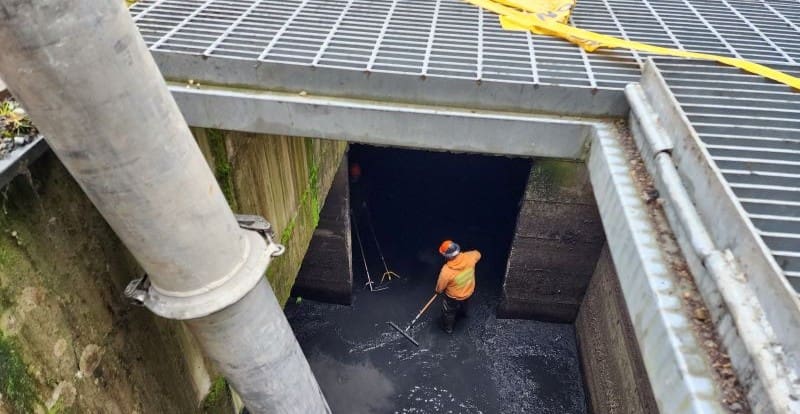
Visible deterioration. Sediment in catch basins or detention areas, clogged inlets or outlets, erosion near drainage structures, and overgrown vegetation around BMPs are all signs maintenance is overdue.
Unusual discharge. Discolored or odorous water from drainage outfalls may indicate an illicit discharge, which triggers both cleanup liability and City enforcement.
No maintenance records on file. Federal Way requires that records be kept for all new facilities, including as-built plans, operations and maintenance requirements, and logs of inspections and repairs. The City can request these records at any time, and properties that cannot produce them have no way to demonstrate compliance.
Upcoming sale or change in ownership. Maintenance responsibility in Federal Way stays with the property. If you are buying or selling, an AQUALIS assessment before closing can surface any issues before they become your liability.
The information on this page is provided for general informational purposes only and is not legal advice. Regulations change frequently — AQUALIS makes no warranty as to the accuracy or completeness of this content, and any reliance on it is at your own risk. Consult a qualified professional or your local regulatory authority to confirm requirements applicable to your specific property.