

Last Updated 08/15/2019
The City of Mobile has enacted a Stormwater Ordinance in order to establish minimum stormwater management requirements and controls to protect and safeguard the general health, safety, and welfare of the public residing in watersheds within this jurisdiction. The City of Mobile is the permitting authority for all land disturbing activities and requires the land owner to maintain all on-site stormwater control facilities and all open space areas (e.g. parks or “green” areas) required by the approved stormwater control plan. The City of Mobile will only provide construction permits to projects that establish a plan to manage stormwater runoff occurring during the construction process. The City of Mobile, under the NPDES program, also has the authority to inspect properties for noncompliance and can issue a notice of violation (NOV) for any deficiency or infraction onsite. Property owners are responsible for the maintenance of any stormwater facilities or practices located on the property. The City of Mobile has the authority to inspect stormwater facilities and practices in order to ascertain that they are properly maintained and functioning.
Excerpt from Mobile County Stormwater Page
Under the Federal Clean Water Act, counties and municipalities are required to reduce the amount of stormwater pollution entering our waters. Each government agency is issued a stormwater permit. This permit is called a National Pollutant Discharge Elimination System (NPDES) permit.
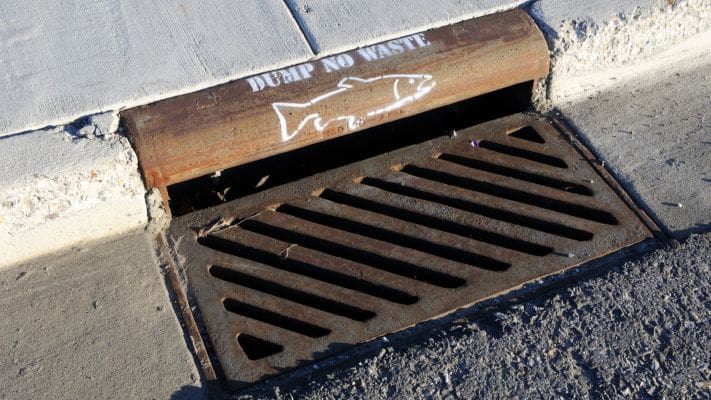
Mobile County is designated by the United States Environmental Protection Agency (EPA) and the Alabama Department of Environmental Management (ADEM) as an owner/operator of a Phase II municipal separate storm sewer system (MS4). This requires Mobile County to develop a stormwater management program designed to protect water quality and to prevent harmful pollutants in stormwater runoff from entering the MS4 area. Stormwater runoff is rainfall that does not seep into the ground but runs off over our yards, streets, parking lots, and buildings. The runoff then enters our storm sewer system which flows directly into creeks, rivers, bays and the Gulf of Mexico.
The County received its current Phase II Stormwater NPDES permit on October 1, 2016. The current permit coverage will expire on October 31, 2021. Requirements of the permit include:
- Identifying major sources of stormwater pollution (mapping for source tracking)
- Reducing pollutants in runoff from industrial, commercial, and residential areas (enforcement and drainage system maintenance and cleanup)
- Controlling stormwater discharges from new development and redevelopment areas (inspections and site plan process)
- Implementing a water quality monitoring program
The intent of the Phase II regulations is to reduce the adverse impacts to water quality and aquatic habitat by controlling unregulated sources of stormwater discharges. In order to comply with these regulations Mobile County must satisfy specific “minimum control measures,” including:
- Public Education and Involvement
- Illicit Discharge Detection and Elimination
- Construction Site Runoff Control
- Post-Construction Stormwater Management
- Pollution Prevention/Good Housekeeping
Stormwater Management Program Plan
1.1 Regulatory Overview
This Stormwater Management Program (SWMP) Plan includes pollution prevention measures, stormwater monitoring, use of legal authority, and other appropriate means to control the quality of stormwater discharged from the City of Mobile (City) Separate Storm Sewer System (MS4), in accordance with the Preliminary Draft National Pollutant Discharge Elimination System (NPDES) Permit number ALS000007 and current NPDES Permit number ALS000002. The SWMP is implemented in accordance with Section 402(p)(3)(B) of the Clean Water Act, and the Stormwater Regulations at 40 CFR Part 122.26.
It is the goal of the SWMP to reduce the discharge of pollutants to and from the MS4 to the maximum extent practical (MEP), thus protecting the quality of water in the receiving water bodies. This Stormwater Management Program covers the term of the permit and is updated as necessary, or as required by the Alabama Department of Environmental Management (ADEM), to ensure compliance with the statutory requirements of the Clean Water Act.
Mobile Municipal Code
CHAPTER 17 – ARTICLE I. – STORMWATER MANAGEMENT AND FLOOD CONTROL
DIVISION 1. – GENERAL
Sec. 17-10. – Maintenance and repair of stormwater facilities—Post-construction stormwater management in new development and redevelopment.
(a) Maintenance easement—Tier 1 developments. Prior to the issuance of a tier 1 permit, the owner of the site must agree to a maintenance easement that runs with the land and provides the city all authority required to monitor and enforce BMPs. If the land is to be subdivided, the maintenance easement shall be identified on the subdivision plat recorded in the records of the probate judge for the county. The easement shall provide for access to the property at reasonable times for periodic inspection by the city, and for regular or special assessments of property owners to ensure that the facility is maintained in proper working condition to meet design standards and any other provisions established by this division. Any stormwater easement agreement that does not appear on a subdivision plat shall be recorded in the records of the probate judge for the county.
(b) Maintenance covenants—Tier 1 developments. Maintenance of all stormwater management BMPs shall be ensured through the creation of a formal maintenance covenant that must be approved by the city and recorded in the records of the probate judge for the county, prior to final plan approval. The covenant shall include a schedule for routine maintenance checks, and periodic inspections in a frequency sufficient to assure the proper performance of the BMPs. Maintenance and inspection shall be the responsibility of the property owner.
In the event the stormwater BMPs fail to perform effectively, the parties may amend the maintenance covenants by written amendment recorded in the records of the probate judge for the county.
(c) Records of installation and maintenance activities. Parties responsible for the operation and maintenance of a stormwater management BMPs shall make records of the installation and of all maintenance and repairs, and shall retain the records for at least five (5) years. Inspections shall be completed by a QCI or QCP. These records shall be submitted to the city engineer annually on January 1 or such other date designated by the city engineer. In the event the responsible party fails to provide the annual records, city officials may conduct an inspection of the property. The fee for said inspection shall be five hundred dollars ($500.00) or the actual cost of inspection, whichever is greater.
(d) Failure to maintain practices. If a responsible party fails or refuses to meet the requirements of the maintenance covenant, the city, after reasonable notice, may correct a violation of the design standards or maintenance needs by performing all necessary work to restore or repair the BMPs. In the event that the stormwater run-off becomes a danger to public safety or public health, the city shall notify the party responsible for maintenance of the BMPs in writing. Upon receipt of that notice, the responsible person shall have fifteen (15) days to correct the deficiency in an approved manner depending upon the severity and nature of the violation. After proper notice, the city may assess the owner(s) of the facility for the cost of repair work and any penalties; and the cost of the work shall be a lien on the property, or prorated against the beneficial users of the property, and may be collected as a municipal lien in accordance with the procedures applicable to the abatement of public nuisances.
(e) Unauthorized discharge prohibited and declared a public nuisance.
(1) Unauthorized discharges prohibited. Any discharge of stormwater made in violation of this division or of any condition of a tier 1 land disturbance permit issued or maintenance covenant, see section 17-10(b), entered pursuant to this division is prohibited and is hereby declared a public nuisance subject to correction and/or abatement in accordance with applicable law.
Sec. 17-12. – Commercial, industrial and high-risk facilities.
(a) BMPs required. All commercial, industrial and high-risk facilities (see the definition of “high-risk facility” herein), shall identify, implement and maintain BMPs for any activity, operation or facility which may cause or contribute to pollution or contamination of stormwater, the MS4, private watercourse waters of the state or waters of the United States. Noncompliance with such BMPs will constitute a violation of this division.
(b) Protection against accidental discharge. The owner or operator of a commercial, industrial or high-risk facility shall provide, at its own expense, reasonable protection from accidental discharge of prohibited materials or other wastes into the MS4 or private watercourses, waters of the state, or waters of the United States, through the use of structural and non-structural BMPs. Any person responsible for a commercial, industrial or high-risk facility which is, or may be, the source of an illicit discharge, may be required to implement, at said person’s expense, additional structural and non-structural BMPs to prevent the discharge of pollutants to the MS4.
Sec. 17-14. – Violations, enforcement and penalties.
(a) Violations. It shall be unlawful and a misdemeanor for any person to:
(1) Violate any provision of this division;
(2) Violate the provision of any permit issued pursuant to this division;
(3) Fail or refuse to comply with any lawful order or notice to abate issued by the city; or
(4) Violate the provisions of conditions and safeguards established in connection with grants of variance or special exceptions.
(b) Enforcement remedies for violations.
(1) Notices, citations. When the city has reason to believe that any person or legal entity has violated or continues to violate any provision of this division or any order issued hereunder, the city may serve that person a verbal warning, and, subsequent to that, a written notice of violation (“NOV”) citing the particular violation(s) and requesting the offender immediately seek to remedy it. Investigation and/or resolution of the matter in response to the NOV do not relieve the alleged violator of liability for any violations occurring before or after receipt of the NOV. If the violation is not remedied within a reasonable time after issuance of the NOV, the city or its agent may cause to be served on the violator a municipal offense ticket (“MOT”), a uniform non-traffic citation and complaint (“UNTCC”), or swear out a complaint and summons before a magistrate for appearance of the violator in municipal court.
ARTICLE II. – STORMWATER MANAGEMENT UTILITY DIVISION
Sec. 17-32. – Stormwater management utility division created.
The city council hereby ordains the establishment of the stormwater management utility division of the department of public works. The stormwater management division shall be responsible for developing and implementing stormwater management plans and managing facilities, stormwater systems and stormwater sewers. This division shall charge a storm drainage service charge based on individual contribution of runoff to the system, benefits enjoyed and service received. The stormwater management utility division shall be administered by the city stormwater management engineer under the direction and supervision of the director of public services.
Sec. 17-33. – Organization of utility division.
(a) The stormwater management utility division of the department of public works of the city shall have the responsibility for planning, developing and implementing stormwater management plans; financing, constructing, maintaining, rehabilitating, inspecting and managing existing and new stormwater facilities, collecting fees and charges for the utility division; implementing and enforcing the provisions of the stormwater management code; and other related duties as directed by the mayor.
(b) The utility division shall be administered by the utility engineer who shall be the superintendent of the division’s facilities.
Sec. 17-34. – Stormwater fund.
All revenues generated by or on behalf of the utility division and interest earnings on those revenues shall be deposited in a stormwater fund and used exclusively for utility division purposes.
ARTICLE III. – STORMWATER MANAGEMENT
DIVISION 2. – CHARGES
Sec. 17-41. – Storm drainage service charge.
(a) A storm drainage service charge shall be imposed on each lot and parcel of land within the city, and the owner thereof, excepting only streets, boulevards, alleys, viaducts, sidewalks, curbing, street crossings, grade separations, other public ways and easements and highway structures and appurtenances belonging to the city.
(b) Underdeveloped land shall be exempted from stormwater service charges.
(c) Road and freeway rights-of-way shall be exempted from the storm drainage service charge as they function as part of the stormwater collection and conveyance system. Railroads and other rights-of-way are not exempt from the stormwater drainage service charge.
(d) Properties that have existing stormwater detention facilities, or those utilizing such facilities, may have their storm drainage service charges reduced as determined by the utility engineer, in accordance with generally accepted engineering standards and practices to more accurately reflect the contribution to runoff from the property and the level of service provided to such property. The detention facilities must be in accord with the hydrologic, hydraulic and structural design requirements of the rules and regulations. Facilities of a temporary nature will not be allowed a decrease in their charges.
Sec. 17-42. – Monthly charge per equivalent runoff unit (eru).
The monthly charge per equivalent runoff unit shall be three dollars ($3.00) maximum.
Sec. 17-43. – Rates.
(a) The utility engineer, shall establish a flat storm drainage charge for each of several categories of residential dwellings. The storm drainage charge for residential categories shall be based on typical ERUs for each category. The smallest residential category shall have an ERU on one (1) and the largest shall have an ERU of two (2).
(b) The storm drainage charge for each nonresidential property or residential property not covered by paragraph (a) above shall be based on the actual ERUs calculated for such lot or parcel multiplied by the monthly storm drainage charge.
Stormwater Management Program Plan – City of Mobile
7.0 POST-CONSTRUCTION RUNOFF CONTROL
7.1 Requirements and Standards
Following construction completion, the City currently requires as-built drawings if there were significant changes from the approved plans submitted for the Land Disturbance Permit. These as-built drawings must show where the detention connects to the MS4. Additionally, a video of the underground detention system as well as the tie from the underground detention system to the City right of way and underground pipe in the right of-ways is required, where applicable. The City will implement a requirement for developers to submit an “As-Built Certification” along with the as-built drawings within 120 days of project completion before a temporary certificate of occupancy will be issued for all qualifying construction sites. The As-Built Certification shall include flow calculations, if there are any revisions from the permit submittal. The City conducts As-Built and right-of-way inspections.
The City is currently developing post-construction runoff control standards to be required and enforced at all qualifying sites. These standards will be utilized for all approved land disturbance permits dated after the effective date of the revised stormwater ordinance. Post-construction BMPs must be designed and constructed to provide runoff that mimics the pre-development hydrology for, a minimum, 1.14 inch rainfall over a 24-hour period preceded by a 72-hour antecedent dry period. Pre-development and post-development drainage calculations must be prepared and sealed by an Alabama Licensed Professional Engineer and submitted with the Land Disturbance Permit Application and with the As-Built Certification.
7.2 Post-Construction Inspections
The City is currently developing a program for performing post-construction inspections on all qualifying sites with approved land disturbance permits dated after the effective date of the revised stormwater ordinance. Post-construction site inspections will be performed to identify site conditions including BMP condition, along with other site characteristics indicating whether site maintenance is required. Post-construction inspections will be required of qualifying construction and new development/ redevelopment sites. Structural and non-structural controls will require annual inspections. Annual inspection documentation will include photo documentation of critical BMP components and maintenance agreements for long-term BMP operations and maintenance.
Alabama Stormwater Partnership
The Alabama Stormwater Partnership was formed in June 2007 at the Alabama Stormwater Summit in Birmingham, AL as a way to organize watershed groups and individual citizens to enact policy change in Alabama through improvements in stormwater law, regulations, and enforcement across the state. Mobile Baykeeper is a founding member and primary coordinator of the Partnership’s work. Since its formation, the Partnership has continued advocating for stronger oversight by regulatory authorities by meeting with officials at EPA, ADEM, and local governments as well as providing comments to those agencies on stormwater regulations currently under revision. Members of the Partnership are also heavily involved in educating citizens, developers, and politicians on the problem stormwater pollution poses, primarily focusing on sources of sediment pollution in our waterways and finding ways to stop it, including Muddy Water Watch and Low Impact Design training.
Mobile Baykeeper has undertaken the tasks of advocating for stormwater regulatory and policy reform at both the federal and state level, educating the public on the harm to waterways from stormwater pollution, and working for increased Clean Water Act compliance by construction sites operators and other regulated entities. The goal is to reduce the impacts of construction, municipal and industrial storm water pollution in the Mobile Bay Watershed.
View State Page
Frequently Asked Questions
What is a maintenance covenant, and does my Mobile property need one?
If your property went through a tier 1 land disturbance permit, yes. The city requires a formal maintenance covenant, approved by the city and recorded with the probate judge, before final plan approval. It sets a schedule for routine maintenance checks and periodic inspections, and maintaining the BMPs it covers is the property owner’s responsibility, not the city’s.
Do I have to submit maintenance records to the City of Mobile every year?
Yes, if you are responsible for a stormwater BMP under a maintenance covenant. Installation and maintenance records have to be kept for at least five years and submitted to the city engineer annually, typically by January 1. Miss that submission and the city can conduct its own inspection, billed at $500 or the actual cost, whichever is higher.
How quickly do I have to fix a stormwater deficiency in Mobile?
If the city determines your runoff poses a danger to public health or safety, you get 15 days from written notice to correct the deficiency. If the work doesn’t get done, the city can perform the repair itself and place a lien on the property to recover the cost and any penalties.
Can my stormwater fee be reduced in Mobile?
Potentially. Properties with existing stormwater detention facilities, or those that use shared detention, may qualify for a reduced storm drainage service charge, based on how much the property actually contributes to runoff and the level of service it receives. The reduction only applies to permanent facilities that meet the city’s design standards. Temporary detention doesn’t qualify.
What happens after construction wraps up on a Mobile property?
The city requires as-built drawings if anything changed from the approved plans, along with video documentation of the underground detention system and its connection points. Developers have to submit an As-Built Certification, including updated flow calculations if applicable, within 120 days of completion. That certification is required before the city will issue a temporary certificate of occupancy.
How are post-construction BMPs designed to perform in Mobile?
Under the city’s evolving post-construction standards, BMPs have to manage runoff so it mimics pre-development conditions for at least a 1.14-inch rainfall over 24 hours, following a 72-hour dry period beforehand. Pre- and post-development drainage calculations supporting that design have to be sealed by a licensed Alabama engineer.
How often will my post-construction stormwater controls be inspected in Mobile?
Annually, once the city’s post-construction inspection program is fully in place for qualifying sites. Inspections document BMP condition through photos and confirm that a long-term maintenance agreement is in place, not just that the structure was built correctly.
What happens if the City of Mobile issues a notice of violation?
The city typically starts with a verbal warning, followed by a written notice of violation if the issue isn’t resolved. Responding to the notice doesn’t erase liability for what happened before or after it was issued. If the violation still isn’t corrected, the city can escalate to a municipal offense ticket or a court summons.
How can AQUALIS help my property stay compliant with Mobile's stormwater ordinance?
AQUALIS helps Mobile property owners meet maintenance covenant obligations, keep the annual recordkeeping the city requires, and prepare as-built certifications and post-construction BMP documentation before deadlines put a certificate of occupancy or a compliance deadline at risk.
The information on this page is provided for general informational purposes only and is not legal advice. Regulations change frequently — AQUALIS makes no warranty as to the accuracy or completeness of this content, and any reliance on it is at your own risk. Consult a qualified professional or your local regulatory authority to confirm requirements applicable to your specific property.