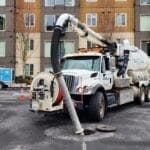
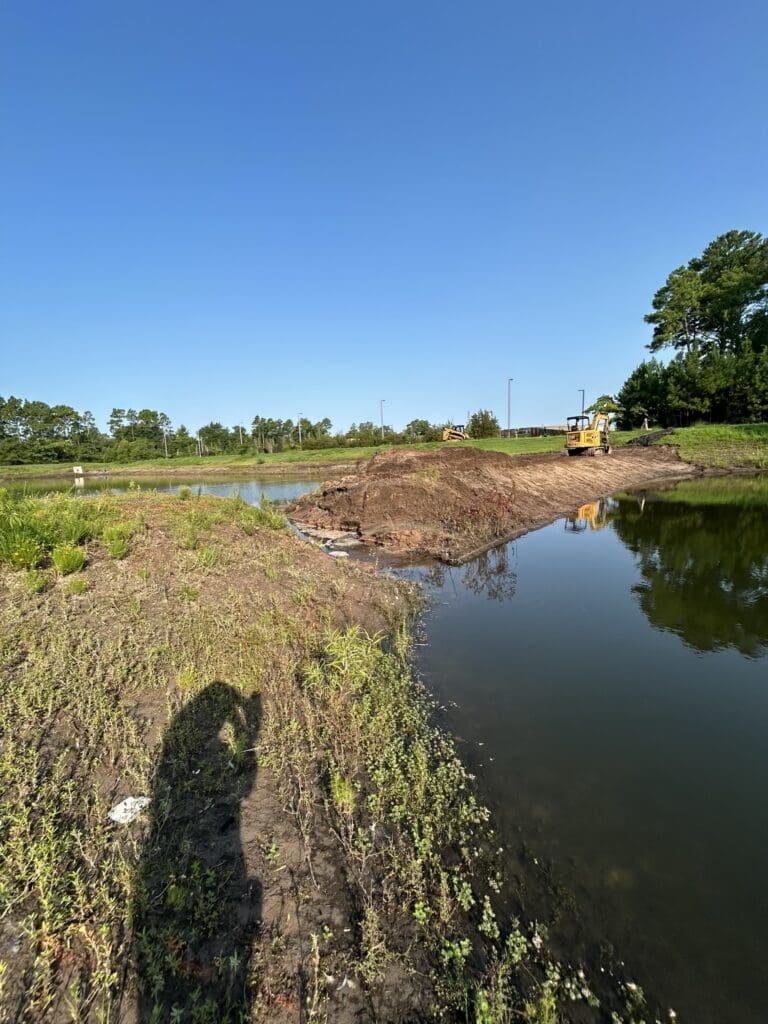
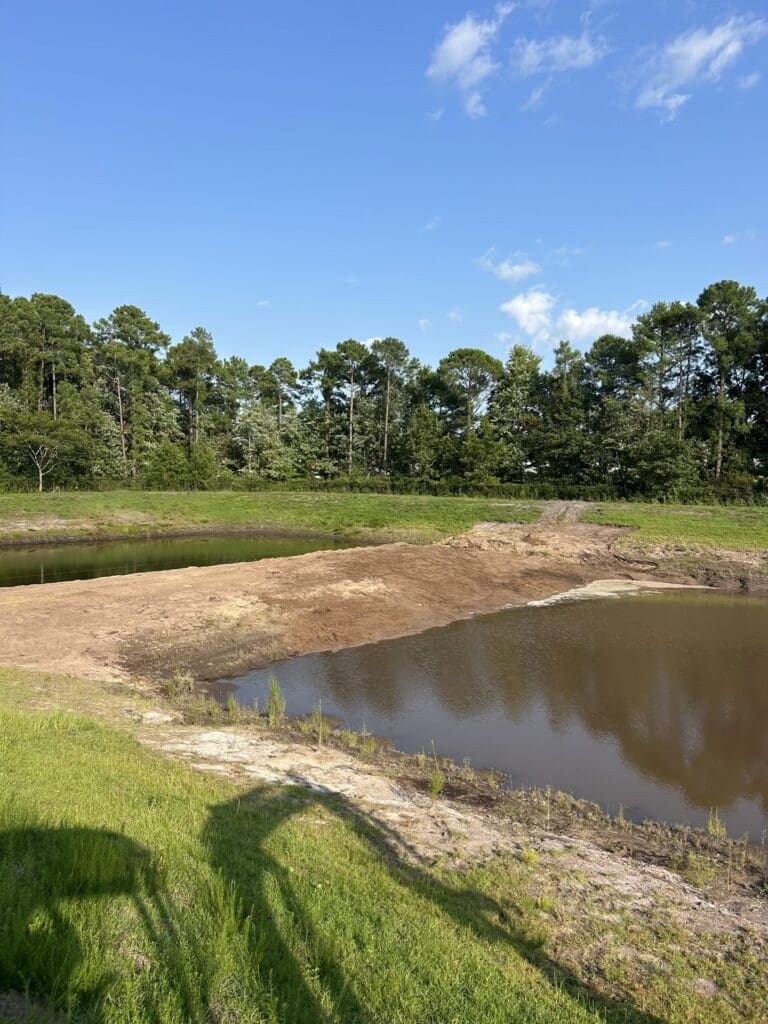
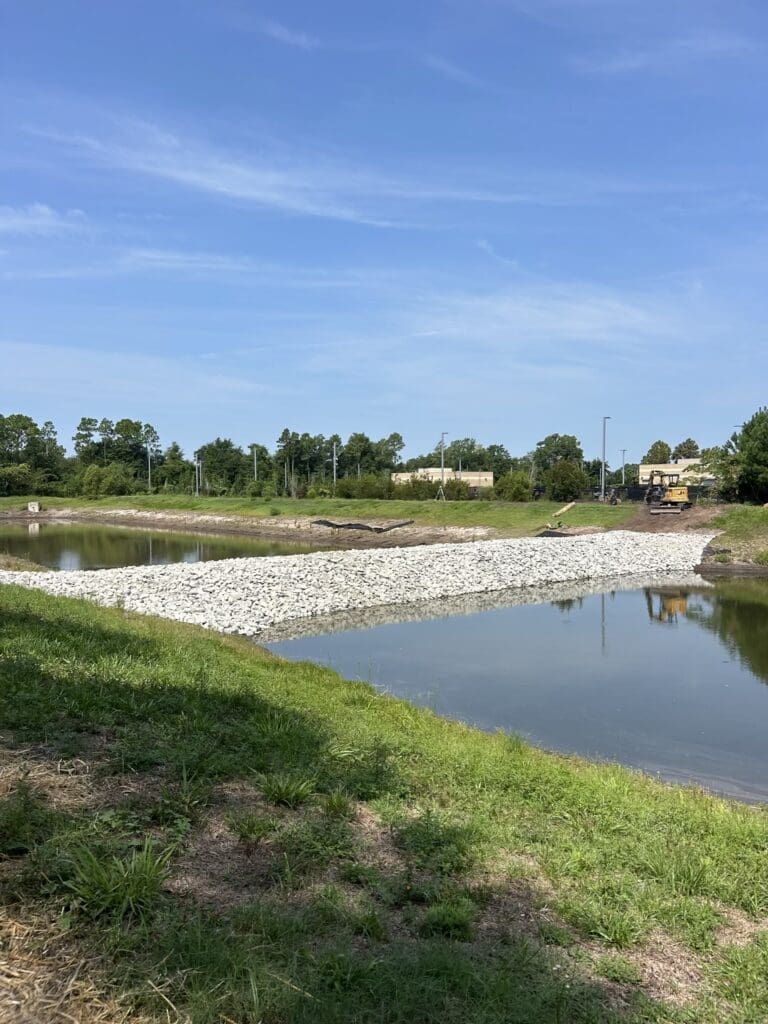
Before any physical work began, AQUALIS conducted diagnostic testing to fully understand what the pond and berm were dealing with. That included a bathymetric study, a depth mapping of the pond floor, which revealed how much sediment had accumulated over time and where the pond had lost capacity. That data informed the engineering redesign, ensuring the new berm was specified for the actual conditions rather than the original ones.
A redesign of this nature also required approval from the city before any work could begin. The original pond design was reviewed and permitted by the local municipality, and any significant departure from that approved design, particularly a full redesign of a forebay and berm, has to go back through that same process. AQUALIS managed that communication with the city on behalf of the property owner, submitting the new engineering plans, responding to questions and working through the approval process. That step alone can stall a project for weeks or longer if the supporting documentation is incomplete or the rationale for the redesign is not clearly established. Because AQUALIS had the inspection history, the bathymetric data and the engineering analysis in hand, the case for the redesign was straightforward to make.
With the approved design in hand, AQUALIS performed the repair. Because the berm sits at the waterline and the forebay held standing water, the area had to be dewatered before any excavation could begin. Dewatering pumps were used to drain the forebay, and a silt bag was deployed at the discharge point to capture sediment from the pumped water, keeping it out of adjacent waterways and stormwater infrastructure while work was underway.
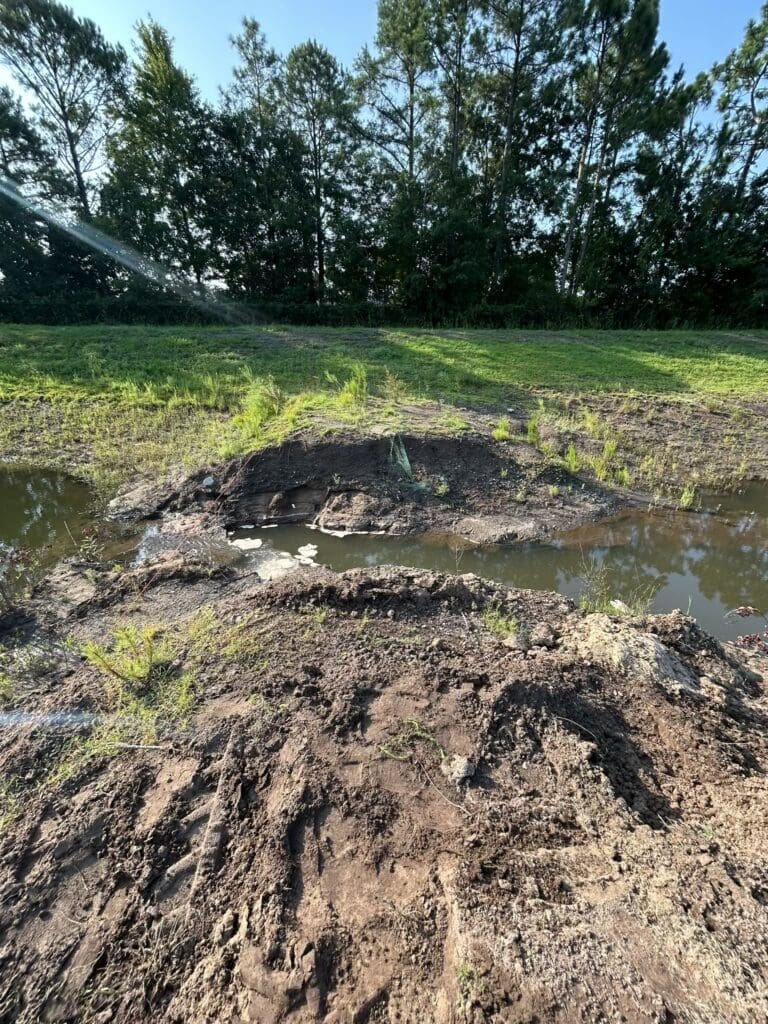
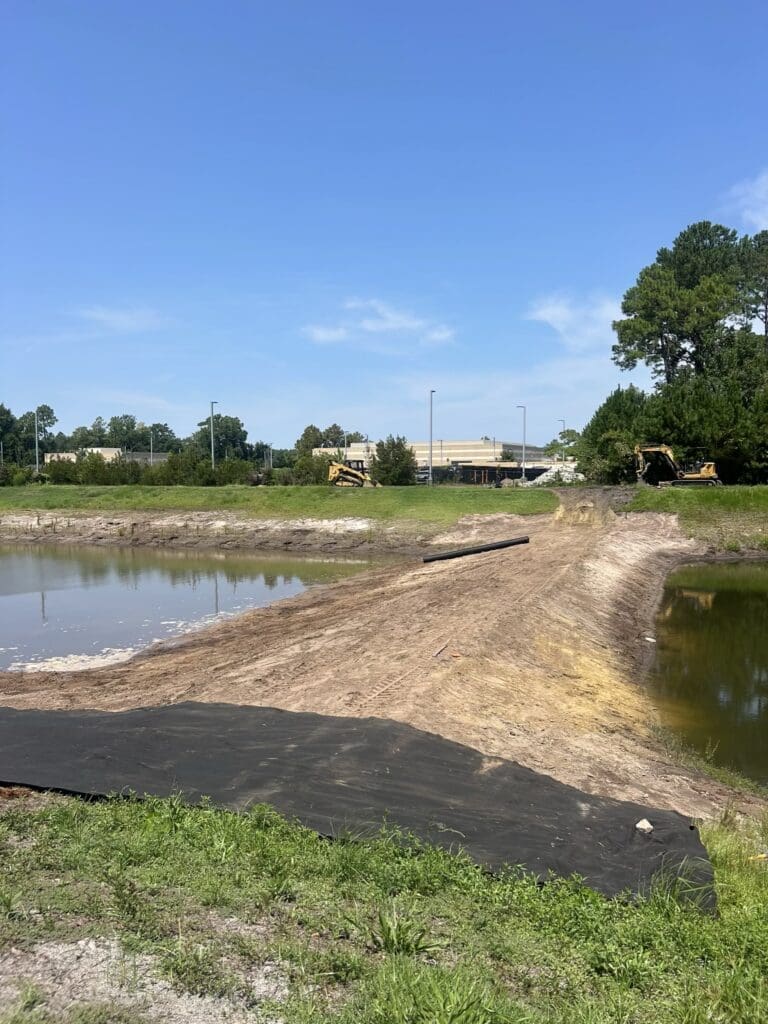
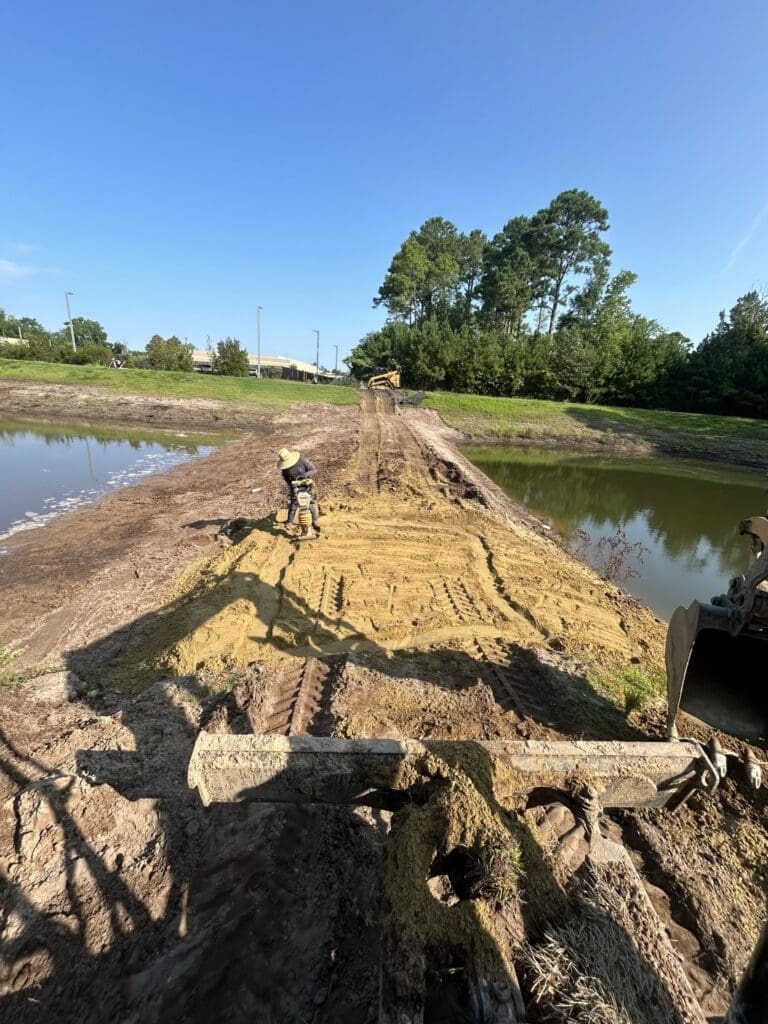
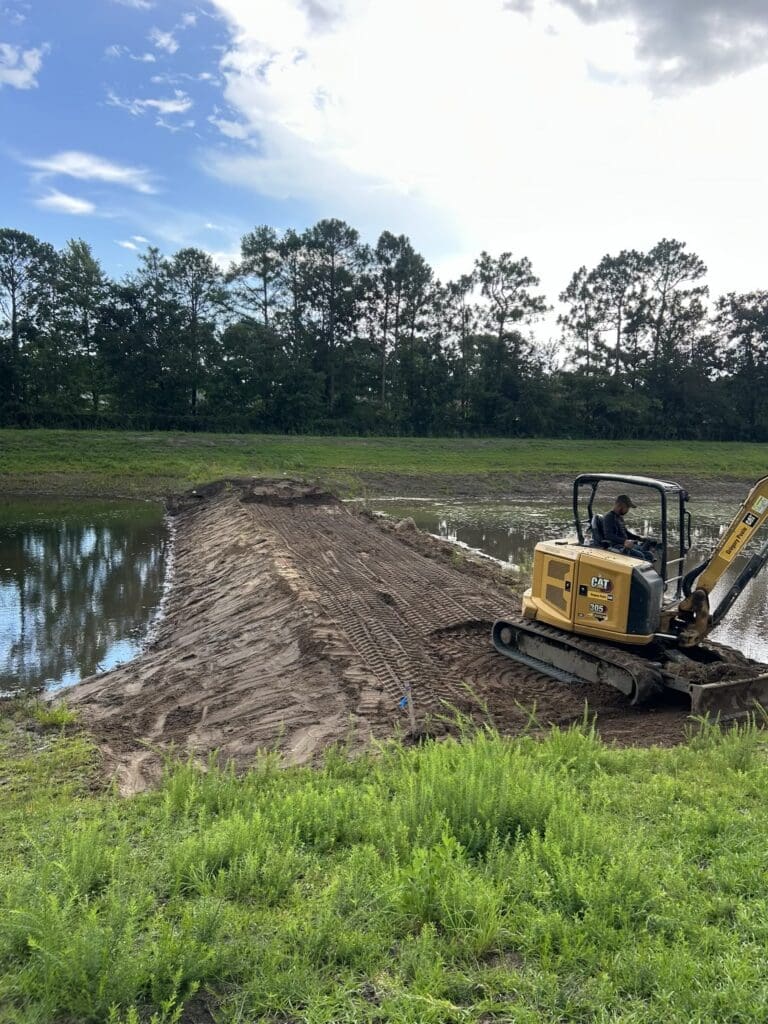
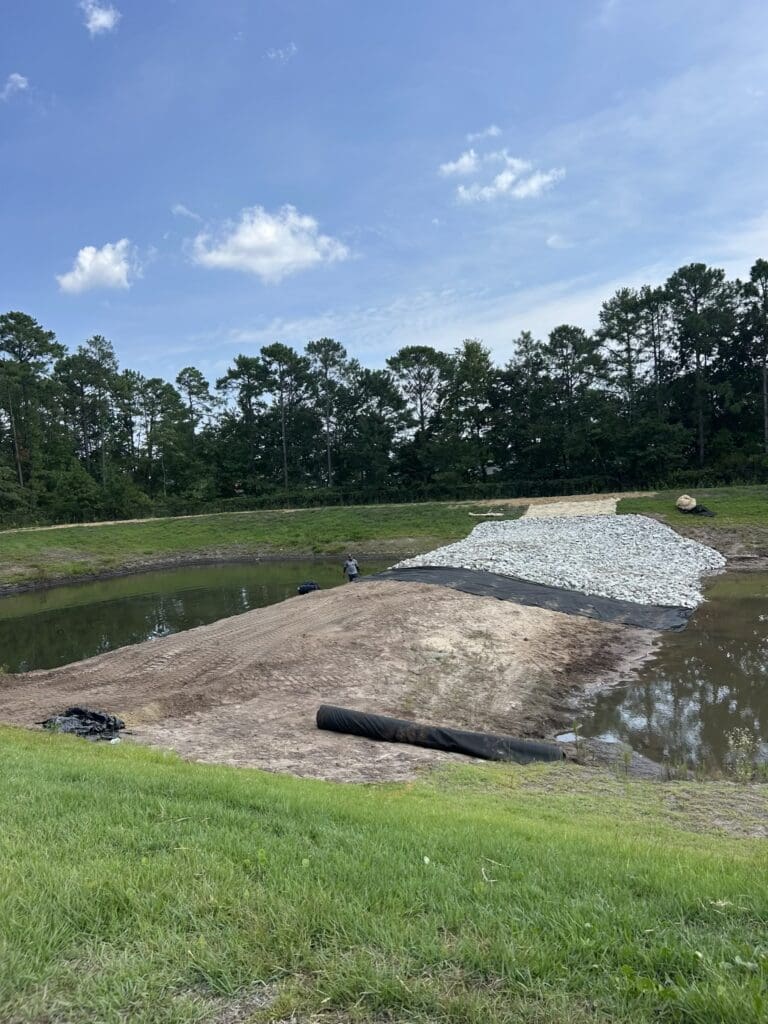
Crews then excavated the eroded berm down to stable, compactable soil. Building on anything less would have recreated the same unstable foundation that contributed to the previous failures. The berm was rebuilt in six-inch compacted layers, a method that distributes load evenly and eliminates the soft internal pockets that form when large voids are filled all at once and only surface-compacted.
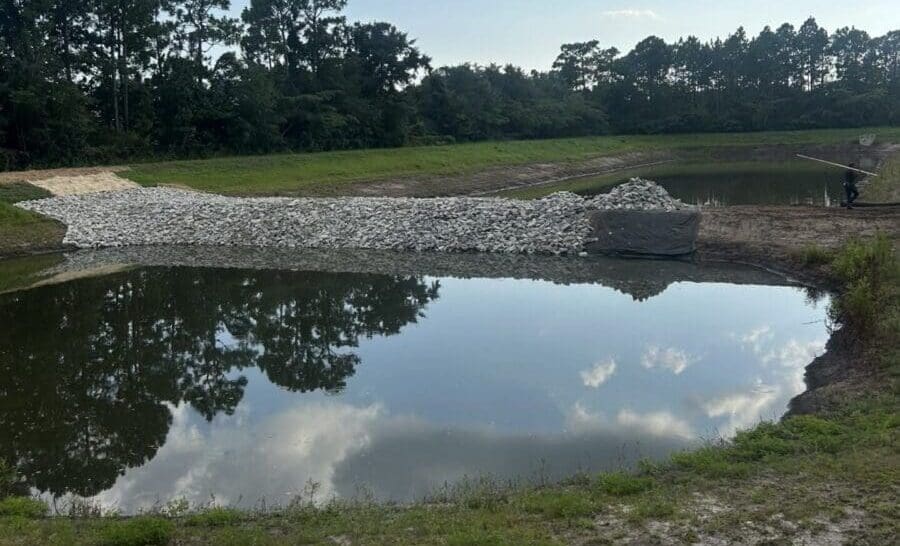
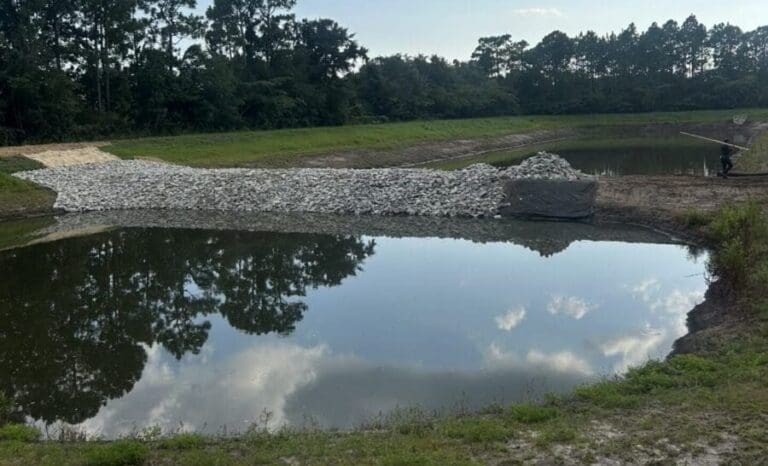
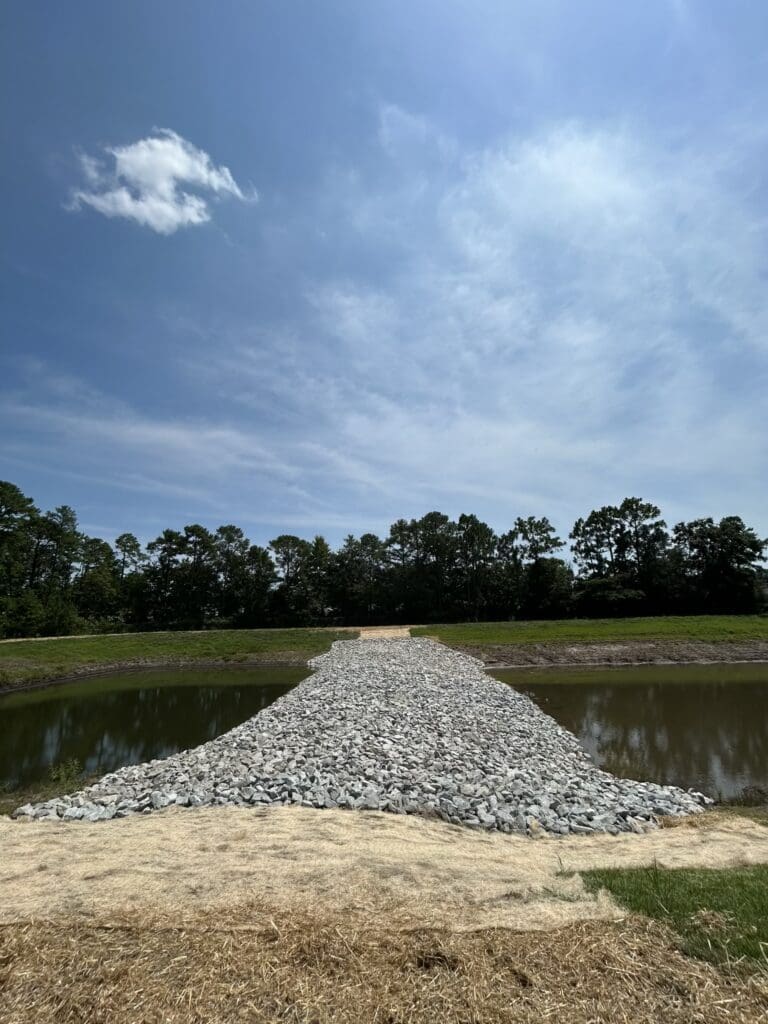
Once the berm reached the elevation and slope specified in the new engineering plans, a geotextile fabric was installed across the surface and secured in place. This woven, permeable material holds soil in position while still allowing water to pass through it, and it serves as the base for a layer of rip rap, large angular stones that absorb and distribute the energy of incoming water across the slope rather than letting it concentrate and dig in. That combination of fabric and stone is what makes this repair fundamentally different from the two that preceded it. The previous repairs restored the berm to its original shape. This one changed the surface so the berm could withstand the forces it is actually facing.
All areas disturbed by equipment were finished with erosion control matting and seed to stabilize the surrounding slopes while new vegetation took hold.
The Value of Inspections, Records and a Partner Who Understands Both
This project illustrates why inspection records matter as much as the inspections themselves. A single report noting berm erosion is easy to address with a routine repair. Two reports documenting the same failure in the same place, with dates and conditions attached, tell a different story and make the case for a different response. Without that documentation, the pattern is invisible and the same repair keeps getting authorized because no one has a clear view of how many times it has been done before.
AQUALIS builds inspection records over time specifically to surface these patterns for property owners. When erosion appears a second or third time, AQUALIS can show when it was first observed, what was done, how long it held and what changed in the interim. That history is what turns a maintenance call into a meaningful conversation about the actual condition of the asset and what it will take to stabilize it long term.
That documentation also serves a purpose beyond the property owner. When a redesign requires city approval, the municipality needs to understand not just what is being proposed but why the original permitted design is no longer working. An inspection record that shows repeated failure in the same location, paired with bathymetric data showing how the pond’s capacity has changed and engineering analysis connecting both to increased upstream runoff, makes that case in a way that a verbal explanation or a single site visit cannot.
As development continues to increase across the country, more stormwater systems will find themselves in this situation: designed for one set of conditions, operating under another, and failing in ways that look like maintenance problems until the site history is examined closely. AQUALIS helps property owners stay ahead of that curve by tracking conditions, communicating risks clearly and presenting budget-appropriate paths forward before a system reaches the point of repeated failure.
For this property owner, working with AQUALIS meant that one team handled everything, from the initial diagnostic testing and bathymetric study through the engineering redesign, the city approval process and the physical repair. There was no need to coordinate between separate firms, track down records held by different parties or advocate to the city without technical support. AQUALIS carried all of it, and the owner was able to move forward with confidence that the problem was finally being solved by the same people who had taken the time to fully understand it.

 Regenerative Stormwater Conveyance Improves Highway Drainage in Kenosha, Wis.The Root-Pike Watershed Initiative Network Kenosha County, and others worked with AQUALIS to design and implement an innovative solution for stormwater control along Highway KR.
 Sinkhole Leads to Stormwater System Repair in Durham, N.C.The tenant on this property noticed a depression that opened to the ground below and notified the property owners.