Sequencing the Work
The project broke into two distinct types of work: trenchless rehabilitation on the sections of pipe that could still be lined, and open excavation on the two sections that required replacement. Trenchless work moves faster and leaves the surface intact, so those sections were completed first as weather conditions allowed. The excavation work required removing all water from inside the pipe and blocking the flow upstream, as well as creating a large access area at the surface. The excavation work was more disruptive, so it was scheduled to keep the roadway and entrance open whenever possible and allow the property to remain operational throughout the project.
The roadway and entrance were closed in coordinated phases to allow the business to remain operational. Best management practices, barricades, and signage were set up across the work zone, and the layout was adjusted as the work moved from one area to the next.
Trenchless Rehabilitation of the Intact Runs
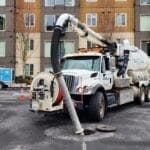
A jet/vacuum combination truck cleaned the three sections of pipeline to clear debris and sediment that had accumulated inside, preparing the existing pipe walls for the new liner.
Before lining, expansive structural grout was injected around the pipes and surrounding structures to help stabilize the soil. Decades of water movement can leave voids in the soil around buried pipes, and a liner installed within a pipe surrounded by unstable ground may be affected by further soil movement. Stabilizing the surrounding soil before lining helped support the existing pipes and reduce the risk of future movement.
Three CIPP sections were then installed and cured in place using pressurized steam. Once cured, post-work CCTV verified the installation across all three runs.
Replacing the Collapsed Sections
The collapsed pipe sections could not be lined and had to be removed. The work area sat below the water table, so groundwater levels had to be lowered before excavation could begin. A wellpoint dewatering system was installed around the work area to lower the groundwater, and it ran continuously throughout the structural repair. The system was monitored daily because an extended pause could have allowed groundwater to return to the excavation.
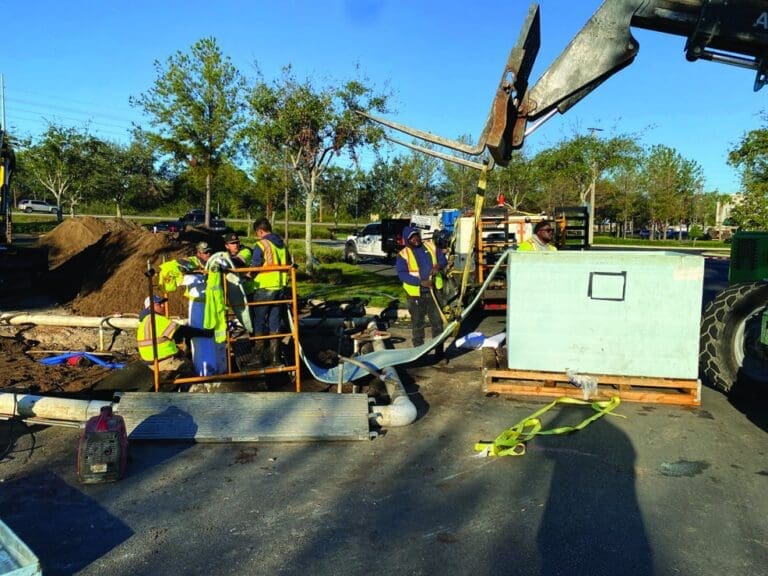
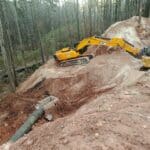
Once the area was dry, the asphalt over the failed sections was sawcut and removed in two 15-foot-wide paths spanning the roadway and parking area. Crews excavated to sand bottom, removed two 20-foot sections of collapsed pipe, and installed the replacements.
Restoration and Results
With the new pipe in place, the excavated areas were backfilled in lifts and compacted. The wellpoint system was removed once the ground was stable enough without it. The disturbed areas were graded and hand-raked, and approximately 800 square feet of sod was installed to restore the landscaped areas around the work zone. Final asphalt restoration was completed by the property’s asphalt vendor over the compacted base, and the temporary closures were lifted as each area was returned to service.
The project rehabilitated three pipe sections with structural CIPP lining and replaced two sections of collapsed pipe that showed no visible signs of failure at the surface. By coordinating all repairs with AQUALIS, the property avoided multiple mobilizations, redundant closures, and fragmented documentation.

 Regenerative Stormwater Conveyance Improves Highway Drainage in Kenosha, Wis.The Root-Pike Watershed Initiative Network Kenosha County, and others worked with AQUALIS to design and implement an innovative solution for stormwater control along Highway KR.
 Sinkhole Leads to Stormwater System Repair in Durham, N.C.The tenant on this property noticed a depression that opened to the ground below and notified the property owners.