Case Study

Trenchless Stormwater Pipe Rehabilitation Restores Underground Infrastructure in Hampton, Va.

Hampton, VA

Hampton, VA

Commercial

Stormwater Infrastructure Rehabilitation

The Challenge

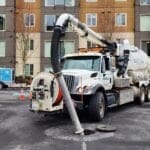
A commercial property in Hampton, Va., needed to assess the condition of its underground stormwater pipe network. AQUALIS was contracted to perform closed-circuit television (CCTV) inspections and jet-vac cleaning, which combines high-pressure water jetting with vacuum debris removal, across the property’s stormwater infrastructure. 

A CCTV inspection conducted according to Pipeline Assessment Certification Program (PACP) standards revealed structural and operational defects across multiple pipe segments. This standardized assessment method allowed AQUALIS to document pipe conditions and identify areas requiring rehabilitation. 

Structural defects included spiral fractures, broken pipe walls and medium to large joint offsets, where pipe sections had shifted out of alignment. Several previous point repairs and localized fixes made to short sections of the pipe, were also found to be defective. Root intrusion, construction debris and compacted sediment further restricted the system’s ability to manage stormwater runoff. 

Visible soil infiltration indicated that surrounding soil was entering the damaged pipes. Over time, this process can create underground voids, increasing the risk of pavement settling and sinkholes. 

Located along the Chesapeake Bay, Hampton faces coastal drainage challenges associated with heavy rainfall, elevated groundwater levels and tidal influences. For commercial properties in the region, reliable stormwater infrastructure is essential to managing runoff, protecting paved surfaces and maintaining site accessibility. 

Based on the inspection findings, AQUALIS recommended rehabilitating nine defective pipe segments using cured-in-place pipe (CIPP) lining. Left unaddressed, the defects could further restrict water flow and increase the risk of drainage problems. Traditional replacement would have required excavation, potentially disrupting parking areas and daily property operations. The recommendation centered on a structural solution that minimized surface disruption.

The Approach

CIPP lining is a trenchless rehabilitation method that creates a new structural pipe within the existing one. Rather than removing and replacing damaged infrastructure, crews can rehabilitate underground pipes through existing access points.

Mobilized to site; liner installation began Progression of liner installation throughout the identified conveyance lines Progression of liner installation throughout the identified conveyance lines Progression of liner installation throughout the identified conveyance lines Progression of liner installation throughout the identified conveyance lines Progression of liner installation throughout the identified conveyance lines Progression of liner installation throughout the identified conveyance lines Progression of liner installation throughout the identified conveyance lines Progression of liner installation throughout the identified conveyance lines Progression of liner installation throughout the identified conveyance lines Progression of liner installation throughout the identified conveyance lines Progression of liner installation throughout the identified conveyance lines Progression of liner installation throughout the identified conveyance lines Progression of liner installation throughout the identified conveyance lines Progression of liner installation throughout the identified conveyance lines Progression of liner installation throughout the identified conveyance lines Progression of liner installation throughout the identified conveyance lines Progression of liner installation throughout the identified conveyance lines Progression of liner installation throughout the identified conveyance lines Progression of liner installation throughout the identified conveyance lines Progression of liner installation throughout the identified conveyance lines Progression of liner installation throughout the identified conveyance lines Progression of liner installation throughout the identified conveyance lines Liner installation completed

Site Preparation and Pipe Cleaning

Before rehabilitation began, AQUALIS coordinated site access, completed utility locates and implemented safety and erosion controls to protect the surrounding property. 

Thorough cleaning was necessary to remove material that could interfere with liner installation. Crews used high-pressure water jetting to clear roots, sediment and loose debris, followed by mechanical removal of compacted deposits and mineral buildup. 

Following cleaning, pre-lining CCTV inspections allowed crews to evaluate each segment’s interior condition, identify remaining obstructions and confirm readiness for rehabilitation. 


CIPP Liner Installation 

With the pipes cleaned and inspected, AQUALIS installed resin-impregnated liners into all nine defective segments through existing access points. 

Once positioned, the liners were cured using heat, hardening the resin into continuous structural pipes within the existing infrastructure. The new liners reinforced deteriorated pipe sections and sealed structural defects, including fractures and damaged joints, helping prevent further soil infiltration. 

Crews then trimmed and sealed the liner ends at the access structures, completing the rehabilitation while preserving the parking areas and drive lanes above the pipe network. 


Post-Installation Inspection 

Following installation, AQUALIS conducted additional CCTV inspections to evaluate the completed rehabilitation. Using PACP-compliant inspection procedures, crews documented the condition of the newly lined segments. 

The review assessed liner integrity and alignment, while quality assurance procedures included verification of proper curing. Inspection videos and condition reports provided a record of the completed work and a reference for future maintenance. 


The Results 

With all nine pipe segments rehabilitated, the property gained a structurally reinforced stormwater network with a clearer path for runoff. Addressing the damaged pipe sections also reduced the risk of continued soil infiltration, helping protect the surrounding ground and paved surfaces. 

The trenchless approach allowed AQUALIS to complete the rehabilitation without excavating the property’s parking areas or drive lanes. Avoiding traditional pipe replacement minimized surface disruption and helped preserve accessibility during the project. 

At closeout, the property team received as-built drawings, inspection videos, warranty documentation and a final summary report. These records provide a baseline for future inspections, support maintenance planning and document the improvements made to the property’s underground infrastructure. 

The project demonstrates the value of identifying stormwater pipe deterioration before structural conditions require more extensive intervention. When existing pipes remain suitable for rehabilitation, CIPP lining offers commercial property owners an alternative to excavation while extending the service life of aging infrastructure. 


Additional Case Studies